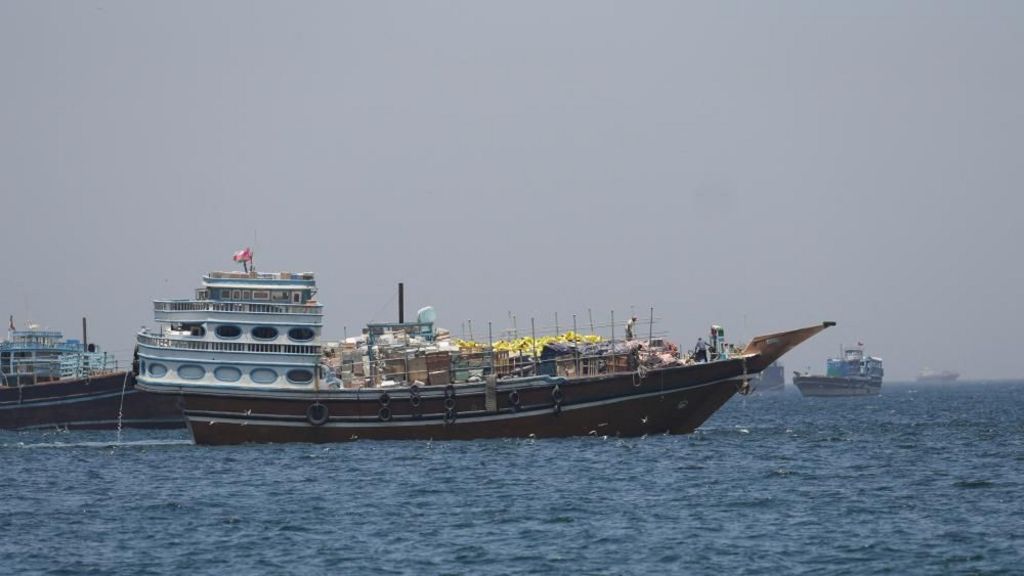
The strategic Strait of Hormuz, a critical global energy chokepoint that carries roughly 20% of the world’s daily oil and liquefied natural gas shipments, has been largely closed to commercial traffic since the United States and Israel launched air strikes against Iran. Tehran responded to the attacks by shutting down the waterway, leaving thousands of vessels and their crews stranded in the Gulf. In response to international requests to free the trapped ships, U.S. President Donald Trump has launched what he has named “Project Freedom,” a mission that threatens to reignite open hostilities between the two nations.
In a Sunday post on his Truth Social platform, Trump stated that leaders from nations across the globe had reached out to the U.S. for assistance, noting that the trapped ships belonged to neutral, uninvolved parties that had become innocent victims of the escalating conflict. Under the new operation, the U.S. military will guide trapped vessels safely out of the restricted waters around the strait. Trump framed the mission as a purely humanitarian gesture, arguing it would benefit not just global shipping interests and Middle Eastern nations, but Iran itself. He pointed to growing urgent concerns: many stranded vessels are running critically low on food and other essential supplies required to keep large crews healthy and maintain sanitary living conditions on board.
Iran has pushed back sharply against the U.S. initiative, however. Iranian officials maintain that the country retains full sovereign control over the Strait of Hormuz, and have issued blunt threats to attack any foreign military force that attempts to enter or approach the waterway, specifically naming the U.S. military as an aggressive target. Senior Iranian commander Maj Gen Ali Abdollahi emphasized that all safe passage through the strait must be coordinated directly with Iran under all circumstances. A day after Trump’s announcement, Iranian Foreign Minister Abbas Araghchi dismissed the U.S. mission, writing on X that “events in Hormuz make clear that there’s no military solution to a political crisis,” and adding, “Project Freedom is Project Deadlock.”
The scale of the humanitarian and economic crisis is substantial. The International Maritime Organisation, the United Nations body that regulates global commercial shipping, estimates that roughly 2,000 vessels and 20,000 sailors have been trapped in the Gulf since the outbreak of hostilities. Concern has risen rapidly over dwindling essential supplies and the growing negative impact of the blockade on the physical and mental health of stranded crew members.
U.S. Central Command (Centcom) has deployed a large military contingent to support the operation, including guided-missile destroyers, more than 100 land and sea-based aircraft, multiple advanced unmanned platforms, and 15,000 active service members. In a public briefing, Centcom commander Adm Brad Cooper confirmed that attack helicopters assigned to the mission had already sunk six small Iranian boats that were targeting unarmed civilian vessels. Cooper warned that U.S. forces will open fire on any Iranian craft deemed to be interfering with the mission to reopen the waterway.
Few concrete details have been released about the full scope and long-term structure of the operation, though Cooper confirmed that the ultimate goal is to reestablish a fully operational two-way shipping lane through the strait. The mission’s ambiguous framework has sparked debate over its risks: if the operation only provides navigational information and advice to crews, it would do little to mitigate Iran’s explicit threats to attack transiting vessels. If the U.S. proceeds with full military escort for all trapped ships, however, that would almost certainly lead to direct open military confrontation between the two nations. Cooper has only stated that the operation includes a broader defensive package than would be required for simple escort duty.
Mick Mulroy, a former U.S. deputy assistant secretary of defense for the Middle East and a veteran of both the U.S. Marine Corps and the CIA’s paramilitary division, told the BBC he believes Project Freedom will focus on providing air cover and defense against Iranian missile and drone attacks, rather than direct physical escort of commercial vessels through the strait. Even so, Mulroy cautioned that there is no guarantee the operation will succeed in restoring free commercial navigation. “The question is whether ships will trust their ability to get through without being attacked, and more importantly, the insurance company,” he explained. “If not, the effort will not have the impact we hoped.”
On Monday afternoon, Centcom confirmed that U.S. Navy guided-missile destroyers had already transited the Strait of Hormuz as part of Project Freedom, adding that American forces were actively working to restore commercial shipping transit but provided no further operational details. The command also announced that as an initial milestone, two U.S.-flagged commercial merchant vessels had successfully passed through the strait and were continuing on their voyages safely, though it declined to release the identity of the ships. Global shipping giant Maersk later confirmed that one of its own vessels had exited the Gulf with U.S. military accompaniment. Iran’s powerful Islamic Revolutionary Guard Corps has directly denied any vessels have been allowed to pass through the strait.
Grant Rumley, a Middle East security expert who advised both the Biden and Trump White Houses between 2018 and 2021, noted that securing safe passage for all 2,000 trapped vessels would be an extraordinarily difficult challenge. He argued that achieving that goal would likely require a more aggressive, large-scale kinetic military operation, a outcome he views as increasingly probable. “I think that the general consensus is that a resumption of hostilities is a question of when,” he said. “Not if.”
Within hours of the operation’s launch on Monday, the Iranian military claimed it had opened fire on American and Israeli enemy destroyers, saying U.S. forces had ignored multiple warnings. Centcom immediately denied Iranian claims that one of its warships had been hit by two Iranian missiles. According to Centcom’s account, Iran fired cruise missiles at both U.S. warships and U.S.-flagged commercial vessels, and deployed drones and small speed boats to attack commercial shipping. In a subsequent Truth Social post, Trump confirmed that Iran had fired on uninvolved commercial vessels, prompting the U.S. strikes on Iranian small boats.
The United Arab Emirates, a key U.S. Gulf ally that has faced repeated Iranian attacks during the ongoing conflict, confirmed that a tanker owned by its state-owned national oil company Adnoc was targeted by two drones while transiting the Strait of Hormuz. The UAE foreign ministry reported no crew injuries in the attack, and confirmed that at least three incoming missiles were successfully intercepted. Trump also added in his post that a suspected missile strike had hit a South Korean cargo vessel anchored in the Strait of Hormuz, in waters adjacent to the UAE.