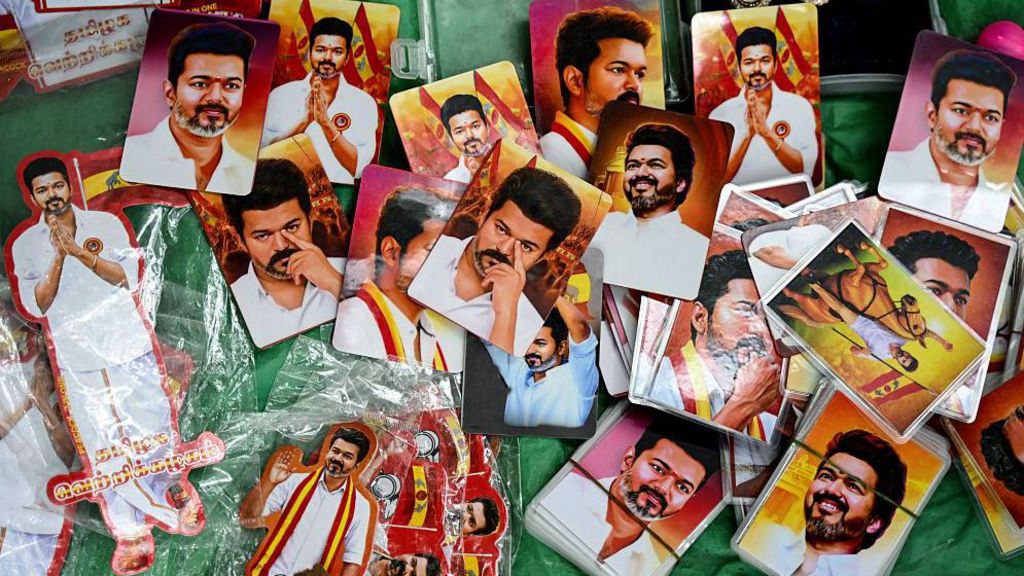
For decades, electoral politics in India’s Tamil Nadu state has revolved around a stable two-way contest between the long-dominant regional Dravidian parties, the Dravida Munnetra Kazahagam (DMK) and its historic rival All India Anna Dravida Munnetra Kazhagam (AIADMK). That long-standing status quo is now on the brink of collapse, following a historic breakthrough by C Joseph Vijay, the beloved Tamil film superstar turned first-time political candidate, whose new party Tamilaga Vettri Kazhagam (TVK) defied all pre-election polling and pundit predictions to nearly seize an outright majority in the 2026 state assembly election.
Vijay’s rapid ascent to the cusp of power has already drawn inevitable comparisons to one of Tamil Nadu’s most iconic political ancestors: MG Ramachandran, another legendary matinee idol who split from the DMK to launch his own party and rose to become the state’s chief minister in 1977. But while parallels exist in the path from silver screen to statehouse, Vijay’s political emergence comes at a uniquely opportune moment for a political newcomer.
When final vote counts were tallied on Monday, TVK secured 108 of the 234 available assembly seats, falling just 10 seats short of the 118-seat threshold required to form a majority government. The result is a landmark upset that ousted the incumbent DMK from power, ending the party’s latest tenure leading the state. For Vijay, the next critical step is transitioning from a charismatic crowd-pleasing campaigner to a skilled coalition builder: over the coming days, he will negotiate with smaller regional parties and independent elected legislators to secure the additional support needed to claim the chief minister’s post.
Political analysts and observers across India frame the result as a clear reflection of growing voter fatigue with the decades-long DMK-AIADMK duopoly, particularly among the state’s fast-growing young electorate. “Vijay carries a different kind of verve,” explains social scientist Shiv Visvanathan. “He offers a sense of fun, confidence and an aura of competence rooted in individuality, and that gives him a different kind of power.”
Unlike many celebrity politicians who jump from the screen to the campaign trail without long-term groundwork, Vijay’s path to electoral politics has been more than 15 years in the making. As early as 2009, he began restructuring his vast network of fan clubs into the Vijay Makkal Iyakkam, a grassroots welfare organization that delivered local aid, educational support and disaster relief to communities across the state. By 2011, the network tested its political influence by aligning with an AIADMK-led coalition, proving that stardom could translate into organized voter support. Over the following decade, Vijay increasingly wove political messaging into his public appearances, speaking to young audiences about widespread youth unemployment, student exam stress, and government corruption, while also taking high-profile positions on national issues such as criticizing the 2019 Citizenship Amendment Act. He formally launched TVK only in 2024, but his slow, deliberate conversion of popular stardom into organized political capital set him apart from other celebrity aspirants who have failed to gain traction in Tamil Nadu politics, from Rajinikanth to Kamal Haasan.
In the lead-up to voting, Vijay has deliberately crafted a new public persona distinct from his film identity, making high-profile visits to prominent Hindu temples and Christian churches across the state. Images of these visits have circulated widely on social media and broadcast news, a notable shift in a state whose modern politics was shaped by the rationalist Self-Respect Movement, which fought for equal rights for marginalized castes. Analysts frame this visible turn to faith as a deliberate strategic choice to broaden his electoral appeal.
Polling data confirms that Vijay’s surge is driven most strongly by two key demographic groups: young voters and women. According to Pradeep Gupta, chief pollster at Axis My India, voters between the ages of 18 and 39 — who make up 42% of Tamil Nadu’s total electorate — have turned out for TVK in overwhelming numbers, particularly first-time voters. Significant support also crosses caste lines, including large backing from Scheduled Castes and Other Backward Classes communities across the state. “He’s the new hope for Tamil Nadu,” says prominent political strategist Prashant Kishor, summing up the sentiment driving his rise.
For most supporters, the appeal of TVK is rooted less in detailed policy platforms and more in a widespread desire for change after decades of rule by the two legacy parties. Even though the incumbent DMK delivered solid governance, including 11.2% economic growth in 2024-25 and strong social indicators that rank among India’s best, voters have expressed growing restlessness with the same entrenched political leadership. “This is not a verdict against Dravidian politics,” notes prominent Indian vocalist and social activist TM Krishna. “It is something else. Vijay offers a new imagination.”
Vijay’s ideological positioning has also resonated with Tamil Nadu’s long-standing tradition of regional autonomy: he has positioned the national Bharatiya Janata Party (BJP) as his core ideological adversary, and the incumbent DMK as his immediate political rival, aligning with the state’s historic resistance to the BJP’s national expansion rooted in Tamil language and identity politics.
Not all observers are convinced of TVK’s long-term potential, however. Analyst and author Nilakantan RS argues that the party lacks substantive policy positions on key state issues, framing Vijay’s public gestures and temple visits as carefully calibrated marketing moves rather than reflections of a clear governing vision. “There is an absence of any original position on real issues,” he says. “Virality has become the currency of his actions.” Critics warn that this focus on image over policy could leave a Vijay-led government without the administrative depth needed to address the state’s pressing challenges.
Vijay’s path to power has also not been without setbacks. Last year, a deadly crowd crush at one of his party rallies killed dozens of attendees, drawing widespread criticism of his initial response to the tragedy. Yet voters ultimately forgave the incident, and it failed to dampen enthusiasm for his campaign. His final planned film, *Jana Nayagan* (People’s Leader), which was set for a January release ahead of the election, also ran into protracted delays after a dispute with India’s national film classification board, and it remains unreleased to date.
As post-election coalition negotiations get underway, the moment remains a historic one for Tamil Nadu politics. A state that has long blurred the lines between cinema charisma and political power is once again turning to a beloved film icon to deliver the change a majority of voters are demanding. “This election is to herald change,” Vijay declared on the campaign trail. His supporters echo that sentiment: “People are tired of both major parties. They want change. They see TVK as that change,” says TVK spokesperson Felix Gerald. Whether that promise of change will translate into a stable new government and durable political authority remains to be seen, but the 2026 election has already irrevocably broken the decades-old political order in one of India’s most important states.