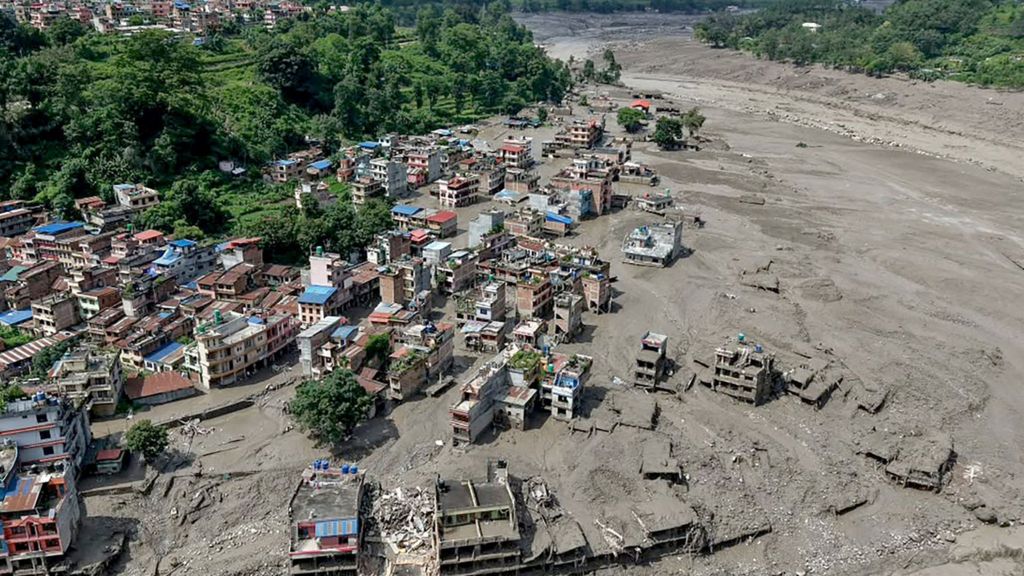
A catastrophic natural disaster consisting of massive landslides and destructive flash floods has swept across the Nepal-China border region, leaving a trail of widespread destruction and leaving hundreds of people either confirmed dead or unaccounted for. Emergency teams from both nations have already launched active search and rescue operations to locate survivors trapped in the debris or cut off by floodwaters, as authorities on both sides of the border warn that the final human cost will likely be far higher than current preliminary counts.
The disaster has sparked immediate uncertainty over its root cause. Nepal’s top foreign affairs official initially told reporters that a small earthquake had been recorded along the border just minutes before the landslides began, leading to early speculation that seismic activity had triggered the movement of unstable mountain slopes. However, updated data analysis from the United States Geological Survey (USGS) has found no evidence of a seismic event in the area prior to the disaster, leaving investigators still working to pinpoint what caused the massive slope failure.
Located roughly 64 kilometers north of Nepal’s capital Kathmandu, the affected border region includes popular trekking routes that draw thousands of mountaineering tourists and religious pilgrims annually, making the disaster a cross-national humanitarian concern. Visual footage from Nepal’s Nuwakot district, one of the hardest-hit areas, captures a powerful surging wall of mud, rock and debris moving rapidly through the valley, sweeping away entire residential buildings, paved roads and parked vehicles as local residents run for higher ground to escape the advancing hazard. Multiple major river systems, including the Bhote Koshi, Trishuli and Narayani, have all recorded severe flood levels that have exacerbated the damage across the region.
As of the latest update, casualties have been confirmed on both sides of the border, with roughly 100 deaths reported jointly by Nepalese and Chinese authorities. Official data from Nepal’s national tourism board puts the current number of missing people at 403, a group that includes 341 foreign nationals. Indian nationals make up the largest share of missing foreign visitors, with people from 25 other nations also unaccounted for, including 47 citizens of the United States and 33 from the United Kingdom.
Satellite imagery captured by Reuters in the days immediately after the disaster dramatically illustrates the scale of flooding around the Khadga Bhanjyang community located along the Trishuli River, showing dramatic changes to the landscape and infrastructure between pre- and post-disaster captures.
National leaders across Asia have responded to the crisis with offers of support and pledges of coordinated action. Nepal’s Prime Minister released a statement saying the entire country has been left shocked and deeply distressed by the disaster, confirming that Nepalese authorities are working closely with Chinese officials to coordinate cross-border relief efforts. Chinese President Xi Jinping has ordered an all-out search and rescue operation for missing people, and has directed officials to strengthen hazard monitoring and early warning systems to prevent secondary disasters that could threaten recovery teams. Neighboring Indian Prime Minister Narendra Modi also announced that New Delhi stands ready to provide all possible forms of humanitarian assistance to Nepal as it responds to the crisis. UK Prime Minister Andy Burnham has added that the British government is committed to doing everything in its power to support British nationals affected by the disaster in Nepal.