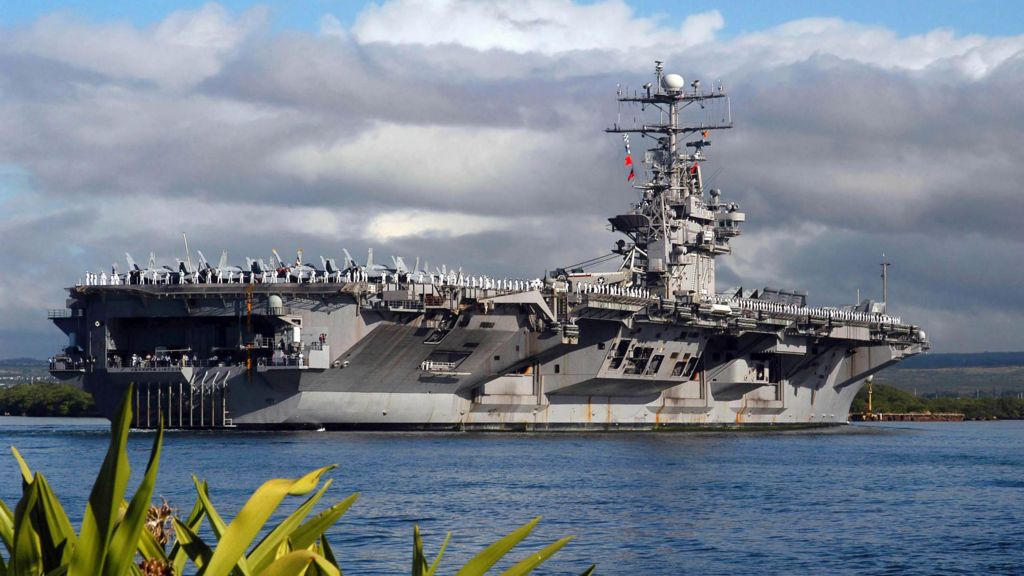
For over eight months, the USS Abraham Lincoln, a nuclear-powered American aircraft carrier, has been deployed to the Middle East as part of ongoing United States military operations against Iran. What was supposed to be a standard rotational tour has stretched to more than twice the length of the 111-day deployment former Navy photographer Jonny Burnell completed aboard the USS Carl Vinson during the 2001 invasion of Afghanistan, sparking fierce debate over the crew’s living and mental health conditions.
Burnell, who had unique access across every section of his ship due to his documentation role, remembers watching crew morale deteriorate steadily over his three-and-a-half month tour. What began as eager enthusiasm faded into a pervasive, visible low mood that he still describes as the hardest part of his service. “There was one point where there was a visible kind of deadness in the shipmates’ eyes,” he recalled to the BBC. “I still think the hardest part of my job was watching the sadness in people’s faces every frickin’ day.” Today, watching the reports of the Lincoln’s extended deployment leaves him on the verge of tears, he says.
Recent reporting from two leading American military publications, Military Times and Stars & Stripes, has painted a grim picture of conditions aboard the Lincoln: crew members are contending with food shortages, failing plumbing systems, and extreme physical and mental exhaustion. Family members of deployed sailors have gone public with fears over rapid mental health decline, with reports that multiple crew members have even attempted to jump overboard to escape the conditions.
These accounts have been fiercely disputed by military officials and some veteran advocacy leaders. Retired Navy Lt Commander Steve Rogers, director of the non-profit Association of the United States Navy (AUSN), which supports active-duty service members, claims the media reports are “99% hype” and largely inaccurate. In his outreach to family members of Lincoln sailors, Rogers notes that familial anxiety during wartime deployment is normal, and says the crew is fully prepared for the challenges of their mission. He frames reported talks of suicide attempts as nothing more than offhand “locker room talk,” comparing it to casual complaints he heard during his own service.
Not all accounts align with Rogers’ dismissal, however. One anonymous relative of a Lincoln sailor told the BBC their family member has lost 29 kilograms (65 pounds) due to persistent exhaustion caused by constant noise and vibration from the ship’s operations.
When asked about the growing controversy during a press availability Friday, former President Donald Trump shrugged off the concerns, saying the Lincoln’s deployment was “not nearly long enough.” Two days later, Admiral Brad Cooper, head of U.S. Central Command, which oversees Middle East operations, released a more nuanced statement. He noted that of the 11 active aircraft carriers in the U.S. Navy fleet, the Lincoln currently reports one of the lowest rates of documented mental health incidents. Still, Cooper acknowledged that long-term sea duty is inherently challenging: “This doesn’t mean all is perfect. Service at sea for long periods isn’t for everyone. It is uniquely challenging and tough. Mental health is another aspect of individual health and requires our attention just like physical health and spiritual health.”
A three-day onboard visit by CNN reporters last month found no evidence of widespread catastrophic issues. While the outlet noted that several sailors reported food rationing and unintended weight loss over their months-long deployment, CNN reported food was plentiful at the time of their visit and hot showers were available, though minor issues including mold were observed.
From his own experience decades ago, Burnell says even shorter deployments bring brutal living conditions that are often hidden from the public. Many crew members assigned to below-deck duties go weeks or months without stepping onto the top deck to see the sky, he says. His own sleeping berth, nicknamed a “coffin rack” by troops, was too small to turn around in, and positioned directly against a wall through which aircraft arresting cables ran, leaving him exposed to non-stop noise from flight operations. He described the USS Carl Vinson as a “floating prison,” recalling one colleague who went to extreme lengths including drug dealing and organizing an underground rave to get removed from the ship.
The U.S. Navy has announced the USS George Washington will rotate in to relieve the Lincoln, with the replacement carrier expected to arrive in the Middle East within a week. But the George Washington carries its own well-documented history of mental health crises. In 2022, a series of suicides aboard the ship while it was docked in Virginia prompted a formal inspector general investigation. The 2023 investigative report concluded that the deaths stemmed from a combination of interconnected problems tied to poor living conditions, and found that senior Navy leadership had “let our standards slip — and in doing so we let our people down.”
Mental health experts who study military service say the conditions reported aboard the Lincoln align with decades of research showing prolonged sea deployment creates unique, severe stressors. Dr. Harold Kudler, former head of mental health policy for the U.S. Department of Veterans Affairs (VA), explains that the combination of social isolation, long stretches of unrelenting boredom punctuated by sudden periods of extreme alert, and uncertainty over mission goals and return timelines amplifies mental health struggles for all crew, regardless of rank.
“Especially in this kind of asynchronistic war that we’re seeing,” Kudler said. “You’re isolated. You don’t know exactly what’s going to happen. You’re not even sure what the mission is anymore. And you don’t know when you’re going to come home.”
This is not a new discovery: Kudler notes that U.S. military researchers identified these stressors as early as World War II, when officials produced a training film highlighting the “combat irritability” experienced by below-deck crew who never saw the enemy but still operated under constant stress. Years of VA research have confirmed that active-duty troops and veterans face a 50% higher risk of suicide than the general American population.
To address these challenges, Kudler says the military must work to make every crew member feel connected to the broader mission while also validating the monotony and stress of their daily work. While some ships organize recreational activities like singing contests and top-deck picnics to combat isolation, Kudler supports ongoing calls from congressional Democrats for a formal investigation into the Lincoln’s deployment to get to the bottom of the reported issues.
“The ship can only perform as well as its crew,” he noted. “Those 5,000 people comprise a community. Not just men and women under stress. It’s a community under stress. The capabilities of the ship fall off as the crew falls off. So if the reports that are being shared are true, one really has to worry.”
Rogers, for his part, argues that military media coverage has blown minor common issues out of proportion, damaging troop and family morale for no reason. He notes that all Navy ships deploy with chaplains and mental health counselors, and that service members are trained to cope with the normal stresses of long sea tours. “We’re all human beings. We all go through difficult times,” he said.