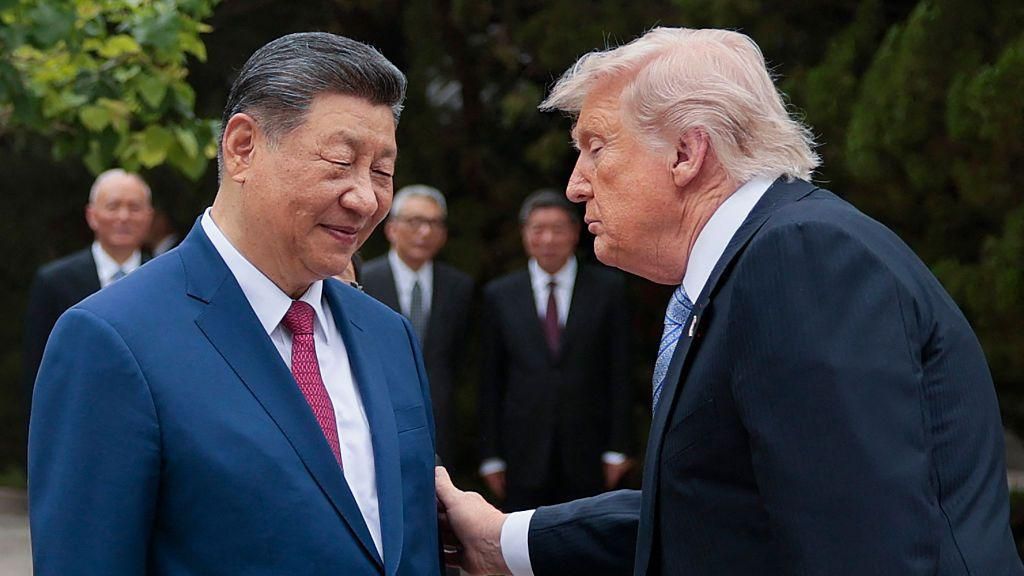
Just a decade ago, at a raucous 2016 campaign rally in Fort Wayne, Indiana, Donald Trump painted China as the United States’ top economic antagonist, roaring to the crowd that “We can’t continue to allow China to rape our country.” That fiery anti-China rhetoric defined his political career through years of rallies, his 2024 presidential run, and the early months of his second term in the White House.
When Trump reclaimed the Oval Office, he stacked his senior cabinet with long-time China hawks who had built their political brands on criticizing Beijing: Secretary of State Marco Rubio, Vice President JD Vance, and senior economic advisor Peter Navarro. All were united in their claims that China was “ripping off” the U.S., stealing American intellectual property on an industrial scale, and fueling the national fentanyl crisis by channeling the drug into U.S. communities. The aggressive rhetoric quickly translated to policy: by mid-April 2025, dubbed “Liberation Day” by the Trump administration, U.S. tariffs on Chinese goods climbed from an initial 10% in February all the way to 145%. China responded in kind, imposing 125% retaliatory tariffs on U.S. imports and halting exports of critical rare earth elements to the U.S., launching a full-scale trade war.
But in a stunning turn of events this week, that antagonistic posture gave way to diplomatic detente during Trump’s landmark visit to Beijing. Welcomed with full ceremonial honors at the Great Hall of the People, Trump walked a red carpet to the sounds of the U.S. national anthem played by a Chinese military band, flanked by hundreds of flag-waving Chinese children. Standing alongside Chinese President Xi Jinping, Trump struck a dramatically warmer tone: “It’s an honour to be with you. It’s an honour to be your friend, and the relationship between China and the US is going to be better than ever before.”
The shift from labeling China an economic predator to calling its leader a friend came alongside early announcements of limited but high-profile trade agreements, though concrete details and official figures remain scarce. Reports indicate that U.S. chip giant Nvidia has received approval to sell its semiconductors to 10 Chinese firms, aerospace manufacturer Boeing has locked in a 200-aircraft order, and global bank Citi has won approval to launch a full securities business in mainland China.
Yet even amid the public pleasantries and softened rhetoric, long-standing hawkish U.S. positions and unresolved core tensions remain intact. Less than a week before the Beijing summit, the U.S. State Department imposed sanctions on three Chinese companies over allegations they provided satellite intelligence to Iran to aid attacks on U.S. military forces in the Middle East.
The most contentious and unresolved issue remains the status of Taiwan, the self-governing island that Beijing claims as an integral part of its territory. The fate of a long-delayed $14 billion U.S. arms sale to Taiwan, a priority for both Democratic and Republican hawks, remains hanging in the balance. Ahead of the summit, a bipartisan group of U.S. senators sent a public letter urging Trump to move forward with the sale and raise the issue directly with President Xi. Speaking to reporters aboard Air Force One en route to Beijing, Trump offered no clarity: “On Taiwan, he [Xi] feels very strongly. I made no commitment either way. I will make a determination over the next fairly short period.”
Notably, the official Chinese readout of the closed-door meeting centered heavily on the Taiwan issue, warning that failure to reach a clear understanding on the question could lead to “clashes and even conflicts, putting the entire relationship in great jeopardy.” No mention of Taiwan appeared at all in the White House’s official summary of the meeting. The stark difference in messaging was interpreted as an unambiguous threat by hardline figures within Trump’s own Make America Great Again movement. “I am shocked, given how much people wanted to make this into a positive spirit, he [Xi] started with a threat,” former Trump chief strategist Steve Bannon told Politico. “It was so brazen and so blatant, that they made this at the very top.”
Surprisingly, most other prominent China hawks on Capitol Hill and within the Trump administration have remained largely silent in the wake of the summit, offering little public pushback against Trump’s new friendly tone and non-committal approach to the arms sale.
U.S. China policy experts say this lack of backlash was entirely predictable. David Firestein, president and CEO of the George HW Bush Foundation for US-China Relations, told the BBC that even repeated high-level summits cannot erase decades of deep structural disagreement between the two global powers. “If you had 50 presidential summits in one month or one year, it still wouldn’t change the fact that there are some issues on which the US and China are simply never going to agree,” Firestein explained. “That doesn’t mean it’s not going to be a successful summit.”
Firestein added that Trump’s softer tone likely reflects a quiet acknowledgment that the hardline tariff strategy adopted over the past eight years has failed to resolve long-standing U.S. grievances. “We still have the same problems today with market access, intellectual property rights, subsidies…the list goes on. None of those problems have been solved after eight years of having these tariffs on the books,” he said.
David Sacks, an Asia studies fellow at the Council on Foreign Relations, noted that Trump’s new approach is likely to reshape broader Republican rhetoric and policy across the board, unlike the more fragmented approach of the first Trump administration. “Unlike the first Trump administration, and frankly, any other US administration in recent memory, this is much more top down. I think those in the administration are, mostly, in the role of implementation,” Sacks said. Stephen Orlins, president of the National Committee on US-China Relations, echoed that assessment, noting “When Trump opines, people follow. And the base follows.”
For Trump, the Taiwan issue remains an intractable diplomatic dilemma. Bipartisan pressure to approve the $14 billion arms sale will only build ahead of President Xi’s planned reciprocal visit to the White House in September. Sacks noted that Congress will continue to press the administration for movement on the deal, with senior officials set to face repeated questions on the sale’s status during congressional hearings. Yet a final decision from Trump is far from certain. “A large US arms sale to Taiwan between now and September would potentially imperil that visit,” Sacks added. “The $14-billion package is actually now a big question.”