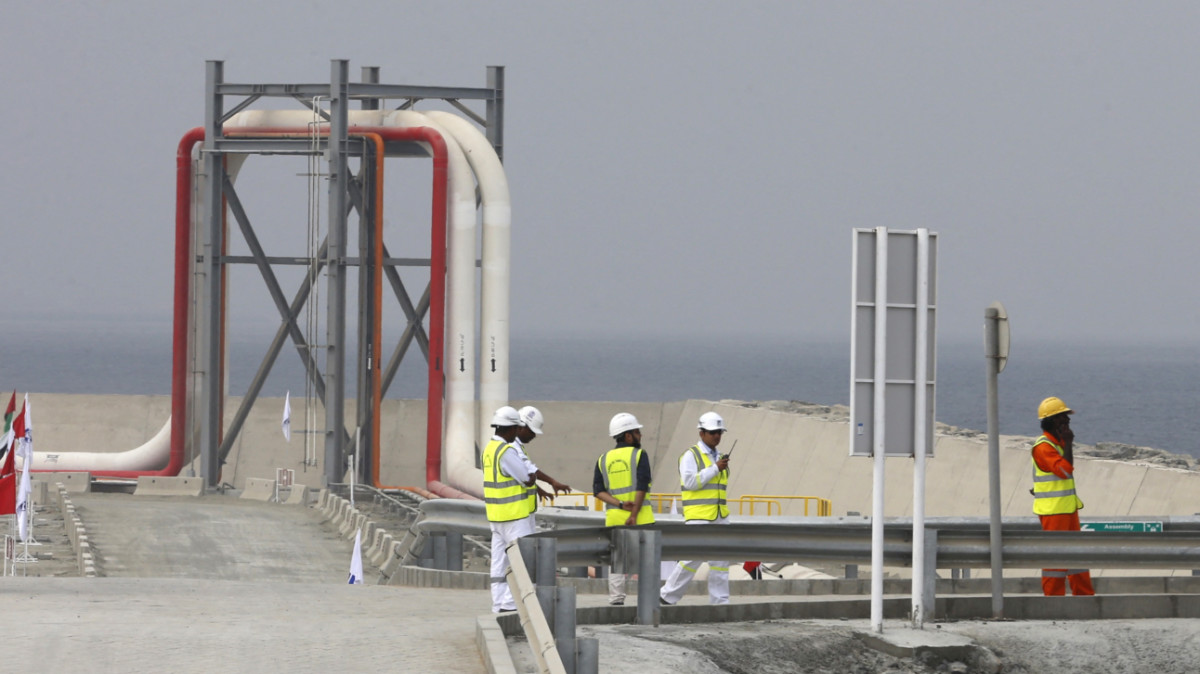
Against the backdrop of escalating regional tensions following the US-Israeli military campaign against Iran, the United Arab Emirates has unveiled plans to speed up expansion of its oil pipeline network, a strategic move that will double the volume of crude the nation can export without passing through the contested Strait of Hormuz. The project is on track to be fully operational by 2027, state-owned Abu Dhabi National Oil Company (Adnoc) confirmed in an official statement released Friday.
Abu Dhabi Crown Prince Sheikh Khaled bin Mohamed bin Zayed Al Nahyan announced the acceleration of the construction during a recent high-level committee meeting, with Adnoc noting that preliminary work on the new pipeline segment had already broken ground. The pipeline will connect the UAE’s inland oil infrastructure to the port of Fujairah, which sits on the UAE’s eastern coast along the Gulf of Oman, eliminating the need for tankers to navigate the Strait of Hormuz, the world’s most critical chokepoint for global oil trade.
Currently, the UAE’s existing Habshan-Fujairah pipeline boasts a daily throughput capacity of 1.8 million barrels. With the expansion, the country’s total bypass capacity will double, allowing it to restore nearly all of its pre-conflict export volume without relying on Hormuz. Before the outbreak of the current war, the UAE was moving roughly 3.4 million barrels of crude per day to global markets. After Iran took control of the strait and implemented a new regional passage authorization system, UAE exports dropped by approximately 60 percent, according to regional energy data.
Once the expanded network is complete, the UAE will be able to ship almost all of its pre-war output via the alternative pipeline route. Longer-term, the Gulf nation has set an even more ambitious target: reaching a total export capacity of nearly 5 million barrels per day by 2027, aligning with massive infrastructure investments it has made to ramp up domestic production capacity over recent years.
The strategic pivot away from Hormuz comes amid a series of disruptive regional developments tied to the ongoing conflict. In the opening weeks of the war, Iran blocked oil exports from other Gulf states while continuing its own shipments, before a U.S. naval blockade imposed last month effectively halted all Iranian crude exports. The move also follows a landmark decision by the UAE just this month to withdraw from the Saudi Arabia-led OPEC cartel, a split rooted in years of disagreements over production policy. For years, Riyadh pushed for aggressive production cuts to prop up global oil prices, while the UAE pushed for looser output limits to capitalize on its expanded production capacity. The UAE’s exit from OPEC gives it full policy flexibility to pursue its 2027 capacity goals, Abu Dhabi officials have said.
Despite the strategic gains of the project, security risks remain a persistent challenge. The UAE’s close geographic proximity to Iran leaves its critical energy infrastructure vulnerable to attack. Earlier in the conflict, an Iranian drone strike targeted a major gas processing facility located near Habshan, the starting point of the Fujairah pipeline. The port of Fujairah itself has also been hit in previous attacks, forcing a temporary suspension of all cargo operations at the facility.
The UAE is not alone in moving to diversify its oil export routes away from the Strait of Hormuz. Regional rival and neighbor Saudi Arabia already operates the East-West Pipeline, which enables the kingdom to export up to 5 million barrels of crude per day through the Red Sea port of Yanbu, bypassing Hormuz entirely.
This independent coverage of Middle East energy and security developments is provided by Middle East Eye, a publication specializing in on-the-ground reporting and analysis of the Middle East and North Africa region.