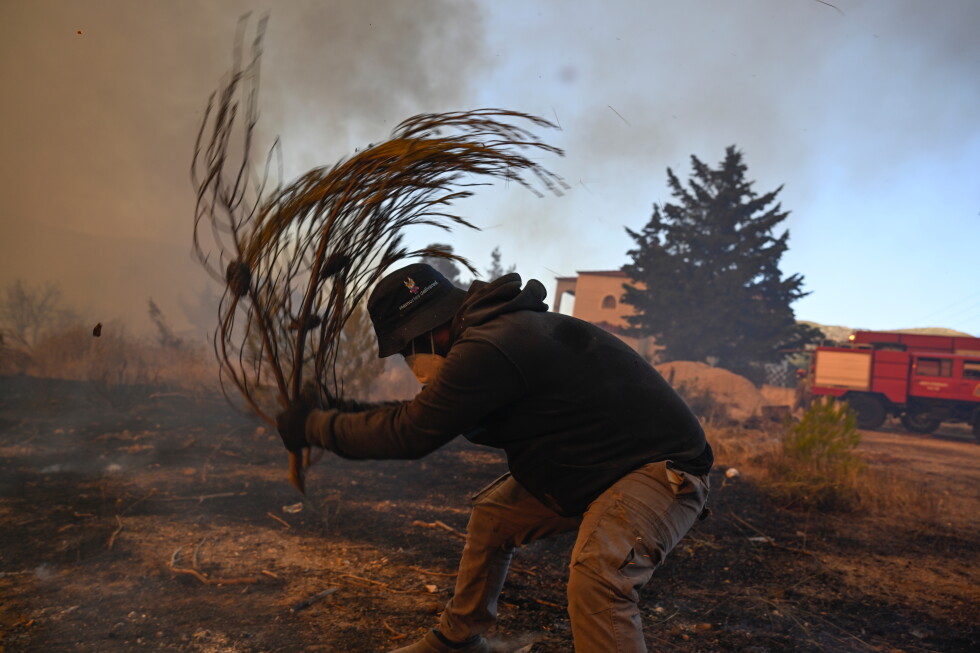
As Europe confronts one of its most severe summer wildfire emergencies in recent memory, multiple countries are facing expanding blazes, tragic loss of life, and stretched emergency response capacity, with high temperatures and shifting wind patterns keeping authorities on high alert.
On the Greek front, the crisis took a devastating turn Sunday when two firefighting helicopters collided midair while battling a large wildfire burning west of Athens, the nation’s capital. The crash killed two crew members: one Greek national and one Danish firefighter who had been deployed to support Greece’s wildfire response. Two other crew members on the second helicopter — a Greek and a British national — survived with minor injuries and were transported to a local hospital for treatment. The collision occurred near the coastal community of Psatha, where the fire had been raging since Friday morning.
By first light Monday, authorities dispatched 10 additional air assets — five water-dropping planes and five helicopters — to support nearly 500 ground firefighters working to contain the blaze. The collision highlighted the extreme risks facing first responders on the most volatile front of Europe’s wildfire crisis, even as new evacuation orders were issued for three additional communities near Athens in the early hours of Monday as flames pushed deeper into the Attica region. More than 1,000 people have been displaced by the fire so far, including over 250 residents and visitors who were rescued by boat from local beaches as flames reached the coastline.
Greek firefighting authorities announced Sunday that the blaze has been traced to an electrical fault: sparks from a faulty power line connecting a private wind generator facility to the national grid triggered the fire. Two people have already been arrested in connection with the incident, including an electrical engineer who oversaw the project’s design and a contractor who worked on the transmission line. Both face felony arson charges, and an arrest warrant has also been issued for the owner of the wind generator company.
For Greece, large summer wildfires are a recurring annual disaster. Hot, dry conditions combined with frequent strong winds create ideal conditions for small sparks to escalate into major infernos. Officials note that more than 90% of the hundreds of wildfires the country fights each year stem from human negligence, as common risk mitigation measures such as bans on open-air barbecues, welding, and the use of power saws in dry forest areas are regularly ignored. In a separate incident Sunday, authorities on the Greek island of Kefalonia arrested a man on suspicion of deliberately starting a wildfire that forced the evacuation of multiple nearby villages.
A shift in conditions on Monday brought a small measure of hope: the gale-force winds that had fanned the flames and grounded water-dropping aircraft through the weekend began to die down, allowing crews to resume aerial attacks on the blaze and create new firebreaks to slow its advance. But officials warn that the entire Attica region remains at extreme wildfire risk, with forecasts calling for a new round of rising temperatures later this week.
The wildfire crisis is not limited to Greece. Across Western Europe, France is grappling with the largest wildfire in its modern history, which has already forced what officials describe as the largest peacetime civilian evacuation in the country’s history. Some 224,000 people have been displaced by the Gironde megablaze in southwestern France, which has already burned through 420 square kilometers of land — an area roughly four times the size of the city of Paris. While firefighters managed to contain the blaze within its existing perimeter by Sunday night, dozens of hotspots continue to burn inside the fire zone, and thousands of displaced residents remain unable to return to their homes. Nearly 3,000 French firefighters are deployed to battle this blaze and a second major wildfire burning in the Provence region.
When combined with large-scale blazes in Spain, wildfires across Western and Southern Europe have displaced roughly 350,000 people from their homes and summer vacation sites, emptying communities during the peak tourism season and stretching emergency response services across multiple simultaneous disasters.