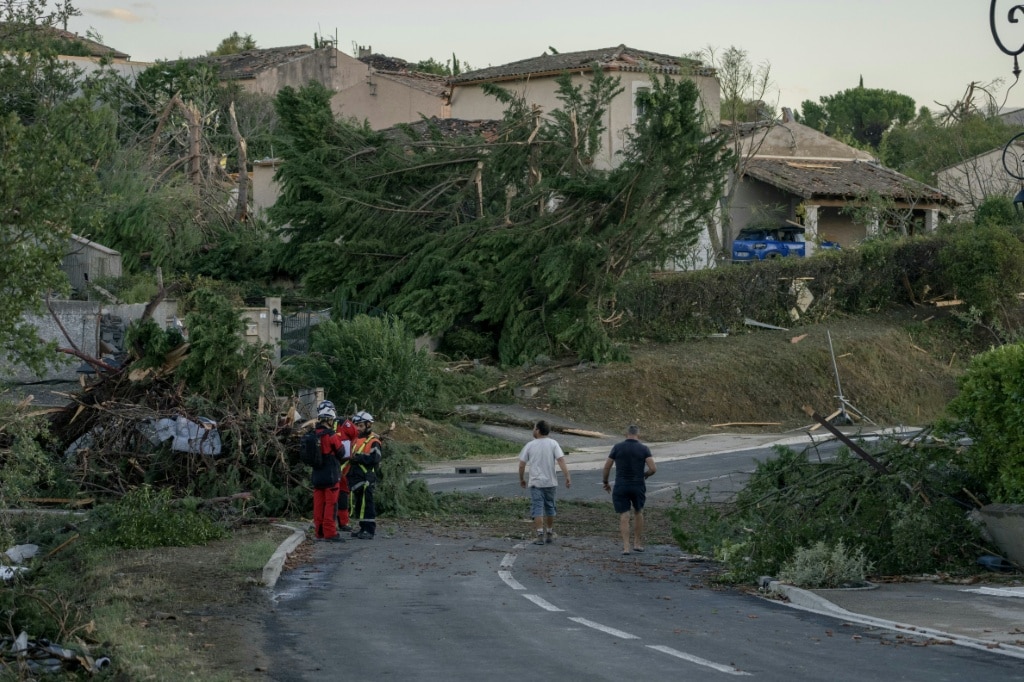
On a late Monday afternoon in southern France’s Aude department, an unusually powerful tornado tore through local communities, leaving a trail of catastrophic destruction in its wake that local leaders have compared to a war zone. The small village of Pomas, home to roughly 1,000 residents, bore the brunt of the extreme weather event, with the storm collapsing building walls, tearing entire roofs off structures, and flattening centuries-old trees.
As of initial emergency updates, 39 people have been confirmed injured, two of whom are in critical condition, and 17 injured residents have been admitted to local hospitals for ongoing care. In an interview with reporters Tuesday, Pomas mayor Herve Gine described the chaotic aftermath as an experience akin to living through active conflict. “We were bombed by nature,” Gine said, noting that many residents are reeling from shock after losing all their personal property in the storm. Key public infrastructure, including the village nursery school and town hall, have been completely destroyed, he added. Gine also emphasized that a complete loss of life was avoided by what he called a miracle, noting that the scale of destruction easily could have killed dozens of people.
Walking tours of the village Tuesday revealed the full force of the tornado: narrow streets were choked with fallen debris, uprooted trees blocked access to many neighborhoods, broken roof tiles covered sidewalks, multiple cars were flipped onto their roofs, and nearly every residential building suffered broken windows or torn away shutters. Of Pomas’ 476 residential properties, approximately 300 sustained varying levels of damage, and Gine confirmed that large swathes of the village will require full reconstruction.
French Interior Minister Laurent Nunez characterized the tornado as an event of “rare intensity” in a social media post Tuesday, while regional deputy prefect Marie-Helene Bouissac called it “an exceptional and highly traumatic event” for the local community. Power grid operator Enedis reported that by early Tuesday, 7,250 households across the broader Languedoc-Roussillon region remained without electricity, 1,600 of which are located in Aude department. An AFP reporter on the ground observed that crews had already covered exposed, roofless buildings with blue and green tarpaulins to shield remaining interiors from further damage under clear Tuesday skies. Nearby agricultural areas, including commercial vineyards, were scattered with debris carried by high winds, ranging from broken outdoor furniture to fragments of building insulation and shredded wire fencing.
Emergency response teams worked through the night to clear debris, search for trapped victims and support displaced residents, assisted by canine search units and specialized reinforcement teams. As of Tuesday afternoon, search and safety inspections were still ongoing, with 75 firefighters deployed to the impacted area. Overnight, dozens of displaced residents were housed in a repurposed community hall that served as a temporary emergency shelter, while hundreds more stayed with friends or family in undamaged nearby towns. At police checkpoints controlling access to the damaged village, relatives of local residents gathered to drop off emergency supplies and wait for clearance to help loved ones salvage belongings.
Local residents shared harrowing accounts of the storm’s impact. Jose Gomes, a resident of neighboring Trebes, told reporters that his friend’s home completely collapsed while the friend was inside, leaving him with a head injury and multiple broken ribs. The injured man was released from the hospital Tuesday morning, Gomes added. Abdallah Wakkas, a local grandfather of two teenagers aged 13 and 17, said that while his grandchildren’s home escaped major damage, the pair are still traumatized after seeing their grandmother’s home destroyed.
France typically records several dozen tornadoes of varying intensity each year, according to national weather service Meteo-France. This summer, the country has already faced three back-to-back heatwaves, with a record 52 days of extreme high temperatures amplified by human-caused climate change. These extreme weather conditions have already triggered severe droughts, widespread wildfires, and a record number of dangerous rockfalls in the French Alps. While international climate scientists note that the explicit link between global warming and changing tornado frequency or intensity remains under ongoing research, the devastating impact of this rare extreme event has underscored growing risks of severe weather across Europe.