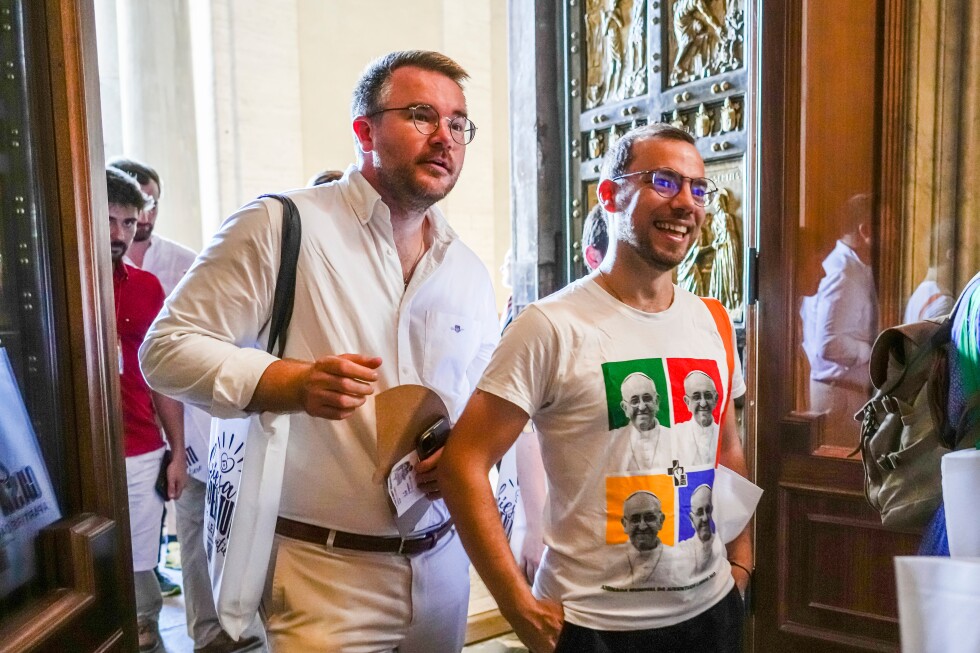
Twelve years of Pope Francis’ pontificate brought unprecedented shifts in how the Catholic Church approaches LGBTQ+ believers, and now, under Pope Leo XIV, the Vatican is sending mixed, carefully calibrated signals about the future of pastoral outreach to this community, pairing new openness to listening with firm limits on doctrinal change.
This week, LGBTQ+ Catholic advocates celebrated a milestone: an official Vatican working group report released as part of post-Francis synodal reform efforts included first-person testimonies from two openly gay, married Catholics detailing their experiences of faith, harm from the church’s longstanding negative teachings on homosexuality, and self-acceptance. The report, a non-binding synthesis of expert deliberations on contentious post-reform issues, marks the first time an official Vatican document has centered such detailed personal narratives from LGBTQ+ Catholics.
One man, a Portuguese native, shared his journey of coming to terms with his sexuality, marrying his husband, and the ongoing harm he faced at the hands of church leaders — including insensitive comments from a spiritual director and pressure to undergo conversion therapy, the thoroughly discredited practice that claims to change sexual orientation. The second witness, an American man, criticized mandatory counseling he received from Courage International, a Catholic pastoral group that urges people with same-sex attraction to practice celibacy. “My sexuality isn’t a perversion, disorder, or cross; it’s a gift from God,” he wrote in his testimony.
In response to the critical depiction of its work, Courage issued a statement Friday pushing back against what it called a false portrayal, denying it has ever participated in reparative therapy. “Courage has suffered calumny and detraction before, but usually from secular outlets,” the group said. “It is a great sadness and an additional wound to our members to have this false and unjust depiction in a Vatican document.”
For leading American Jesuit advocate Father James Martin, who has spent decades pushing for greater church outreach to LGBTQ+ people, the development reflects strong continuity with Pope Francis’ agenda. “If the Catholic Church has begun to listen to LGBTQ Catholics as part of its methodology, the church has already moved forward in a significant way,” Martin noted, adding that the publication of the testimonies alone represents a major step forward in mending the rift between the church and the LGBTQ+ community.
But the shift has already drawn fierce pushback from conservative Catholic leaders. Bishop Joseph Strickland, the former bishop of Tyler, Texas who was removed from his post by Francis, called the report “deeply alarming,” arguing it directly contradicts unchanging church teaching that defines homosexual activity as “intrinsically disordered.” In an online post titled “An Emergency in the Church,” Strickland argued that church teaching on homosexuality comes not from human prejudice, but from divine revelation. “To suggest that the sin does not consist in the same-sex relationship itself is not merely confusing language. It is a direct assault upon Catholic moral doctrine and upon the words of Scripture itself,” he wrote.
The most contentious flashpoint in this new era remains the question of blessings for same-sex couples, an issue that has already split the global church and put the Vatican at odds with progressive regional bishops, most notably in Germany. In 2023, under Francis, the Vatican’s doctrinal office issued the declaration *Fiducia Supplicans*, which allowed priests to offer spontaneous, non-liturgical blessings to individual same-sex people, while clarifying such blessings cannot be confused with sacramental marriage, which the church defines as a lifelong union between one man and one woman. The declaration triggered widespread conservative backlash, including coordinated dissent from a bloc of African bishops, forcing the Vatican to clarify that blessings must be brief, around 10 to 15 seconds, and cannot be interpreted as approval of a same-sex union itself.
Earlier this year, Germany’s Catholic bishops and a prominent lay organization issued their own national guidelines for implementing *Fiducia Supplicans* that go beyond the Vatican’s parameters. While the guidelines acknowledge the requirement for non-liturgical, spontaneous blessings, they frame the blessings as being for the couple’s relationship rather than just the individual people, and outline formal criteria for celebrations including liturgical readings, pre-event preparation, and congregational acclamation, prayer and song.
During a return flight from a recent visit to Africa, Pope Leo made clear the Holy See disagrees with the German framework, and this week a 2024 letter articulating that position was published publicly. Signed by Vatican doctrine chief Cardinal Victor Manuel Fernández, the letter argues that the German guidelines’ inclusion of acclamation mirrors the structure of formal marriage rites, and “in this sense effectively legitimizes the status of these couples, contrary to what is stated” in the 2023 *Fiducia Supplicans* declaration. Fernández also noted that the guidelines’ focus on ceremony details like location, aesthetic design and music effectively creates a liturgical event that contradicts the Vatican’s limits. The letter stops short of an outright veto, offering only formal observations rather than punitive action.
Vatican Secretary of State Cardinal Pietro Parolin recently noted that talk of sanctions against German priests who adopt the national guidelines is “premature,” adding that ongoing dialogue between Rome and the German bishops is the preferred path. “The hope is never to have to resort to sanctions, that problems can be resolved peacefully, as should be the case in the church,” Parolin said. Pope Leo met this week with German Cardinal Reinhard Marx, who has encouraged priests in his archdiocese to use the national guidelines for pastoral care.
In the same airborne press conference that addressed the German dispute, Leo laid out his broader approach to the issue, making clear that he views core church teachings on social justice, equality and religious freedom as far more important than doctrines around sexual morality, signaling he does not intend to prioritize debates over LGBTQ+ issues during his pontificate. On the question of same-sex blessings, however, Leo confirmed he will not go beyond the limits set by Francis, reaffirming the Vatican’s opposition to regional efforts that deviate from the Holy See’s existing stance.
For many LGBTQ+ Catholic advocates, Leo’s measured approach is still a welcome change. Francis DeBernardo, executive director of New Ways Ministry, a group that advocates for LGBTQ+ inclusion in the Catholic Church, praised Leo’s framing of priority issues. “It is good to hear from the pope that he is making a decisive turn away from the church’s obsession with sexual matters,” DeBernardo said. He added that Leo’s non-confrontational response to the German guidelines — declining to condemn church leaders, framing disagreement as not a cause for schism — marks a positive shift. “Both the new moral emphasis on social issues instead of sexuality, and the fostering of a more collegial church are good news for LGBTQ+ Catholics,” DeBernardo said.
Martin echoed that balance, arguing there is no contradiction between the Vatican’s retention of existing limits on same-sex blessings and the synod’s new call to listen to LGBTQ+ Catholics. “Both ‘Fiducia’ and the synod report are steps forward in the church’s ministry to LGBTQ people,” he told the Associated Press.