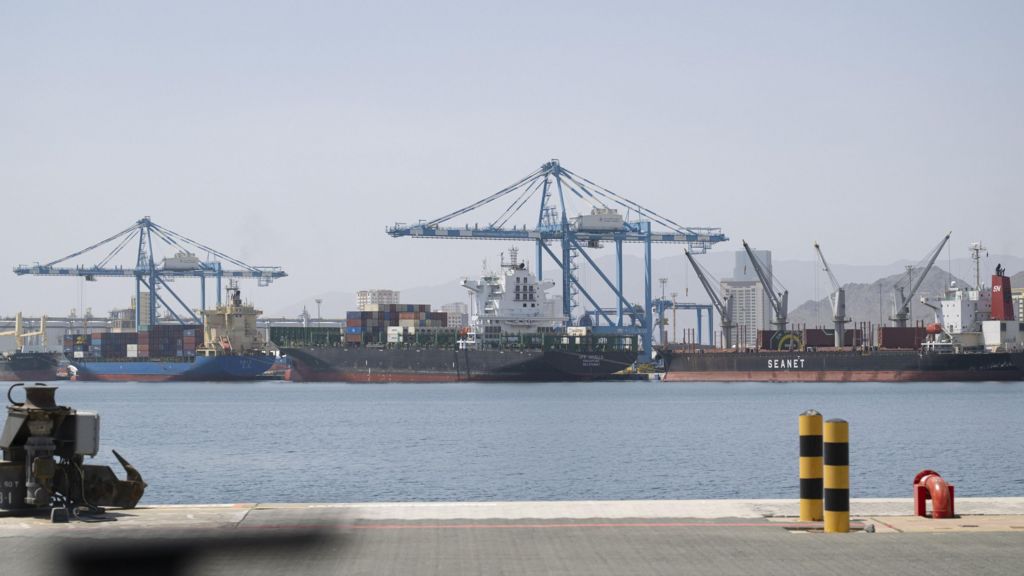
Tensions in the strategically critical Strait of Hormuz reignited dramatically on Monday, as conflicting claims of military strikes, ship attacks and port damage plunged the already volatile Persian Gulf region into a fresh crisis, just weeks after a fragile US-Iran ceasefire took hold.
The waterway, which carries roughly 20% of global oil and liquefied natural gas supplies, has remained effectively closed to commercial traffic since February, when joint US-Israeli airstrikes on Iran prompted Tehran to block all transit. A ceasefire agreed in early April paused Iranian drone and missile attacks on Gulf states including the United Arab Emirates, but the waterway stayed largely blocked amid a separate US blockade on Iranian ports, leaving an estimated 2,000 vessels and 20,000 seafarers stranded in the Gulf.
On Sunday, US President Donald Trump launched what he dubbed ‘Project Freedom’, an initiative to escort stranded neutral ships out of the blocked strait. He announced on Monday that US military forces had destroyed seven Iranian fast-attack boats in the waterway, using helicopter strikes to clear a path for transiting vessels. ‘It’s all they have left,’ the president stated of the small craft. The US military later confirmed that Navy destroyers had already escorted US-flagged commercial ships through the channel earlier that day.
Iran has issued outright denials of all US claims, rejecting that any of its fast boats were targeted or sunk. Iranian officials also dismissed Washington’s assertion that it had escorted ships through the strait as ‘entirely false’, and countered that its own military had fired warning shots at a passing US warship – a claim the US military immediately denied. Iranian Foreign Minister Abbas Araghchi dismissed the US initiative, arguing that ‘events in the strait make clear that there’s no military solution to a political crisis,’ adding that ‘Project Freedom is Project Deadlock.’
The first major breakthrough for the US operation came when global shipping giant Maersk confirmed that one of its US-flagged vessels, the Alliance Fairfax, which had been stranded in the Gulf since late February, had successfully exited the strait under US military escort. The company noted that the transit was completed without any harm to the 20+ crew on board, and all personnel remain safe. Maersk said the US government had reached out to offer the military escort, which the firm accepted.
Even as the first US-escorted ship exited the waterway, multiple attacks on vessels and infrastructure were reported across the region, raising fears of a full resumption of open conflict. The UAE’s foreign ministry confirmed that a tanker owned by its state-run energy giant Adnoc was struck in the strait. South Korean officials also reported an explosion on one of its vessels anchored off the UAE coast.
UAE air defense forces also intercepted a large barrage of incoming fire, shooting down 12 ballistic missiles, three cruise missiles, and four drones. One unblocked projectile impacted near the Fujairah Oil Port – the UAE’s largest oil storage and shipping facility, located on the country’s east coast outside the Strait of Hormuz. The strike sparked a large blaze at the terminal and left three people injured. The UAE condemned the assault as a ‘dangerous escalation’ and said it reserved the right to take retaliatory action. An unnamed Iranian military official, quoted by Iranian state television, denied that Iran had any plans to target the UAE.
The unrest sent global energy markets spiking on Monday: benchmark Brent crude prices jumped more than 5% in intraday trading to push past $115 per barrel, as traders reacted to fears of disrupted supplies. Fujairah has emerged as a critical alternative export route since the strait closed, with a pipeline from Abu Dhabi’s inland oil fields delivering crude to the port for loading onto tankers, allowing limited exports to continue despite the blockade.
Additional unrest was reported elsewhere along the strait: Omani state media reported that two people were injured when a residential building in the coastal town of Bukha was targeted in an attack. Neighboring Qatar, a key regional Gulf state, issued a statement condemning the attack on the Adnoc tanker and calling for the ‘unconditional reopening’ of the Strait of Hormuz to resume global commercial shipping.
The escalation comes amid growing international pressure to resolve the months-long blockade, which has created a growing humanitarian crisis for stranded seafarers. International shipping groups have raised urgent concerns about dwindling food and medical supplies on board stuck vessels, as well as deteriorating physical and mental health for thousands of crew members trapped at sea. Trump has framed Project Freedom as a humanitarian mission, saying the US was responding to requests from nations around the world to free ‘merely neutral and innocent bystander’ ships locked in the Gulf. He has threatened to use additional force if any actor interferes with the evacuation operation, but has not laid out a clear long-term plan to reopen the strait to full commercial traffic.