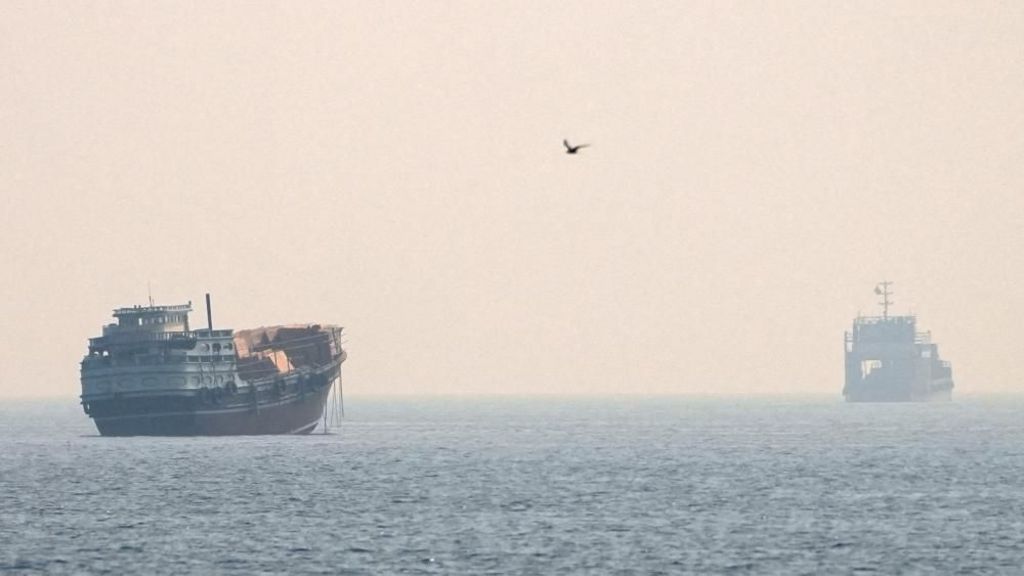
Escalating tensions in the Middle East have reached a new critical flashpoint, after the United States launched a sweeping new round of military strikes against Iranian targets along the Strait of Hormuz, marking the end of a month-long ceasefire agreement between the two longstanding adversaries.
The escalation follows a series of tit-for-tat attacks that unfolded this week, starting with alleged Iranian strikes on commercial shipping vessels in the strategic international shipping lane on Tuesday. That attack prompted immediate U.S. retaliatory strikes late Tuesday, with President Donald Trump promising further heavy action Wednesday evening.
Iranian state media has confirmed multiple large explosions across southern Iranian port cities located along the Strait of Hormuz, including Sirik, Bandar Abbas, Jask, Konarak and Chabahar. According to Iranian reports, multiple missiles hit port infrastructure in Sirik and Jask, while eight explosions were recorded in Bandar Abbas, the country’s key southern trade hub. Strikes were also reported on Abu Musa, a disputed island claimed by both Iran and the United Arab Emirates. Local Iranian outlets have documented blackouts across parts of Chabahar and an active fire at an Islamic Revolutionary Guard Corps barracks in Bushehr, though full details of casualties and infrastructure damage remain undisclosed as of Wednesday night.
U.S. Central Command (Centcom) confirmed in an official statement Wednesday that the operation targeted 90 Iranian military assets along the country’s coastline, including integrated air defense systems and military logistics infrastructure. The command said the strikes were intended to “further degrade Iran’s ability to attack commercial shipping and innocent civilian mariners” in the strategically vital waterway, through which roughly 20% of global oil trade passes daily. Centcom added that the new operation followed successful offensive strikes carried out against Iran the previous night.
Speaking directly to reporters aboard Air Force One Wednesday evening, President Trump confirmed the strikes were deliberate retaliation for the Tuesday shipping attacks. In a subsequent post to his Truth Social platform, Trump emphasized: “This is in retribution for yesterday’s bombing of ships by Iran. If it happens again, it will get much worse!” The president also revealed that Iranian officials had reached out to Washington Wednesday seeking to restart negotiations, but cast doubt on whether Tehran could be trusted to honor any future agreement. “I just don’t know if they’re worthy of making a deal – I don’t know that they’re going to honour the deal, that’s the problem,” he said. Trump also formally declared the 17 June ceasefire memorandum of understanding (MoU) “over”, calling further negotiations with Iran “a waste of time” and using exceptionally harsh language to describe the Iranian leadership.
Top Iranian officials have issued sharp, defiant responses to the new U.S. strikes. Mohammad Bagher Ghalibaf, Iran’s parliamentary speaker and chief nuclear negotiator with the U.S., wrote on the social platform X that “America still hasn’t learned that bullying and breaking promises are no longer cost-free.” He added a clear warning: “Let me put it plainly: if you strike, you’ll get hit.” Ghalibaf also reaffirmed Iranian sovereignty over the strait, stating that shipping access would remain under Iranian control, not “American threats.” Iranian Foreign Minister Abbas Araghchi similarly rejected Trump’s inflammatory language, saying: “We do not answer vulgarity with vulgarity, but with action: fearlessly and with great valour.”
The escalation has already sent ripples across the Gulf region. Local media and officials have confirmed explosions in Manama, the capital of Bahrain, a key U.S. ally in the region. Kuwait’s military confirmed it intercepted incoming missiles and drones launched from Iran, while Qatar’s interior ministry issued a nationwide security alert for civilians.
The June MoU was meant to de-escalate tensions after months of escalating attacks on commercial shipping in the strait. The 14-point agreement included a 60-day ceasefire to allow for comprehensive negotiations, guarantees for safe commercial passage through the Strait of Hormuz, and U.S. sanctions relief for Iran. The 60-day negotiating window has not yet expired, but this week’s attacks have collapsed the fragile truce entirely. This is not the first time the truce has been tested: the U.S. launched limited strikes in late June after an Iranian attack on a cargo ship, but both sides agreed to step back from escalation at that time.