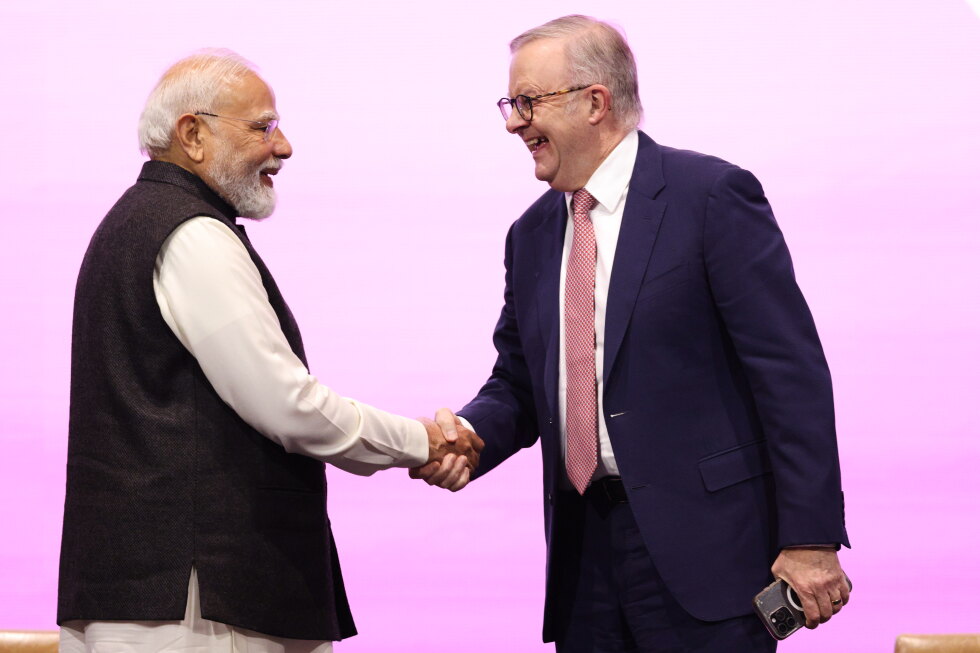
In a landmark step that deepens bilateral ties between two major Indo-Pacific nations, Australian Prime Minister Anthony Albanese and Indian Prime Minister Narendra Modi announced Thursday that Canberra will finally begin selling uranium to New Delhi for civilian energy use, putting a decade-old stalled agreement into motion.
The joint announcement came during Modi’s visit to Australia for the countries’ annual bilateral leaders’ summit, where the pair also unveiled plans for expanded defense and security cooperation across the Indo-Pacific region. Details on the volume of future uranium exports and the timeline for first shipments were not released immediately.
Australia holds the world’s largest known reserves of uranium, but produces the material exclusively for export — the country does not operate nuclear power plants or develop nuclear weapons. For India, a stable supply of imported uranium is a critical piece of its ambitious clean energy expansion plan: New Delhi aims to install 100 gigawatts of nuclear generation capacity by 2047, enough to power roughly 60 million households annually. While India has doubled its domestic nuclear power capacity over the last 10 years, nuclear energy still accounts for just 3% of the country’s total electricity output, leaving massive room for growth to meet rising demand from its 1.4 billion population and expanding middle class.
The path to Thursday’s agreement stretched back more than a decade, blocked for years by longstanding non-proliferation concerns. A 2014 bilateral export framework was never enacted, due to Australia’s longstanding policy restricting uranium sales to countries that are not signatories to the Treaty on the Non-Proliferation of Nuclear Weapons (NPT). India has never joined the NPT, arguing the agreement is inherently discriminatory: it only recognizes five countries as legitimate nuclear weapon states — the U.S., China, Russia, the U.K. and France — based on nuclear tests conducted before January 1967, a cutoff that permanently excludes India. After India conducted a series of nuclear tests in 1998, the country faced widespread international trade sanctions on uranium and nuclear technology.
A turning point came in 2008, when the 45-nation Nuclear Suppliers Group granted India a special waiver that allowed member states to sell uranium to the country for civilian use. Since then, New Delhi has actively pursued bilateral sales agreements with major uranium producers, including a deal signed with Canada in March this year. After the 2008 waiver, Australia softened its longstanding opposition to sales, agreeing in 2014 to allow exports conditional on strict International Atomic Energy Agency (IAEA) safeguards and the separation of India’s civilian and military nuclear programs. Thursday’s administrative agreement removes the final bureaucratic barriers to activating the 2014 framework.
Beyond the uranium deal, the two leaders used Thursday’s summit to reinforce their growing strategic alignment. In a joint statement, they pledged to advance deeper defense and security cooperation across the Indo-Pacific, framing the move as a “step‑change in the depth and ambition” of the bilateral relationship. The announcement of closer security ties came just days after Australia publicly criticized China for test-firing a long-range ballistic missile from a nuclear-powered submarine into the South Pacific, a region protected by a regional anti-nuclear treaty. The two leaders did not name China in their public statements Thursday and declined to take questions from reporters.
Modi’s regional tour also included a previous stop in Indonesia, where he sealed a landmark deal for Indonesia to purchase India’s BrahMos missiles, and will continue with a first-ever visit to New Zealand starting Friday. India and New Zealand signed a bilateral free trade agreement back in April.
Economically, India has emerged as one of Australia’s most critical trade partners: official Australian government data puts the total value of two-way goods and services trade at 54.4 billion Australian dollars, or $37.7 billion, for the 2024-2025 financial year, making India Australia’s fifth largest trading partner. Tens of thousands of local residents gathered in central Melbourne to catch a glimpse of Modi during his visit, reflecting the deep people-to-people ties between the two countries.