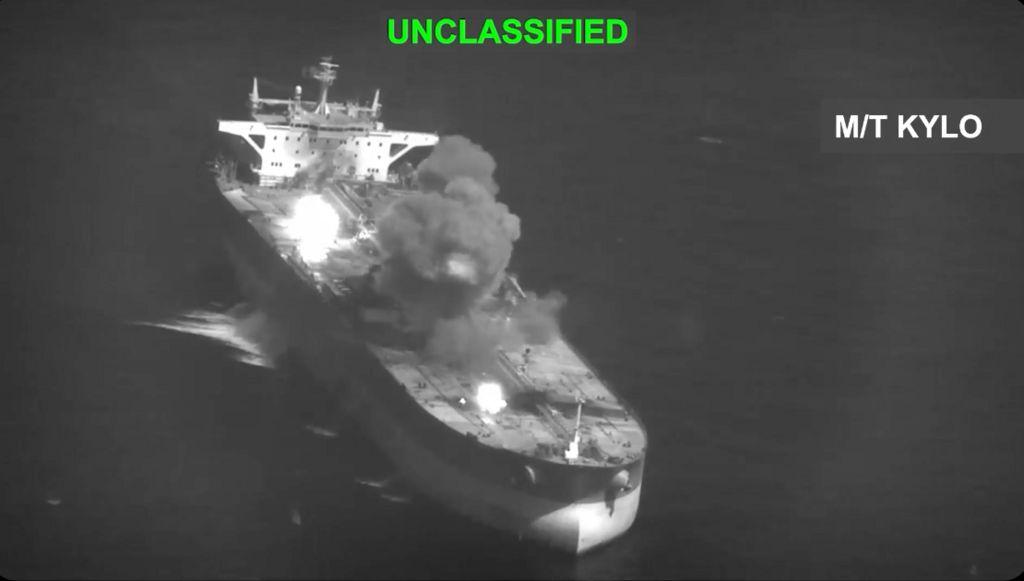
Escalating tensions between the United States and Iran have erupted into open military confrontation in the Persian Gulf region, after U.S. Central Command (Centcom) launched targeted retaliatory strikes against three Iran-connected oil tankers Saturday. The operation came in direct response to ballistic missile launches by Iran’s Islamic Revolutionary Guard Corps (IRGC) against two U.S. military vessels operating in the area.
According to Centcom’s official statement, the strikes inflicted severe, irreversible damage on the targeted vessels: one tanker was permanently disabled off the coast of Kharg Island, a second was rendered inoperable near the strategically critical Strait of Hormuz, and the third, the M/T Kylo crude oil carrier, was completely destroyed in the Gulf of Oman. Centcom confirmed that U.S. forces successfully evaded all incoming IRGC missile attacks aimed at a U.S. aircraft carrier and a guided-missile destroyer, and no American service members were injured in the exchanges.
Iranian state media had earlier reported a strike on one of its tankers off Kharg Island, but Tehran had not issued an immediate official response confirming the IRGC’s attacks on U.S. warships as of Saturday.
Admiral Brad Cooper, head of U.S. Central Command, issued a blunt public warning following the operation. “Let the message to the IRGC be clear: If you shoot at two of our ships, we will impose an even higher economic cost – taking out three of yours,” Cooper said. “We will not hesitate to defend American forces, and if necessary, destroy Iran’s limited and exposed oil fleet.”
Centcom, which is responsible for overseeing all U.S. military activity across the Middle East, alleges that the three targeted tankers operate as part of a sprawling, multi-billion-dollar shadow oil network that generates revenue for the IRGC and its network of regional armed proxies, which the U.S. has long designated as terrorist organizations.
Saturday’s strikes mark a major escalation just one week after a new cycle of open hostilities broke out between the two nations, ending a period of relative calm that had held for months. The most recent round of conflict began on February 28, when the U.S. and Israel launched wide-ranging airstrikes against Iranian targets. Iran responded with its own strikes against Israeli territory, U.S. military bases in the region, and U.S.-allied Gulf states, and effectively closed the Strait of Hormuz – the world’s most important chokepoint for global oil exports – to commercial maritime traffic.
The ongoing dispute over control of the strait has already driven a sharp increase in global energy prices. With U.S. midterm elections scheduled for November, incumbent former President Donald Trump is facing growing political pressure from voters and lawmakers over the rising energy costs that the conflict is imposing on American consumers.