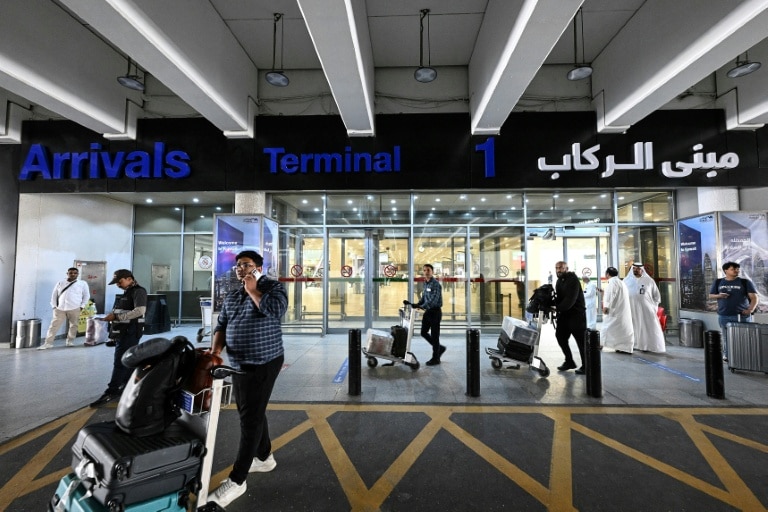
On Saturday, diplomatic missions of the United States across multiple Middle Eastern capitals issued a rare, sweeping security alert urging American citizens currently residing or traveling in the region to prepare for potential evacuation amid growing fears of unanticipated regional conflict escalation. The public warning, published simultaneously on official online channels of US embassies in Bahrain, Iraq, Israel, Jordan, Kuwait, Lebanon, Oman, Qatar, Saudi Arabia, and the United Arab Emirates, came just 24 hours after former US President Donald Trump threatened that Iran would face “very hard” retaliation for recent escalatory actions.
Open hostilities between the United States and Iran have been ongoing since February 28 this year. While a temporary ceasefire brought a brief period of reduced violence to the region, that truce collapsed in recent weeks as both sides resumed targeted strikes. For months, the open conflict has upended daily life for civilian populations across the Middle East and sent shockwaves through global energy markets, with no clear diplomatic offramp to de-escalation in sight.
“Americans in the region should consider departing, or be prepared to depart should there be escalation,” the joint security alert stated. Beyond the general call for evacuation preparedness, embassies urged citizens to confirm the status of commercial flight bookings continuously and comply with all safety guidance issued by local host government authorities. The warning also noted that travelers should anticipate widespread travel disruptions, including sudden flight cancellations, temporary airspace closures, and unplanned interruptions to ground transit networks.
Targeted guidance was issued for citizens in specific hotspots: Americans in Jordan were instructed to avoid all US military bases in the country, which have recently come under Iranian missile attack, while those in Israel were told to locate and familiarize themselves with the nearest bomb shelter. In a post on its official platform, the US Embassy in Jerusalem highlighted the unpredictability of the Iranian government, pointing to recent unprompted attacks on regional targets and the expansion of strikes to previously unaffected areas such as Egypt. The US Embassy in Beirut added that Lebanon remains under “ordered departure status” for US mission personnel, meaning non-emergency diplomatic staff have already been relocated outside the country.
Iran swiftly pushed back against the US warnings Saturday, accusing Washington of intentionally inflaming regional tensions. In a statement carried by Iranian state television, Ali Abdollahi, head of Iran’s military central command, warned that any nation that offers itself as a defensive shield for what he called “criminal and aggressive America” will be consumed by the conflict. Mohammad Mokhber, an adviser to Iran’s supreme leader, issued an additional warning against any US strikes on Iranian critical infrastructure.
“You calculate through military equations, but we respond with the logic of history,” Mokhber wrote on the social platform X. “Attacking Iran’s infrastructure directly awakens the fault lines on which 250 years of your hegemonic architecture have been built.”
Overnight exchanges of fire between US and Iranian forces resumed last month following a days-long lull in fighting, though no strikes were reported between Friday night and Saturday morning. The rising tension comes on the heels of two recent maritime incidents that have further raised alarm: On Wednesday, a drone attack hit a US-owned gas tanker moored in an Egyptian port, sparking a large fire. Egyptian authorities are still investigating the attack and have not yet publicly named a perpetrator. Separately, a British maritime agency reported Saturday that an “unknown projectile” struck an oil tanker off the coast of Oman, as the US and Iran remain locked in a standoff over control of the Strait of Hormuz, one of the world’s most critical chokepoints for global energy trade.
Since the outbreak of hostilities on February 28, Iran has asserted de facto control over commercial navigation through the Strait of Hormuz, requiring all transiting vessels to secure official permission and pay mandatory transit fees to access the waterway. Data from maritime trade analytics firm Kpler, published Friday, shows that commercial traffic through the strait has dropped “sharply” amid the heightened risk. “With US and Iranian public positions still at odds, operators are closely monitoring traffic volumes, routing behaviour and any diplomatic developments that could reshape risk across regional shipping lanes in the days ahead,” the firm noted in a post on X.
The broader regional conflict erupted when the United States and Israel launched joint opening strikes against Iran, which responded with widespread missile and drone attacks targeting positions across the Middle East. On the Lebanese front Saturday, the Israeli military announced it had killed three Hezbollah fighters in southern Lebanon during an operation, while one Israeli soldier sustained moderate injuries in a close-quarters engagement with Hezbollah militants.