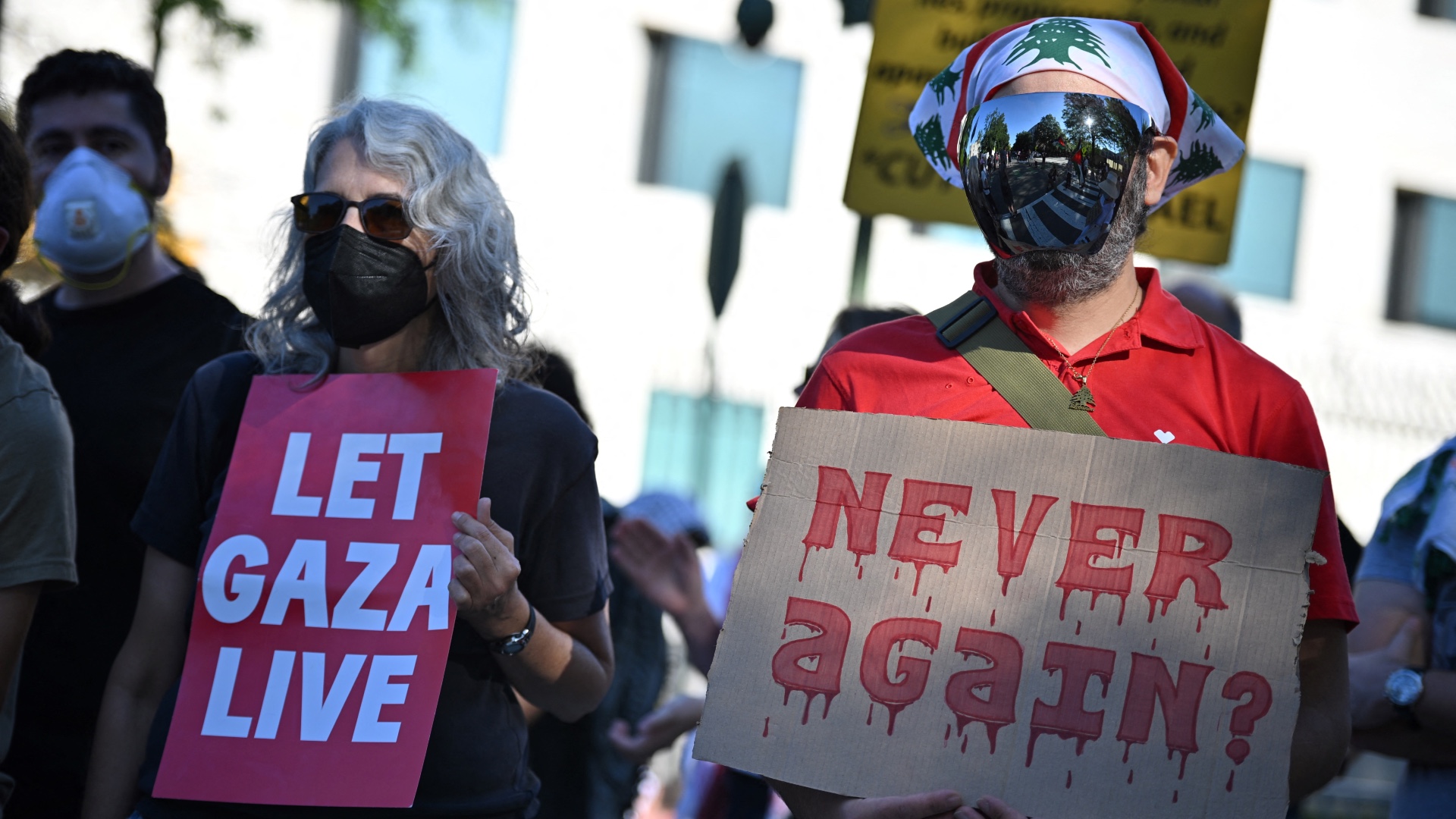
In a sweeping new move targeting pro-Palestinian advocacy groups, the outgoing Trump administration has added UK-based activist network Palestine Action to the U.S. government’s Specially Designated Global Terrorist (SDGT) list, framing the designation as part of a broader crackdown on what it calls “violent far-left terror networks”.
Wednesday’s designation marks one year exactly after the United Kingdom formally banned Palestine Action under national counterterrorism law, following a series of the group’s direct actions targeting facilities owned by Israeli weapons manufacturer Elbit Systems. Elbit, a top supplier of military technology to the Israeli military, operates amid mounting global condemnation of Israel’s nearly three-year military campaign in Gaza, which the United Nations and leading Holocaust scholars have formally characterized as a genocide against Palestinian civilians.
In an official statement, the U.S. Department of the Treasury justified the sanctions by arguing Palestine Action has “materially assisted, sponsored, or provided financial, material, or technological support for, or goods and services to or in support of, an act of terrorism”. The department further claimed the group has carried out multiple high-profile break-ins at British defense infrastructure and military installations, causing millions of dollars in damage to military equipment, and has promoted its tactics across social media to encourage copycat actions internationally, including within U.S. borders and along the U.S.-Mexico border.
The SDGT framework at the center of this action is not a new tool: it was created just days after the September 11, 2001 terrorist attacks, when then-President George W. Bush signed Executive Order 13224 to enable sweeping counterterrorism sanctions. The very first entity targeted under the order was the Holy Land Foundation, once the largest Muslim charity operating in the U.S. In a widely criticized outcome, five Palestinian-American men connected to the charity were tried twice and sentenced to decades in prison on allegations of funneling funds to Hamas-affiliated groups, despite no court ever presenting evidence linking the men to violent activity.
Addressing growing concerns over potential censorship of protected political speech, the Treasury’s statement asserted that “the United States does not sanction persons for engaging in political speech or other constitutionally protected activities”. It went on to cite the text of E.O. 13224, which defines terrorism as “violent acts and acts dangerous to human life, property, or infrastructure, that appear to be intended to intimidate or coerce a civilian population, or to influence the policy of a government by intimidation or coercion”.
Palestine Action is not the only Palestinian rights group targeted in the Trump administration’s latest announcement. Officials also unveiled new sanctions against Masar Badil, a movement that advocates for a “alternative revolutionary path” to secure Palestinian rights and self-determination after decades of stalled peace negotiations failed to deliver progress. According to the Treasury, Masar Badil is inextricably linked to Samidoun, another Palestinian advocacy network that was sanctioned by both the U.S. and Canada in 2024. Samidoun has repeatedly and publicly denied any connection to terrorist activity.
Founded in 2020, Palestine Action launched after a group of activists broke into and spray-painted Elbit Systems’ London headquarters, marking the start of its campaign against what it calls the “corporate enablers of the Israeli military-industrial complex”. Since its founding, the group’s decentralized network of activists has relied on non-violent direct action tactics to target companies that supply the Israeli military, with Elbit remaining its primary focus. Group members have broken into corporate offices and factory facilities to spray-paint or damage equipment they argue is used to enable war crimes in the occupied Palestinian territories and Gaza.
The campaign has yielded tangible impacts for the group: Palestine Action says its pressure has forced multiple companies to sever ties with Elbit, costing the arms manufacturer “billions” in lost contracts and shareholder divestments. Most recently, British banking giant Barclays sold its 16,000-share stake in Elbit in October, and the UK Ministry of Defence canceled a £280 million portfolio of contracts with the firm.
Last July, the UK government proscribed Palestine Action under Section 3 of the country’s 2000 Terrorism Act, a move that criminalizes membership in the group as well as any public invitation or reckless expression of support for the organization. In the months since the ban went into effect, British police have arrested hundreds of protesters — including elderly and disabled activists — solely for holding signs declaring public support for Palestine Action. Videos of these arrests circulating widely on social media have drawn intense backlash, with critics dismissing the crackdown as political theater that wastes valuable law enforcement resources. Multiple Palestine Action activists who participated in actions against Elbit have also reported developing severe post-traumatic stress disorder (PTSD) following their detention by British counterterrorism police.
The group’s crackdown in the UK has already resulted in a high-profile legal case that spotlights divisions over the government’s ban. Eight Palestine Action activists face charges of violent disorder and criminal damage connected to an August 2024 break-in at an Elbit Systems plant in Filton, near Bristol. The defendants are accused of coordinating the raid by carrying out pre-action reconnaissance and purchasing supplies, though prosecutors do not allege any of the eight entered the factory during the action. In a recent development, defendant William Plastow, 35, was acquitted of violent disorder by presiding judge Patrick Field, who ruled the prosecution had failed to present sufficient evidence to support the charge; Plastow still faces separate criminal damage charges. After an eight-week trial and 37 hours of deliberations at London’s Old Bailey court last week, jurors were unable to reach unanimous verdicts for the remaining seven defendants, who are now expected to face a retrial.