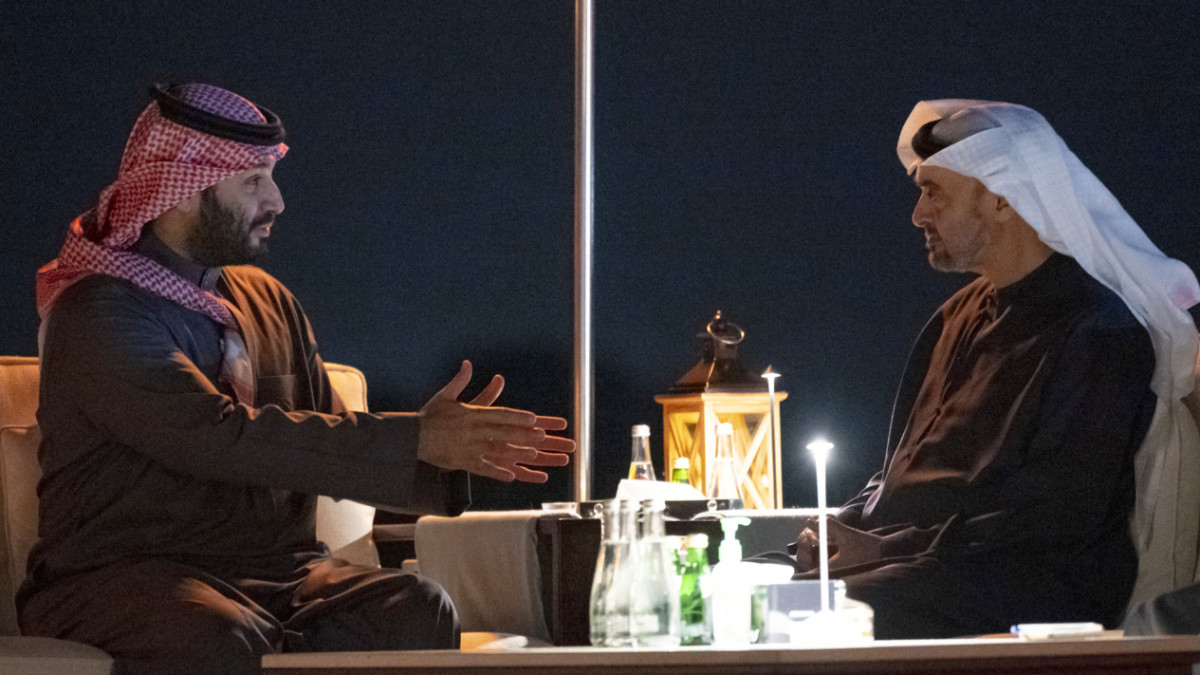
Diplomatic circles across the United States and the Arab world are buzzing with analysis after United Arab Emirates President Mohamed bin Zayed made an unusual direct communication to 90-year-old King Salman of Saudi Arabia, a move widely interpreted as a deliberate effort to bypass the kingdom’s de facto leader, Crown Prince Mohammed bin Salman, known universally as MBS.
Multiple Saudi and Emirati media outlets confirmed the outreach on Monday, confirming that the UAE leader sent a handwritten letter delivered via the UAE’s ambassador to Riyadh, Mater Salem Ali Marran al-Dhaheri, to Saudi Arabia’s Deputy Foreign Minister Waleed Elkhereiji. Saudi reports note the correspondence addressed the current state of bilateral relations between the two neighboring Gulf monarchies, while the UAE’s official state news agency WAM framed it primarily as a personal invitation for King Salman to attend a United Nations-sponsored water conference hosted in Abu Dhabi this coming December.
For regional analysts and Gulf affairs watchers, the unconventional outreach is a clear reflection of the increasingly fragile relationship between MBS and his Emirati counterpart, Sheikh Mohamed bin Zayed. One anonymous Western official with direct knowledge of the diplomatic dynamic told Middle East Eye, “The Emiratis felt they had no other option than to go straight to the top.” The official added that MBS, who has held effective day-to-day control over Saudi governance for nearly a decade, is expected to take umbrage at the bypassing tactic.
King Salman ascended to the Saudi throne in 2015 following the passing of his half-brother King Abdullah, but age has greatly reduced his public and diplomatic activity in recent years. The monarch rarely travels outside Saudi borders, with his last confirmed international public appearance dating back to a 2019 Arab League Summit in Tunisia. All major decision-making and high-level diplomatic representation now falls to MBS, who just completed a high-profile two-day visit to Paris where he met with French President Emmanuel Macron to discuss bilateral trade agreements and regional security issues across the Middle East.
This is not the first time a foreign government has attempted to communicate directly with King Salman outside MBS’s established diplomatic channels, but the timing of the letter is particularly significant: it comes amid steadily growing friction between the two major oil-rich Gulf powers, who were once considered close and coordinated allies. Tensions between the pair boiled over into open conflict earlier this year, when Saudi military forces carried out airstrikes on secessionist factions in Yemen that are backed by the UAE. The disagreement has spread to another regional conflict, with Riyadh and Abu Dhabi backing opposing armed factions in Sudan’s ongoing devastating civil war.
The United States had stepped forward to offer mediation to resolve the rift, with a senior Washington administration official expected to travel to the UAE for talks this week. However, a U.S. source confirmed that the planned visit never went ahead. Separately, Middle East Eye has learned that a planned trip to the UAE by Steve Witkoff, former President Donald Trump’s special peace envoy, also scheduled earlier this month, was similarly canceled at the last minute.
A brief moment of renewed alignment between Riyadh and Abu Dhabi emerged in recent weeks amid the U.S.-Israeli campaign against Iran, with both Gulf states joining the U.S. in military strikes on Iranian targets. That tentative alignment quickly dissolved, however, after Saudi Arabia moved to back a mediation effort led by its longstanding ally Pakistan – a push that the UAE actively worked to block.
Earlier this month, Saudi Arabia joined Pakistan and Turkey to launch the Mecca Pact, a new joint defense cooperation agreement. The framework is widely viewed by regional analysts as an alternative security bloc to the expanding formal partnership between the UAE and Israel. While Saudi Arabia and its Pact partners have publicly insisted the agreement is not intended to counter the UAE and is open to new member states, the deal has drawn sharp criticism from Emirati political commentators. Abdulkhaleq Abdulla, a prominent Emirati political analyst and former advisor to Mohamed bin Zayed, questioned the purpose of the new alliance, writing, “One of the conditions for the success of any alliance is identifying the common enemy. So who is the enemy for the countries of this alliance?”
Beyond bypassing MBS, the UAE president’s letter also sends a clear signal that Abu Dhabi rejects the separate mediation channel proposed by the Saudi crown prince earlier this year. Middle East Eye previously reported that MBS sent a letter to Emirati National Security Advisor Tahnoon bin Zayed, the president’s brother, laying out Riyadh’s concerns over UAE activities in both Yemen and Sudan. That correspondence offered an official mediation channel led by MBS’s brother, Saudi Defense Minister Khalid bin Salman. Tahnoon, widely nicknamed the “spy sheikh,” is the UAE’s top diplomatic troubleshooter who led the 2021 reconciliation effort that restored diplomatic ties with Qatar after the 2017 Gulf diplomatic rift. Most recently, Reuters reported that Tahnoon hosted senior leaders from Iran’s Islamic Revolutionary Guard Corps for talks focused on ending attacks targeting Emirati territory.