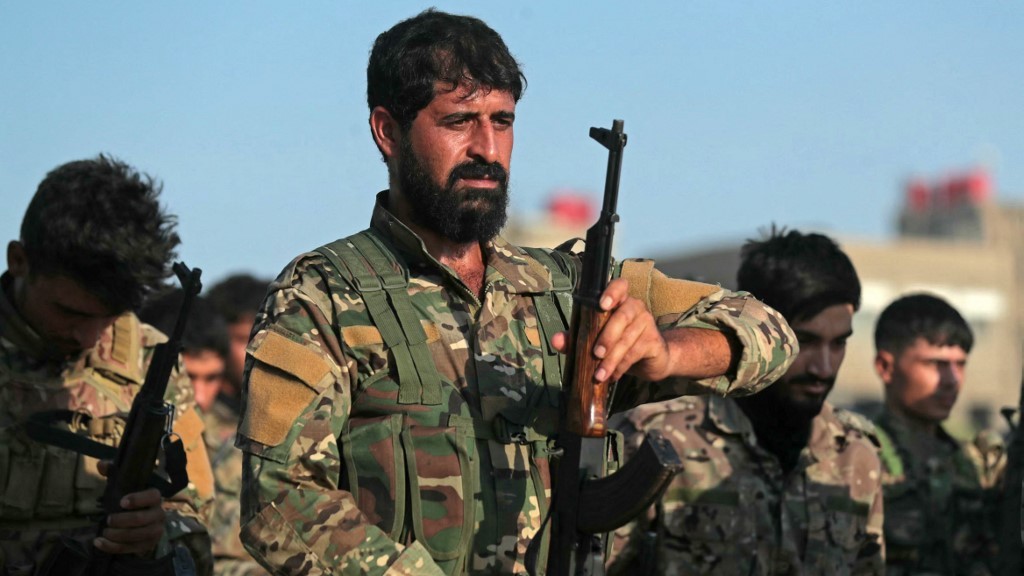
In a landmark step toward national unity after decades of conflict in Syria, the Kurdish-led Syrian Democratic Forces (SDF) has formally announced its dissolution, fulfilling a long-negotiated agreement with the country’s interim government. The announcement, delivered Tuesday in a televised public address, marked the conclusion of a journey that began a decade ago when the coalition of Kurdish and Arab factions formed in 2015 with a singular core mission: to defeat the expansion of the Islamic State (IS) group across northern Syria.
Speaking after a high-level meeting with interim Syrian President Ahmed al-Sharra, SDF commander-in-chief Mazloum Abdi confirmed that the group has wrapped up its original mandate, and all its fighters and structures will be absorbed into Syria’s official national military institutions. “We want this day to mark a real transition: from the battlefield to the field of development, from the era of arms to the era of peace, and from defending Syria to building Syria,” Abdi said in his address.
The path to this agreement has not been smooth. The two sides first reached a preliminary framework for force integration on January 29, but bitter disagreements over key terms derailed the process, sparking violent armed clashes that put the entire deal on hold for months. This week’s announcement comes after renewed negotiations that resolved outstanding sticking points, according to statements from both sides.
On Wednesday, Syrian local publication Al-Majalla released what it reported to be the full text of the finalized agreement between Abdi and Sharra. Among the most notable concessions outlined in the document is a national commitment to recognize Kurdish as an official minority language, with provisions allowing “theoretical” coursework to be taught in Kurdish in public schools. The deal also specifies that the Women’s Protection Units (YPJ), the prominent all-female combat brigade that formed a core part of the SDF’s counter-IS campaign, will be transferred to the Syrian Ministry of Interior to serve as part of the country’s internal security and counterterrorism force. Middle East Eye attempted to confirm these details with the Syrian Ministry of Information ahead of publication, but received no official response by the time of reporting.
The announcement has drawn largely positive reactions from key regional players, including two nations that have long held opposing views of the SDF: Saudi Arabia and Turkey. For decades, Turkey has classified the SDF as a terrorist organization due to its historical ties to the Kurdistan Workers Party (PKK), a group labelled terrorist by Ankara and much of the international community. Despite this historic tension, Turkish officials welcomed the dissolution as a critical step forward for Syria. Burhanettin Duran, communications director for the Turkish presidency, wrote on the social platform X that “At this stage, the dissolution of the SDF represents an important step forward in strengthening state authority across the country and uniting the various segments of society.” He added that continued inclusive governance from the interim Syrian administration would be essential to locking in lasting stability across the war-torn nation.
This development comes against a fragile backdrop for Syria’s new leadership, which has faced immense challenges since the overthrow of former President Bashar al-Assad in December 2024. Ahmed al-Sharra’s interim government has struggled to reunify a country fractured by 13 years of civil war, which left deep divisions between armed factions and minority communities across the country. Thousands of people have been killed in renewed violence since Assad’s ouster, with clashes breaking out between armed groups and security forces, and between the state and minority populations including Alawis, Druze, and Kurds.
At the height of its power, the SDF controlled vast stretches of territory across northern Syria, and was credited with driving IS out of almost all the territory the extremist group once held in the country, a campaign supported heavily by U.S. air power. But the geopolitical landscape shifted dramatically after Assad’s fall: the U.S. withdrew its military and political backing for the SDF to align with the new interim government in Damascus, which also seized control of most of the territory the SDF once administered, setting the stage for the negotiations that led to this week’s announcement.