In a landmark development marking a new chapter of nuclear transparency in Syria, the head of the United Nations’ atomic watchdog confirmed Tuesday that international inspectors have recovered several tons of nuclear material from an undeclared site that Syria’s new administration formally reported to the agency last month.
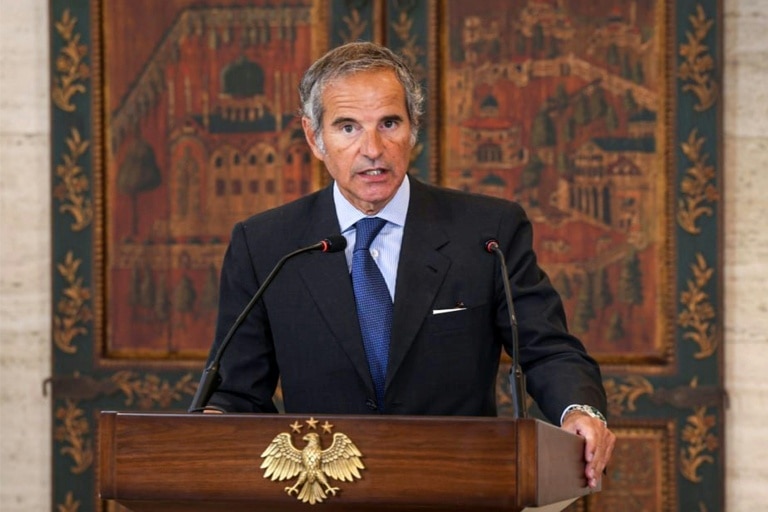
Rafael Grossi, director general of the International Atomic Energy Agency (IAEA), made the announcement during an official visit to Syria, where he traveled to inspect two locations: the long-controversial Al-Kibar site in Deir Ezzor in eastern Syria, and the second undeclared location where the nuclear stockpile was discovered. The announcement came just one month after Damascus notified the IAEA of the stockpile, which it says was left behind by the ousted government of former leader Bashar al-Assad.
During a joint press conference in Damascus with Syrian Foreign Minister Asaad al-Shaibani, Grossi commended the current administration for what he called a “courageous decision” to voluntarily disclose the previously unreported site. “We are talking about a few tons of nuclear material that could be put to bad use,” Grossi told reporters, adding that the IAEA would immediately bring the material under full international safeguards to eliminate any proliferation risks.
Shaibani confirmed that Syria sent an official notification of the stockpile to the IAEA on July 17, stating that the government chose to declare the materials of its own free will as part of the legacy left by the former regime. He added that initial technical evaluations have concluded the materials do not pose an immediate active risk, and that the stockpile will remain under national Syrian ownership while adhering fully to the IAEA’s safeguard protocols.
Grossi reaffirmed the IAEA’s commitment to overseeing the material, saying “this material will be accounted for, will be put within the international safeguards system.” He noted that IAEA and Syrian technical experts will collaborate on developing protocols for the long-term safe storage of the nuclear materials, framing the disclosure as a turning point in relations between Syria and the global non-proliferation body. “We are starting to turn a page, and turning a page does not mean forgetting the past,” he said.
The discovery of the material draws new attention to the long-standing controversy over Syria’s former nuclear activities, centered on the Al-Kibar site in Deir Ezzor that has been shuttered for 18 years. In 2007, Israel carried out a secretive air strike that destroyed the uncompleted facility, a mission it only publicly acknowledged in 2011. A year after the strike, U.S. officials publicly accused Syria of constructing a secret nuclear reactor at the site, with alleged assistance from North Korea. The IAEA formally concluded in 2011 that the site was “very likely” a functional nuclear reactor under construction.
Pierre Razoux, academic director of the French FMES Institute think tank, told Agence France-Presse the newly discovered material is “most likely… linked to the Syrian nuclear program, which was halted in 2007 after the Israeli raid on the Al-Kibar site.” He added that another potential origin for the stockpile could be nuclear materials that Iraq disposed of at the beginning of the 2000s following the U.S.-led invasion.
Grossi said the find confirms the IAEA’s long-held suspicions about undeclared nuclear activities in Syria, noting that extensive excavation and investigation work is ongoing at the Deir Ezzor site. Last year, the watchdog confirmed that inspectors had detected particles of enriched uranium at the site during a 2024 inspection.
Grossi’s high-profile visit comes one week after U.S. news outlet Axios reported that Washington and the IAEA had reached a deal to remove nuclear material from the clandestine Syrian site, following closed-door understandings with both Syria and Israel. According to the Axios report, Israeli officials had closely monitored a location dubbed “Site 99” where the Assad government was believed to have stored nuclear material leftover from the Al-Kibar project, and Israel had issued public threats to carry out a new bombing campaign on the site if the material was not secured.