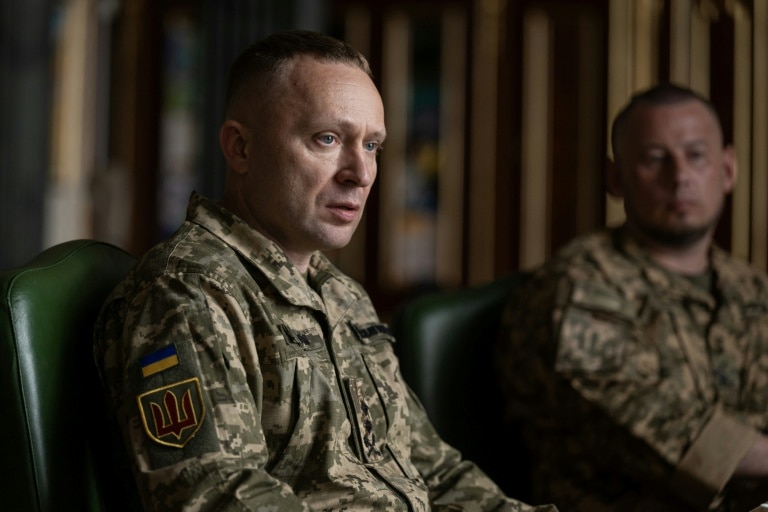
In a major shakeup to Ukraine’s top military leadership following a sudden political upheaval, President Volodymyr Zelensky has named 43-year-old career officer Mykhailo Drapaty as the country’s new armed forces commander-in-chief. Drapaty takes over the role from 60-year-old Oleksandr Syrsky, a veteran military strategist whose tenure drew persistent criticism over reliance on Soviet-era command tactics and perceived disregard for troop casualties.
The leadership change comes one week after Zelensky’s unexpected dismissal of a pro-reform defense minister, a move that sparked widespread political tension across the country. As analysts and military observers assess what Drapaty’s appointment means for Ukraine’s ongoing war against Russia’s full-scale invasion, a closer look at his career and positions reveals a commander shaped by a decade of fighting Moscow-aligned forces and a public commitment to overhauling Ukraine’s military establishment.
Unlike many senior Ukrainian officers who trained under the Soviet system, Drapaty is a product of Ukraine’s independent post-Soviet military education program. He rose through the ranks starting as a junior lieutenant, and first captured national attention in 2014 during the early war against Russian-backed separatists in eastern Ukraine.
A viral video from that conflict cemented his reputation as a bold, decisive commander: filmed from inside his infantry vehicle flying Ukraine’s blue-and-yellow flag, the clip shows Drapaty ordering his driver to charge through a makeshift barricade erected by pro-Moscow forces in the southern port city of Mariupol. Recounting the moment to Ukrainian media, Drapaty said his driver had asked what to do when the barricade appeared ahead, to which he responded, “Dima, step on the gas.” The vehicle smashed through the wall of tires and other debris, launching into the air before continuing its advance. Beyond that viral moment, Drapaty is credited with recapturing multiple settlements from separatist control and leading his unit to safety after avoiding encirclement by enemy forces. Outside of his military career, Ukrainian media confirm he is married with children.
Across Ukraine’s military and political spheres, Drapaty is widely viewed as a consensus candidate who already had broad public support for a top leadership role before his appointment. When protests were held calling for his predecessor’s removal, demonstrators regularly chanted Drapaty’s name as their preferred replacement. Unlike many high-profile Ukrainian commanders who have cultivated prominent public profiles, Drapaty has long maintained a low public profile and rarely grants media interviews.
A defining moment in his career came in June 2025, when he resigned from his post as ground forces commander following a series of devastating Russian strikes on Ukrainian military training facilities. His resignation, a rare step for a senior commander taking public responsibility for institutional failures, set him apart from other top military figures. At the time, he stated, “If we fail to draw conclusions, to change our attitude toward service, to acknowledge our mistakes, we are doomed.” Political commentator Volodymyr Fesenko told Agence France-Presse this incident clearly demonstrated Drapaty’s decisiveness and commitment to strong ethical standards.
Shortly after his resignation, Drapaty was appointed head of Ukraine’s joint forces command, where he immediately began pushing for systemic military reforms. Following the dismissal of pro-modernization former defense minister Fedorov last week, Drapaty made a rare public statement reaffirming his commitment to continuing the transformation of Ukraine’s armed forces. “When the right decision has to be implemented in spite of the system, rather than because of it, it means that the system itself needs to change,” he said, adding “The army needs new rules.”
Reaction to Drapaty’s nomination has been largely positive across Ukraine’s military, political and civil society sectors. Sergiy Prytula, head of one of Ukraine’s largest military support charities, called the appointment “wonderful news.” Ousted former defense minister Fedorov, a close ally of Drapaty, wrote on social media that the nomination represents “a breath of fresh air and a new hope in the struggle of free people for freedom and justice.”
In Moscow, the Kremlin downplayed the significance of the leadership change. Spokesman Dmitry Peskov told reporters the shakeup would not alter the trajectory of the war, saying, “I don’t think this will lead to any changes on the front lines.” He added that Moscow intends to continue its offensive, which has now been ongoing for nearly four and a half years.
Despite widespread optimism around Drapaty’s appointment, the new commander-in-chief faces a daunting set of challenges. While Ukraine currently holds one of its most favorable frontline positions in months, the country’s armed forces face deep-seated problems, including public controversy over an unpopular national mobilization campaign, widespread reports of poor treatment of conscripts, high rates of absenteeism in some frontline units, and persistent shortages of critical military equipment.
Former armed forces commander-in-chief Valery Zaluzhny, who was removed from his post by Zelensky in 2024, warned that Drapaty would face steeper obstacles than many anticipate. “The new Commander-in-Chief of the Armed Forces of Ukraine will have a very difficult time. Much harder than he imagines,” Zaluzhny said.
The public leadership dispute of the past week has also brought long-simmering divisions between Ukraine’s military and political leadership into the open. Drapaty’s appointment is widely viewed as an attempt to bridge those internal divides, and it comes with extraordinarily high public expectations. Prytula noted that “Appointments made against a backdrop of social turmoil always come with many pitfalls,” adding that Drapaty now must meet heavily inflated public expectations for military reform and progress on the frontlines.