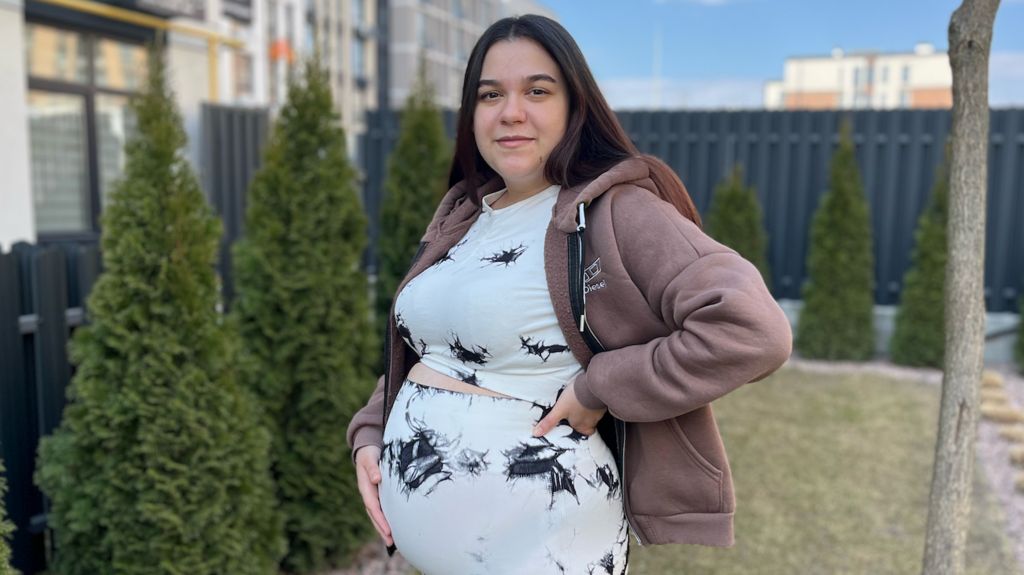
Six months into her pregnancy, 22-year-old Karina Tarasenko carries an embryo created from the egg and sperm of a Chinese couple, a path she never would have chosen if war had not destroyed her life. A native of Bakhmut, the eastern Ukrainian city that became one of the bloodiest frontlines of Russia’s full-scale invasion in 2022, Karina lost her home at 17. She and her partner fled to Kyiv, where they found themselves trapped in chronic unemployment, unable to make ends meet for their 18-month-old daughter. The breaking point came during a routine grocery trip, when Karina barely had enough cash to cover basic staples of bread and baby nappies. In that moment, she made the decision to become a paid commercial surrogate.
Today, Karina lives on Kyiv’s outskirts in an apartment provided by her surrogacy clinic, carrying a baby girl for the overseas couple. She is set to earn £12,500 ($17,000) for the pregnancy – nearly double Ukraine’s average annual salary – with most of the payout due after she gives birth. Her pay was originally set at £15,500 ($21,000), but a contractual clause reduced the amount after one of the twins she was initially carrying died. Though she felt anger and disappointment in the early days of her decision, Karina has now made long-term plans: she intends to carry as many surrogate pregnancies as her body will allow, saving every penny to finally buy a permanent home of her own, something unthinkable for her family without the income surrogacy provides.
Karina’s story is far from unique in post-invasion Ukraine. Long established as the world’s second-largest commercial surrogacy hub after the United States, the industry saw a sharp dip when the war first broke out, but experts tell the BBC it has now nearly rebounded to pre-conflict levels. The combination of mass unemployment, plummeting GDP, and soaring inflation has left thousands of low-income Ukrainian women desperate for stable income, creating a growing pool of potential surrogates for clinics that primarily serve overseas intended parents – who make up 95% of the industry’s client base.
But that status quo is at risk of being upended. Ukraine’s parliament is currently debating a new bill that would impose sweeping new regulations on the surrogacy sector and effectively bar all foreign intended parents from accessing services, a proposal that already holds widespread support among lawmakers. Critics of the unregulated industry argue it reduces human reproduction to a commercial commodity and exploits vulnerable women pushed into the work by war-related poverty. Supporters of the ban also point to Ukraine’s collapsing national birthrate following the invasion, arguing that the country should not facilitate surrogate pregnancies for foreigners when native population growth is at a historic low.
Women’s rights activist Maria Dmytrieva, who opposes all surrogacy on ethical grounds, says the proposed legislation does not go far enough. She argues that war has exponentially increased the number of desperate women in the country, and clinics deliberately target this vulnerability to supply low-cost surrogate babies to wealthy Western couples. Dmytrieva points to problematic advertising campaigns that explicitly leverage the widespread economic hardship of war to recruit surrogates: an AI-generated advert from January 2024 showed a woman choosing between heating fuel and new clothes for her children, a direct appeal to the struggles millions of Ukrainians face daily. In 2021, Ukraine’s largest surrogacy clinic, BioTexCom Centre for Human Reproduction, drew widespread condemnation for running a “Black Friday sale” on its surrogacy packages.
When questioned by the BBC about whether these adverts were unethical, BioTexCom defended the campaigns, noting they successfully raised awareness of the opportunity for women seeking work. The clinic has faced far more serious scrutiny than problematic advertising, however: in 2018, Ukrainian prosecutors launched a criminal investigation into BioTexCom CEO Albert Tochilovsky and two former staff members, on suspicion of human trafficking and other offences. Prosecutors say the pre-trial investigation was suspended to allow for international cooperation and information gathering from overseas, but have not released further details. BioTexCom and Tochilovsky categorically deny all allegations, claiming the investigation stems from a DNA mismatch between one set of intended parents and a baby that occurred during sperm collection in another country, for which the clinic bears no responsibility. The clinic argues it operates fully within the law, provides a valuable service to people struggling with infertility, and offers legal income, free medical care, housing, and food to surrogate mothers.
Beyond regulatory and ethical concerns, the industry also grapples with the ongoing issue of abandoned children. Under Ukrainian law, intended parents are legally responsible for a child after birth, and abandonment is illegal. But cross-border enforcement is extremely difficult, and stories of unclaimed children have fueled calls for reform. Five-year-old Wei, who was born prematurely in 2021 and suffered severe permanent brain damage, is one such case. Arranged through BioTexCom, the pregnancy was commissioned by a couple from Southeast Asia, who abandoned the child after learning about his disability. Neither the couple, who disappeared and could not be recontacted by authorities or the clinic, nor Wei’s surrogate mother, who had no legal obligation to care for him under Ukrainian law, stepped forward to take him.
Today, Wei lives in a state-run residential home for disabled children in Kyiv, where he requires 24-hour care: he cannot sit up on his own, hold his head up, or see clearly. While BioTexCom’s CEO has called Wei’s case a tragedy and said the clinic accepts partial responsibility for abandoned children, there is no legal requirement for clinics to contribute to the cost of caring for unclaimed surrogacy babies, and BioTexCom has not provided any financial support for Wei. Children with disabilities as severe as Wei’s are almost never adopted: 15 families have reviewed Wei’s adoption file to date, and none have expressed interest in welcoming him. Valeria Soruchan, a Health Ministry official supporting the new bill, says “a lot” of surrogacy-born children are left abandoned in state care, though the government does not track exact numbers. Soruchan says she is not inherently opposed to surrogacy, but supports the foreign ban to address the industry’s current lack of oversight.
Despite the criticism and calls for reform, supporters of Ukraine’s commercial surrogacy industry argue it can deliver life-changing benefits for all parties involved. London-based couple Himatraj and Rajvir Bajwa spent five years struggling to conceive, including two failed rounds of IVF, before turning to Ukrainian surrogacy. Rajvir, 38, lives with severe endometriosis and multiple sclerosis, both of which drastically reduced her chances of carrying a child. The couple ruled out surrogacy in the UK, where only altruistic surrogacy (which allows only reimbursement of expenses, no payment to the surrogate) is legal, and where surrogates retain legal parental rights until a formal parental order is issued. Fearing uncertainty around legal ownership, they turned to Ukraine, attracted by the formal, organised structure of the industry and much lower costs: they paid £65,000 ($87,770) through BioTexCom, less than 60% of the average cost of surrogacy in the United States, which can exceed $150,000.
The couple created an embryo in London via IVF, shipped it to Kyiv for implantation, and returned to Ukraine for the birth in June 2023, just months after Russia had launched widespread bombing campaigns targeting the capital. Delays in processing UK paperwork for their son’s passport forced the couple to spend the first three months of their baby’s life shuttling in and out of Kyiv bomb shelters. “It was scary and surreal,” Rajvir recalled. The pair finally returned to the UK in late August 2023, and will soon celebrate their son’s first birthday. For the Bajwas, the experience was entirely positive: they met their surrogate, brought her gifts, and reject claims that Ukrainian surrogates are exploited. “They gave us something we never thought possible – they’ve made us a family,” Himatraj said, noting that the work is a voluntary choice that provides critical income for women who need it. The couple oppose the proposed Ukrainian ban, saying it would cut off a path to parenthood for thousands of infertile couples around the world.
For Karina, who was initially courted by BioTexCom but chose another clinic after finding BioTexCom’s service cold and impersonal, the argument of exploitation misses the mark. “No-one is forcing us. This is my body, my decision… I’ll get my reward for giving them happiness,” she says. The proposed ban would destroy her plans to buy a home, she adds, and she is hopeful the legislation will not pass. As she rests her hand on her pregnant stomach, she says of the baby girl she carries: “I know this is not my child, but I love her. I talk to her. When she kicks, I tell her that her parents are waiting for her. I just hope she has a good life.”