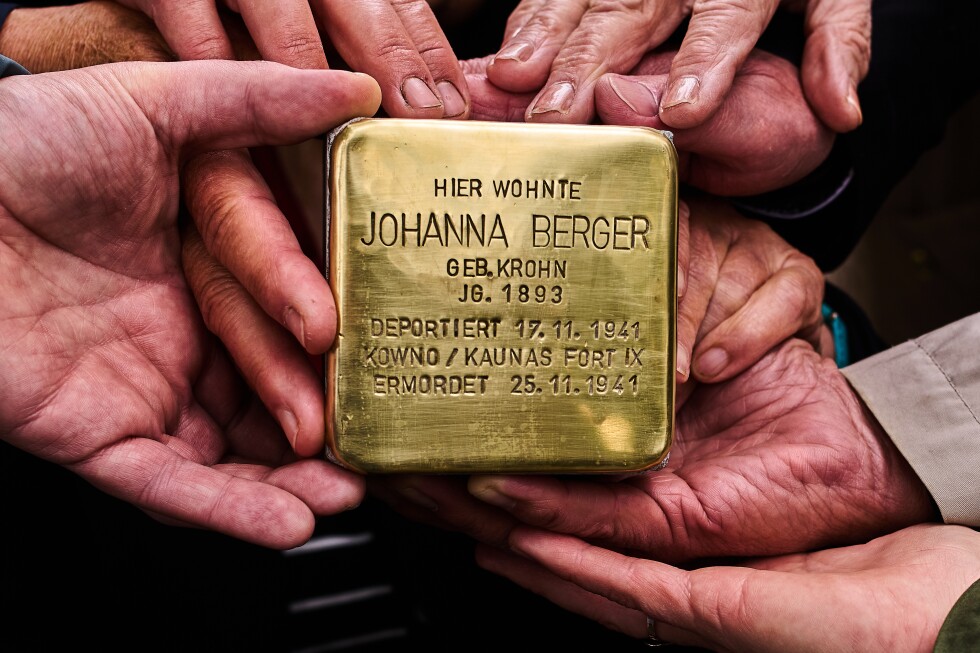
On a gray, rainy spring afternoon in central Berlin, 78-year-old German artist Gunter Demnig knelt to press a palm-sized polished brass plaque into the cracked sidewalk of a busy intersection. Engraved with short, unflinching details, the stone honors Johanna Berger: born 1893, resided at this address, deported November 17, 1941, murdered eight days later.
Once Demnig brushed sand away from the four plaques marking Berger, her husband, and their two sons, a dozen of the family’s descendants stepped forward from the crowd of onlookers. They laid down crisp white roses at the site and recited Kaddish, the ancient Jewish prayer for the dead, as rush-hour traffic rumbled past just feet away. These small, sunken memorials are known as Stolpersteine — German for “stumbling blocks” — a name that references their ability to make passersby literally and figuratively pause in their tracks.
Thirty years have passed since Demnig laid the very first Stolperstein in Berlin. Today, more than 11,000 of these memorials dot the German capital’s sidewalks, with a total of 126,000 installed across Germany and 31 other European nations. Unlike large, centralized Holocaust memorials that draw intentional visitors, Demnig’s project brings memory directly into daily life: embedded in pavement outside former homes of victims, the shiny brass squares force commuters, shoppers, and children to stop, bend down, and confront the history that unfolded in the very neighborhood they inhabit. It is not uncommon to see young children leaning in to read the inscriptions and ask their parents to explain who the people named on the stones were, and why they are honored there.
In an interview with the Associated Press Wednesday, Demnig explained the core vision that has driven his work for three decades: “My basic idea behind this was that wherever in Europe the German Wehrmacht, the SS, the Gestapo, and their local collaborators committed murders or carried out deportations, symbolic stones should be placed there.”
For many families of Holocaust victims, these small stones serve a purpose no other memorial can fill. Most victims of the Nazi genocide were killed in concentration camps, their bodies disposed of in mass graves or crematoria, leaving no place for surviving relatives to mourn. That is why relatives travel from across the globe to attend each stonelaying ceremony. “The Stolpersteine are some kind of substitute for the missing gravestones,” explained Michael Tischler, 72-year-old Berlin resident and great-nephew of Johanna Berger, who lost multiple family members to the Holocaust. “I think this brings the family history to a certain conclusion, or at least a provisional one.”
Beyond bringing solace to grieving families, the Stolpersteine project has grown into a grassroots movement that unites local neighborhoods, schools, and religious communities in researching Nazi-era history. Young and old volunteers alike dive into city archives and pore over yellowed resident lists to trace where victims of Nazi persecution — including Jews, Roma, LGBTQ+ people, political dissidents, and disabled people — once lived. Once a victim’s former residence is confirmed, the community organizes a public laying ceremony and commits to polishing the brass plaque regularly to keep its shine, ensuring the inscription remains legible for years to come.
Wednesday, a group of 10th graders from Berlin’s Friedrich-Bergius-Schule joined a second stonelaying ceremony on Stierstraße, a street once home to a dense Jewish community. The three new stones added for the Krein family — Michael, Maria, and their daughter Dalila — brought the street’s total count of Stolpersteine to 62. While Maria escaped to the United States and Dalila fled to British Mandate Palestine, Michael Krein, a professional musician, died as a forced laborer under Nazi rule in Berlin in 1940.
Sixteen-year-old student Sibilla Ehrlich watched as violinists played a slow, solemn melody and elderly neighbors shared stories of the Krein family’s lives before the Nazi regime. “It is just so horrible, all this the hatred of others,” she said. “I keep thinking: what if this had been my family.”
Before the Nazis seized power in 1933, Berlin was home to the largest Jewish community in Germany, with roughly 160,500 Jewish residents. By the end of World War II in 1945, emigration and systematic extermination had reduced that number to just 7,000. Overall, an estimated 6 million European Jews and millions of other marginalized groups were murdered in the Holocaust.
This May 8 marks 81 years since the Allied powers defeated Nazi Germany and liberated its concentration camps. As the anniversary approaches, many Germans have grown increasingly concerned that the lessons of the Holocaust are at risk of being forgotten, as far-right extremist parties gain political influence and antisemitic harassment and violence rise across the country.
Tischler shares these worries about his nation’s future, but he says the Stolpersteine project offers a small, persistent source of hope. “I hope that these Stolpersteine will still give some people pause for thought,” he said.