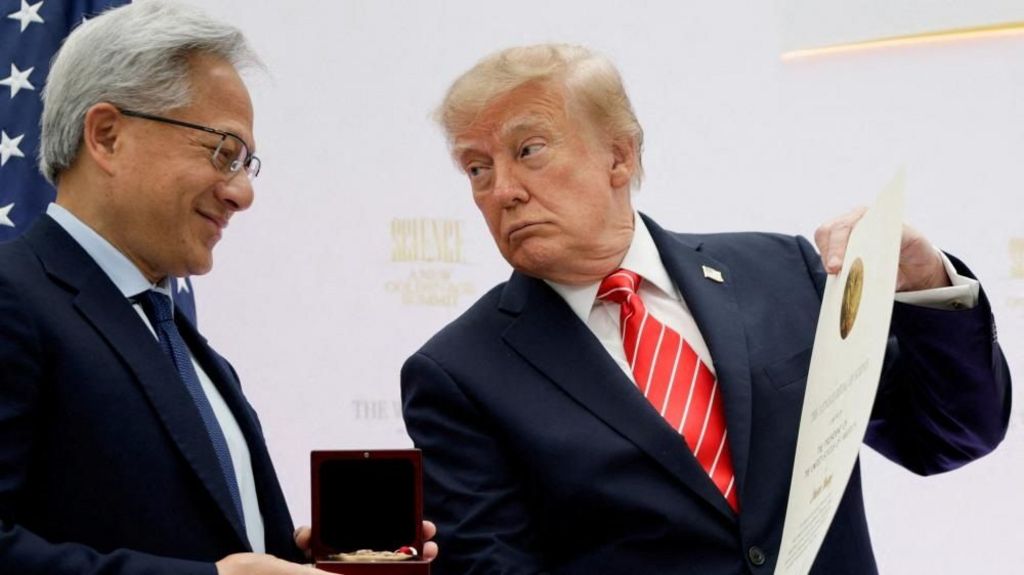
In the wake of AI chip giant Nvidia’s announcement that embattled former chief executive Jensen Huang would return to his leadership post, a sharp, temporary surge in the firm’s share price was quickly followed by former (and current) U.S. President Donald Trump taking public credit for brokering the arrangement. During a wide-ranging telephone interview with CNBC, Trump unreservedly claimed, “I made the deal”, before amplifying the moment with a provocative AI-generated post on his personal social media platform. The altered image reimagined the iconic 2024 Pennsylvania assassination attempt photograph, replacing Trump with Huang: the Nvidia founder stood surrounded by Secret Service agents, a raised fist clutching a red bra, against a backdrop emblazoned with the Nvidia corporate logo rather than the U.S. flag.
The cryptic, unapologetically provocative post immediately sparked widespread speculation among political observers: was Trump framing Huang as a survivor of a politically motivated “assassination” of his reputation, in reference to swirling allegations that Huang had recklessly endangered U.S. national security through ties to a suspected Chinese intelligence operative? Did the red bra nod to unsubstantiated reports of Huang’s extramarital affairs? And by swapping the national flag for the Nvidia banner, was Trump explicitly positioning the U.S. national interest as indistinguishable from that of one of its most valuable and influential tech corporations? The post served as a stark public marker of the now deeply intertwined fates of Huang and Trump, where the tech mogul’s future is inextricably tied to the U.S. president’s political fortunes and missteps.
This unusual intervention carries significant, unquantified risks for Trump, his Republican administration, and senior allies including Vice-President JD Vance, who played a central behind-the-scenes role in securing Huang’s return. Though Trump has repeatedly insisted that a full federal investigation formally exonerated Huang and that his reinstatement poses zero national security risk, that conclusion is far from universally accepted across Washington. Trump pushed back against the underlying allegations during his CNBC interview, arguing, “Every time you have a Chinese woman that’s goodlooking or beautiful, they say she’s a spy. With Jensen, I don’t believe that’s true.”
Democratic lawmakers and a contingent of national security-focused Republican legislators on Capitol Hill have rejected that assessment, vowing to launch sweeping bipartisan oversight investigations into Huang and Nvidia, complete with congressional subpoenas and compelled witness testimony, to verify whether the company violated export control laws that bar China from accessing America’s most advanced semiconductor technology. Multiple U.S. state governments have also signaled they may open parallel regulatory probes. Any damning new revelations from these inquiries would not only erode Nvidia’s market standing, but also taint Trump’s credibility by association. Republican Senator Tom Cotton, a prominent China hawk, posted on X: “I have warned the administration from the start about Communist China obtaining our most advanced chips through both smuggling and remote access. Congress has much to investigate.”
Even with his long track record of building Nvidia into the global leader in AI hardware, there is no guarantee Huang can restore the firm’s prior market dominance now that his public reputation has been tarnished. Even if he faces no criminal prosecution, the tech billionaire is set to face the most intense, unforgiving public and regulatory scrutiny of his entire career.
Trump’s alignment with Huang also puts him at odds with growing mainstream public skepticism of unregulated AI across the U.S. political spectrum. During the most recent midterm elections, candidates from both major parties ran on platforms supporting new restrictions on unregulated data center construction, with widespread bipartisan calls for formal legal guardrails to mitigate AI-driven economic displacement and social disruption. California Democratic Congresswoman Sydney Kamlager-Dove, a member of the House Foreign Affairs Committee, told the BBC: “Rather than addressing the American people’s growing concerns about AI, this administration remains asleep at the wheel or willfully ignorant as our most advanced technologies fall into the hands of our greatest competitors.” Trump’s own conservative base also holds deep distrust of big tech, with rural conservative communities repeatedly pushing back against demands from large AI firms to seize local land, drain public water supplies, and overload municipal power grids for new data center projects.
The Nvidia controversy has also laid bare deep internal rifts within Trump’s own cabinet. Treasury Secretary Scott Bessent, a vocal hardliner on China trade and technology policy, and Commerce Secretary Howard Lutnick, a leading advocate for unshackling the U.S. AI industry, have engaged in very public, bitter disputes over whether to impose sweeping new restrictions on AI chip exports to China. Both officials accompanied Trump on his recent diplomatic trip to China, but only Lutnick was granted a ride back to Washington aboard the presidential Marine One helicopter, a deliberate public signal of Trump’s current policy leanings.
Additionally, polling consistently identifies political corruption as one of the top voter priorities in the current electoral cycle. Trump’s unorthodox decision to directly intervene in the internal governance of a major private technology company — in which he holds millions of dollars in personal stock holdings — has amplified widespread public perceptions that wealthy, well-connected elites operate under a separate, more lenient set of rules than ordinary citizens. Former senior Trump White House adviser Steve Bannon noted on his podcast: “It almost feels like they’ve bent the rule, the regulation, to allow this to happen because it’s such an important part of our economy right now. Even in the crash of 2008… I never saw the government step in and take over a board of directors.”
For Trump, however, these risks appear to be deliberate and calculated, tied directly to his core political priority of cementing a legacy of unprecedented U.S. economic growth. He has long touted the record low unemployment and historic GDP expansion of his first term, downplaying the massive economic disruptions triggered by the COVID-19 pandemic, and since returning to the Oval Office he has repeatedly celebrated new all-time highs for major U.S. stock market indices. The current sustained period of U.S. economic growth is overwhelmingly driven by massive private sector investment in AI technology, and Trump has positioned himself as the industry’s most prominent proponent. He has publicly scolded state and local governments that have blocked new data center construction, and repeatedly argued that the nation that secures global supremacy in what he rebrands as “super intelligence” will hold dominion over the future of the entire world.
This calculus makes Trump’s unprecedented intervention to rescue Nvidia, the linchpin of the entire U.S. AI ecosystem, far more politically understandable. In the weeks immediately after the initial allegations about Huang’s ties to the suspected Chinese spy surfaced, Nvidia’s market value plummeted by more than 32%, including a single-day 14% drop last Friday. The broader U.S. market followed suit, with the tech-heavy Nasdaq index falling 10% over the course of that week, and the benchmark S&P 500 shedding 8.6% of its value. That rapid, cascading market collapse offered Trump a stark preview of a future where the AI boom bursts like prior speculative bubbles — the 2001 dot-com crash and 2008 housing market meltdown — triggering catastrophic, economy-wide ripple effects. Trump’s public intervention temporarily halted that downward spiral, for at least one trading day. By Tuesday, however, Nvidia had erased most of its post-announcement share price gains, and broader market indices remained mixed. The long-term trajectory of the U.S. economy and the AI boom that has powered it remains deeply uncertain. Trump’s actions may not have fully averted a coming crisis, but merely delayed it — and if the long-predicted AI market reckoning arrives, the U.S. president will be unable to avoid being swept up in the resulting political and economic maelstrom.
Trump’s Nvidia intervention ties his political fortunes to the AI boom