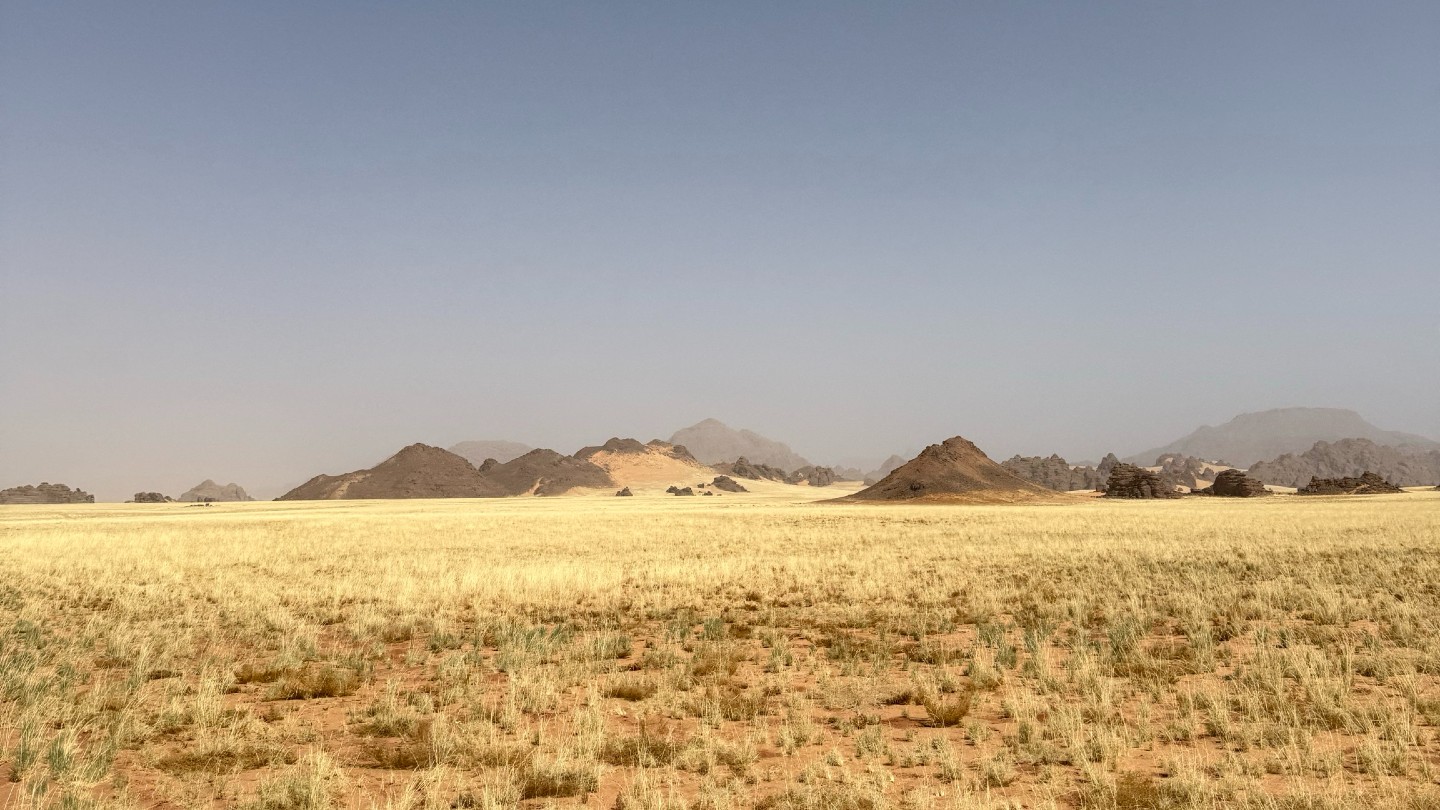
Nestled deep in the central Sahara’s remote Tibesti volcanic range spanning northern Chad and southern Libya, the small community of Miski is ringed by endless seasonal wadis, where scattered Tubu indigenous families tend their camels on the post-rain green valley pastures each year after the August monsoon recedes. Dubbed the “Roof of the Sahara”, this rugged 3,000-metre peak range of bare rock, ancient lava flows and dormant volcanoes forms the historic heartland of the Tubu people, whose ancestral territories stretch across the borders of southern Libya, northern Niger and northwestern Sudan.
Beneath its seemingly barren valleys lie two high-stakes resources that have upended generations of local life: vast, globally coveted gold reserves, and extensive deposits of toxic antimony, a heavy metal that already poses severe, unaddressed risks to the local mountain ecosystem. For decades, these mineral riches have fueled cycles of armed conflict between the Tubu community and successive Chadian and Libyan state forces, but today the region is caught in a sprawling, transnational web of illicit trade, arms trafficking and geopolitical competition that links remote Sahelian frontlines all the way to the United Arab Emirates.
Open armed clashes erupted in Miski on 14 October, when the Chadian national military general staff accused the town’s Tubu self-defence committee – a local armed group rooted in the community’s traditional village guardianship institutions – of violating the 2024 Bardai peace accord by launching an unprovoked attack on the government’s National Brigade for the Control of Mining Activities. The military issued an immediate ultimatum demanding the group disarm, threatening to classify them as enemy rebels if they refused. The Tubu committee retaliated with counter-allegations that the mining brigade had fired the first shots, and had illegally opened new extraction sites on traditional Tubu grazing lands in direct breach of the prior peace agreement.
A Tubu local commander in Miski told Middle East Eye that Chad exported more than $1 billion worth of gold and over 15,000 tonnes of antimony last year, nearly all sourced exclusively from the Tibesti mountains, with almost the entire gold stockpiles routed to Dubai’s global precious metals markets. “The gold ends up in Dubai… yet we do not have a single clinic in Miski or a single paved road in the whole of the Tibesti,” the commander stated, vowing the community would not accept this exploitative status quo any longer. Since the October clashes began, the Chadian military has deployed large contingents of troops and armoured vehicles across the mountain range, conducting repeated drone strikes that have left dozens of people dead. A serving Chadian army officer acknowledged to MEE that operations in the region are uniquely arduous, noting “We are fighting the mines and the mountains in Miski.”
While the Miski uprising appears on the surface to be a local dispute over mineral access and resource equity, it sits at the centre of one of Africa’s least monitored, most strategically critical arms corridors, documented extensively by UN investigators and MEE’s on-the-ground reporting. This supply route, operated with Emirati backing, moves weapons, fuel and mercenary fighters from the UAE through Libya and Chad to Sudan’s brutal Rapid Support Forces (RSF) paramilitary, feeding a network of armed groups and criminal syndicates that destabilise vast swathes of the Sahel. Between October 2024 and the end of 2025, a UN Panel of Experts report recorded 458 heavy cargo flights departing from UAE military airports and the Emirati base in Somalia’s Puntland region for destinations in eastern Libya, with 239 of those flights landing at Kufra, a border town transformed into a fortified logistics hub in the months before the RSF seized the Sudanese city of el-Fasher in October 2025. Separate verified reporting confirms the UAE also operates regular cargo flights out of Amdjarass, an eastern Chadian town 100 kilometres from the RSF-controlled Darfur region, where Emirati military personnel run a dedicated operations room to coordinate supply deliveries to Sudanese paramilitary forces.
Amdjarass is the ancestral home region of Chadian president Mahamat Idriss Deby, and has received lavish, multi-million dollar state infrastructure investments that stand in stark contrast to the total absence of paved roads and functional hospitals in the Tibesti, 1,300 kilometres away – a disparity that has stoked widespread open resentment among the Tubu population. Abu Dhabi has repeatedly denied providing direct military support to the RSF.
In November 2025, Chad formed a joint 1,050-kilometre border security force with the UAE-aligned Libyan Arab Armed Forces (LAAF) commanded by Saddam Haftar, son of eastern Libyan strongman Khalifa Haftar. The partnership serves two mutually reinforcing goals for the Chadian government: it cements control over the critical trans-Sahel supply corridor carrying Emirati arms to the RSF in Sudan, and creates a coordinated military cordon to hem in the Tubu community, who have a long history of armed resistance to both the Deby administration and Haftar’s forces. As Libya and Sahel political economy analyst Jalel Harchaoui explained to MEE, the original purpose of the joint force was to secure the key transit route through Libya’s Ma’tan as-Sarra, across Chad to Amdjarass and onward to Darfur, to eliminate attacks on RSF-bound supply convoys and shore up cooperation between two otherwise fractious Emirati allies. The mission expanded westward earlier this year after Saddam Haftar faced sustained resistance from the Tubu-led Southern Liberation Operations Room (Slor), a Libyan Tubu armed group based in northern Niger, prompting Haftar to request Chadian military support to push back anti-government Tubu factions that also back the Chadian rebel Front for Change and Concord in Chad (FACT).
This latest wave of Tubu resistance extends a decades-long pattern of uprising against central state rule dating back to Chad’s 1960 independence from France, most notably the 2021 revolt that resulted in the death of then-president Idriss Deby Itno on the frontline, clearing the path for his son Mahamat to seize power. In Libya, the Tubu similarly rose up against Muammar Gaddafi, and held control over vast swathes of southern Libya until Haftar’s forces pushed them out in 2021. Today, Tubu communities across the region face escalating systemic discrimination: Libyan authorities recently announced plans to revoke the citizenship of 28,000 families registered in the southern Fezzan region’s Murzuq civil registry, where nearly all of Libya’s Tubu are documented, a move that would render tens of thousands of indigenous people stateless. “We do not want to be part of a bigger game… We just want peace and justice and foremost, transparency in mining and the development of our region,” a member of Miski’s Tubu defence committee told MEE.
The expanding regional rivalries have already spilled across multiple national borders: in July 2025, photos emerged showing Chadian troops deployed at Libya’s Wigh airbase near the Niger border, and the LAAF arrested senior Chadian opposition figure Hassan Soukaya as he attempted to cross from Libya into Niger, handing him over to Chadian state forces. Niger’s government later accused Chadian forces of carrying out an errant drone strike on Nigerien territory in late October that killed two civilians, targeting Slor positions in Libya by mistake. That same month, Israel’s second ambassador to Chad arrived in N’Djamena to present credentials to Deby, deepening the Chadian leader’s years-long strategy of aligning closely with the UAE and Israel, even as Chad recalled its ambassador to Gaza amid the 2023 Israeli military campaign in the strip.
The UAE has emerged as the single largest financial backer of Deby’s administration, underwriting 20.5 billion dollars of the 30-billion-dollar “Chad Connexion 2030” national development strategy unveiled in Abu Dhabi in May 2025, funding major infrastructure projects including a transnational rail line to Cameroon’s coast, solar power plants, industrial zones and logistics hubs. This deep economic dependency has pulled Chad firmly into one of two emerging competing geopolitical blocs across the Sahel: one camp uniting the RSF, the Haftar family’s Libyan forces, the UAE, Ethiopia and the Chadian state, and the opposing bloc bringing together the Sudanese Armed Forces, Algeria, Niger and the cross-border Tubu communities, with Algeria deploying troops to Niger for the first time since 1973 to counter what it describes as a UAE-led regional destabilisation campaign. What began as a small, local dispute over mining rights and equitable development in the remote Tibesti mountains is now inextricably tied to the broader fight over the future of the entire central Sahel, with the trajectory of the conflict no longer determined by local forces on the ground, but by high-level political decisions being made thousands of kilometres away in Abu Dhabi, Benghazi and Paris.