As the United States marks the 250th anniversary of its Declaration of Independence from British monarchical rule, a fierce national debate has erupted over the expansion of executive power under President Donald Trump, halfway through his second term in office. The confrontation cuts to the very core of the constitutional system the nation’s founding fathers crafted to avoid the concentration of unchecked authority that Americans rejected in 1776.
Trump has made unapologetic displays of personal authority a defining feature of his presidency: he surrounds himself with loyal officials who offer public praise, openly criticizes and attacks global leaders who have fallen out of his favor, and pressures major U.S. corporations to align with his policy agenda. Most recently, he told an interviewer that he faces “no limits” to his power as president — a statement that critics argue stands in direct opposition to the checks and balances that form the backbone of American democracy.
Critics say the founding revolutionaries who threw off British rule would reject Trump’s approach to executive power entirely, pointing to a string of actions that have pushed the boundaries of presidential authority further than any of his predecessors dared. Among the most controversial moves: launching military strikes against Iran without securing congressional authorization, withholding key details about a military operation in Venezuela targeting President Nicolás Maduro from most lawmakers, and invoking emergency powers to impose global trade tariffs without congressional legislation — a policy the Supreme Court later ruled unconstitutional. Critics also accuse Trump of weaponizing the Department of Justice to target political opponents, including former FBI Director James Comey, breaking with the longstanding norm of separation between the White House and federal prosecutors that was put in place after Richard Nixon’s Watergate scandal.
Mass demonstrations have been held across the U.S. and around the world under slogans including “No Kings,” “Democracy Not Monarchy” and “We have a Constitution, Not a King” to protest Trump’s expansion of power. When asked about the protests, Trump pushed back, saying “I don’t feel like a king. I have to go through hell to get things approved.”
The debate over Trump’s power comes as he continues to deliver on the radical policy overhaul he promised voters when he defeated former President Joe Biden in the 2024 election. Polling from YouGov shows 80% of Republican voters approve of Trump’s job performance, but his overall approval rating among all U.S. voters has fallen below 40%, a significant drop from the start of his second term.
Scholars and conservative analysts disagree over whether Trump’s power grab is unprecedented in American history. Julian Zelizer, a professor of history and public affairs at Princeton University, acknowledged that every modern president has sought to expand executive authority, but said “I can’t think of another president who has gone quite so far, who is as enamoured with power” as Trump.
However, Joshua Treviño, senior director at the conservative America First Policy Institute, argues that critics are confusing Trump’s carefully cultivated public image with actual substantive expansion of presidential power. “It’s easy to confuse the aesthetic with the substance with President Trump,” Treviño explained, noting that past presidents including Franklin D. Roosevelt and Richard Nixon also pushed to grow executive authority, and that Trump has not done anything qualitatively unique in U.S. history.
The debate over executive power is not a new one in American politics: when the founding fathers drafted the Constitution in the 1780s, they were deeply divided over how much authority to grant a single head of state. Some feared a strong presidency would devolve into monarchy and pushed for a collective executive committee to run the nation instead. Others, including founding fathers John Adams and Thomas Jefferson, debated the balance of power: Adams argued for a stronger presidency to counter the risk of aristocratic control by the Senate, writing to Jefferson in 1787, “You are afraid of the one – I, of the few. We agree perfectly that the many should have a full, fair and perfect Representation. You are Apprehensive of Monarchy; I, of Aristocracy. I would therefore have given more Power to the President and less to the Senate.” Intriguingly, the founding fathers even considered regal-sounding titles for the new office, debating options including “His Highness,” “His Excellency,” “His Elective Majesty” and “His Mightiness” before settling on the simple title of “President.”
At Middleton Tavern, a centuries-old seaside pub in Annapolis, Maryland — where the founding fathers are said to have gathered to debate the future of the new nation in the 1770s — ordinary Americans are split over Trump’s approach to power. Lorraine Ross, who was celebrating her 60th birthday at the tavern alongside the nation’s 250th birthday, said she is deeply anxious about the trajectory of the country. “I’m not going to be running around saying, yay, USA, we’re free,” she said, expressing particular concern over cuts to social assistance for low-income families and children with disabilities, and anger at Congress for allowing Trump to “run amok and ignore all the laws” that have constrained past presidents.
Other patrons took a different view. Atlanta visitor John Knox said that people who oppose Trump should save their activism for the upcoming November midterm elections, rather than politicizing the Fourth of July national celebration, which the Trump administration has promised will be the largest and most ambitious in recent history.
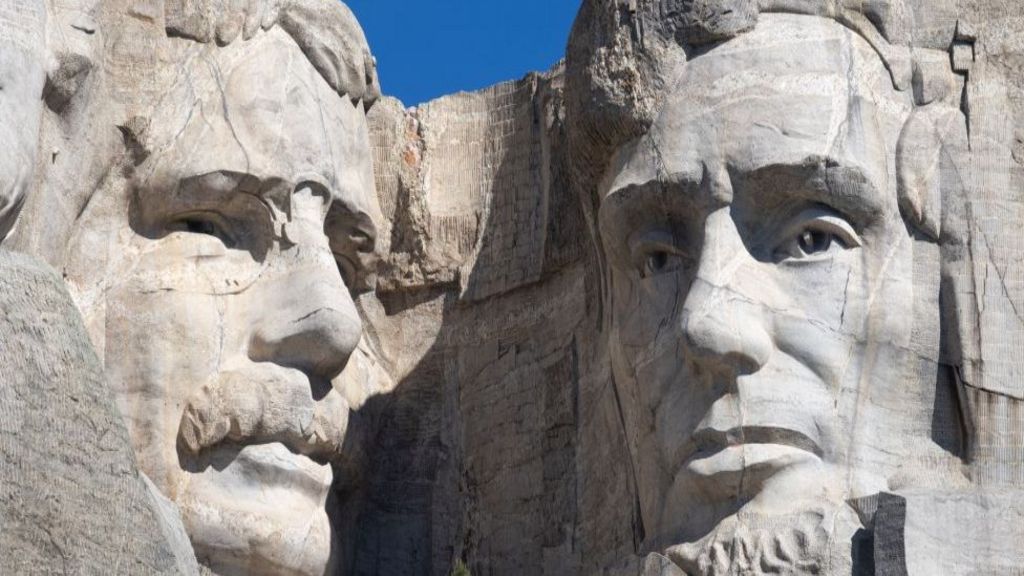
Thousands of miles away in Keystone, South Dakota, preparations are underway for Trump’s Fourth of July eve visit to Mount Rushmore, the iconic national monument where the likenesses of four of America’s most revered presidents are carved into granite. Trump has leaned into viral online memes that add his face to the monument alongside George Washington, Thomas Jefferson, Abraham Lincoln and Theodore Roosevelt, and a congressional bill has even been introduced to formally add his carving to the site — an idea that draws enthusiastic support from his base.
Among those supporters are Terry Davis and Tim Burke, two retirees traveling through the American heartland on a motorbike trip between national parks, who were disappointed to miss out on tickets for Trump’s Fourth of July fireworks display at the monument. When asked about the idea of adding Trump’s face to Mount Rushmore, 72-year-old Terry said Trump deserves a prominent spot: “I have not been this passionate about any other president in the past until he took the reins of this country.” The pair, like many of Trump’s supporters, celebrate his status as a political outsider who has bucked Washington norms, and back his use of executive power to confront congressional Democrats and what they see as an overreaching federal government. Tim added, “Long after he’s left office, 20, 30 years from now, I believe the historians will say that he’s been one of the greatest presidents in the history of our nation for the things that he has done for it.”
Historians warn that whatever the current debate holds, Trump’s expansion of presidential power will have long-lasting consequences for the American political system, affecting how future presidents approach the office. “Every chapter in the expansion of presidential power has had long-lasting consequences,” Zelizer said. “It creates actual precedents that future presidents can use that they didn’t have before. And it also fuels a process of normalisation where this just becomes part of what we expect presidents to do.”
That long-term legacy stands in stark contrast to the example set by George Washington, the nation’s first president, who set the original mold for the office in 1789. In his inaugural address, Washington spoke with humility about the weight of presidential power, noting that a leader “ought to be peculiarly conscious of his own deficiencies” — a sentiment few would expect from Trump, who has repeatedly declared himself “the greatest president in history.”