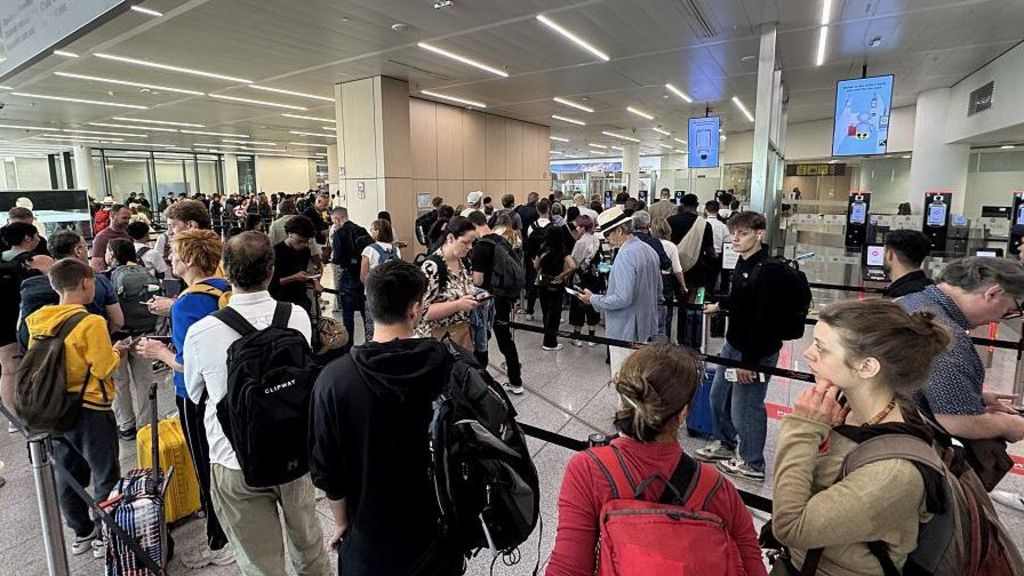
As the peak summer travel season approaches, the European Union’s newly launched digital Entry-Exit System (EES) has become a source of major disruption for non-EU travelers, with airport leaders and industry groups warning that unresolvable delays could ruin the travel plans of millions of visitors.
Berlin Airport chief executive Aletta von Massenbach recently told the BBC that non-EU nationals entering the German capital now face passport control wait times of up to two hours under the new biometric registration system. She specifically highlighted terminals hosting low-cost carriers Ryanair and Wizz Air, where queues consistently stretch between 60 and 120 minutes, warning that the current situation is “not bearable over the summer.” The root of the problem, von Massenbach explained, lies in the fragmented structure of the system: each EU member state operates its own unique sub-system, creating unnecessary complexity that undermines smooth border processing.
Rolled out for full operation across the bloc in April, EES was designed to modernize EU border control. The system requires all non-EU travelers entering the 29-nation Schengen free movement zone to register facial and fingerprint biometric data, which is stored digitally and verified when travelers exit the zone. Officials designed the framework to boost border security and eventually cut down on long-term wait times, but rollout has been far from smooth. While the system has functioned as intended at some locations, consistent reports of crippling queues at peak travel periods have emerged across the continent, with dozens of passengers reporting missed flights due to extended delays.
One tourist who experienced the disruption firsthand is Anne Robinson, a UK resident from Dunbarton, who says the stress of her June EES-related ordeal has convinced her to avoid travel to Europe entirely this year. Robinson and her 13-year-old son Jack faced 90-minute queues just to enter Rome upon arrival, and the problems only grew when it came time to return home. Though the pair arrived at Rome Fiumicino Airport three and a half hours ahead of their scheduled departure to the UK, most EES automated checking machines were out of service, forcing them to queue for an additional 90 minutes for exit checks. By the time they cleared border control, their flight had already departed. Stranded in Rome, the pair had to pay £250 for replacement flights departing two days later, and Robinson’s travel insurance claim to recover the unexpected cost was rejected. “That was too stressful,” she said, explaining her decision to skip future European trips in 2026.
Industry groups representing airports and airlines across Europe and North America have united to call for urgent action to address the crisis. Airlines UK and Airlines for America say the rollout of EES has been deeply inconsistent across member states, and warned that with summer travel demand set to hit peak levels, EU officials need to prioritize contingency planning and re-evaluate whether the current full rollout timeline is realistic.
Jet2 chief executive Steve Heapy echoed that criticism, saying it is baffling that EU officials continue to push forward with full implementation when the system has clearly not been rolled out properly across member states. He called for regulators to allow EES checks to be paused at locations where infrastructure and operations are not yet ready, a change that he says would immediately deliver a far better experience for holidaymakers.
The continent’s leading airport lobby group, ACI Europe, has gone even further, writing directly to European Commission president Ursula von der Leyen to sound the alarm over the scale of the delays. The group says wait times at some busy airports already reach five hours during peak travel windows, and conditions are set to worsen as the summer holiday season brings even higher passenger volumes. ACI Europe warned that the delays are already causing major disruptions to airline operations: “airlines face half-empty planes at gate closing time, while passengers are stuck in border control queues.”
While current EU rules already allow member states to suspend EES checks under specific circumstances, ACI Europe is pushing for a policy change that would allow countries to pro-actively pause the system at ports of entry when high passenger volumes are expected. That change, the group argues, would give airports and border authorities the flexibility they need to avoid crippling queues this summer.
Following a high-level meeting on the issue held in Brussels this week, von Massenbach said she believes EU officials are finally starting to recognize the severity of the problem. A European Commission spokesperson acknowledged that issues exist, but pushed back against claims that the system itself is the core problem, noting that in most EU airports, disruptions from EES remain limited. Where problems do occur, the spokesperson said, they stem from member states failing to deploy enough border guards, sufficient infrastructure, or working automated equipment to support the system.
The spokesperson reaffirmed that the European Commission is continuing to offer full support to member states working to implement EES, and is prepared to increase that support “in view of the coming summer period” to limit disruptions for non-EU travelers.