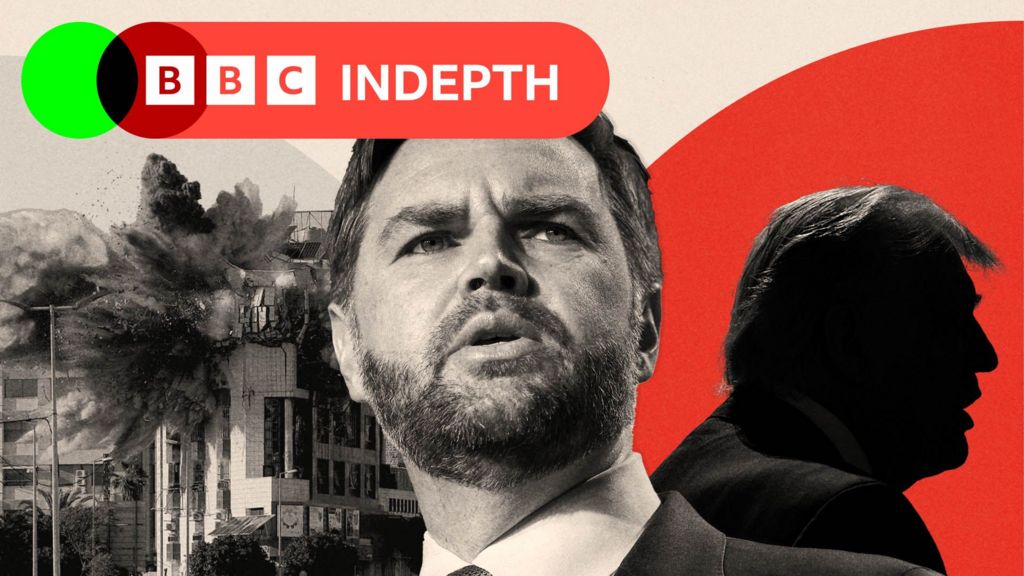
Against the backdrop of a six-week Iran war that has roiled the Middle East and sent shockwaves through the global economy, U.S. Vice President JD Vance finds himself at the center of the most high-stakes diplomatic challenge of his tenure, leading American peace talks with Tehran in Islamabad, Pakistan. What has made his already difficult mission even more complex? A lighthearted off-script joke from President Donald Trump during a White House Easter lunch that laid bare the vice president’s awkward, high-risk predicament.
“If the deal doesn’t go through, I’m blaming JD Vance,” Trump quipped to the room of senior administration officials, including Vice President (then Secretary of State) Marco Rubio and Defense Secretary Pete Hegseth, drawing laughter. Then he added the punchline that underscored Vance’s no-win starting position: “If it does happen, I’m taking full credit.”
The mission Vance now leads is nothing short of a political minefield. To reach a lasting end to the conflict that erupted in late February, Vance must reconcile the competing demands of mutually distrustful stakeholders spanning three continents. At the top of the list is Trump himself, a mercurial commander-in-chief who has flip-flopped between calling for rapid peace and threatening to wipe out Iran’s entire civilization. Just days before the current temporary ceasefire, Trump demonstrated his volatile negotiating style: he gave Iran a 24-hour deadline to reach a deal, took to Truth Social to warn that “a whole civilization will die” if Tehran refused, and then announced the ceasefire less than two hours before his escalation deadline expired. Even Vance openly described the current truce as “fragile,” a framing that diverged from the president’s more upbeat messaging.
Beyond Trump, Vance must win buy-in from a weakened but still defiant Iranian regime that retains critical leverage through its control of the Strait of Hormuz, a key global energy chokepoint. He also has to assuage Israeli concerns over a regional ceasefire, convince war-weary European allies that have refused to assist in reopening the strait to back the deal, and keep the hawkish wing of Trump’s Make America Great Again base satisfied – all while positioning himself for a potential 2028 presidential run.
What makes this assignment particularly tricky for Vance is that it cuts directly against his long-stated foreign policy positions. A former Iraq War Marine, Vance has long opposed endless U.S. military entanglements abroad. As recently as the eve of the Iran war, he told The Washington Post that Trump would never allow the U.S. to be dragged into another permanent Middle East conflict, and he reportedly voiced deep private skepticism about launching strikes on Iran before the war began. “Vance has signaled a desire for restraint in American foreign policy. That’s pretty hard to square with the American war against Iran,” explained Jeff Rathke, president of the Washington-based American-German Institute.
Despite these public and private misgivings, Trump hand-picked Vance to lead the delegation, which also includes veteran special envoy Steve Witkoff and Trump’s son-in-law Jared Kushner, who led preliminary indirect talks before the ceasefire. Some observers have questioned whether the choice was intentional, handing Vance a potentially unwinnable assignment that would damage his political future if talks collapse. But a senior anonymous U.S. official countered that Vance was selected to signal the administration’s seriousness about reaching a durable deal, a framing that has been welcomed by regional allies. “It shows that America is seriously coming to the table,” noted Assaf Orion, a retired Israeli brigadier general.
Vance has been actively positioning himself as a core loyalist and key enforcer of Trump’s “America First” foreign policy agenda since taking office. He made international headlines with a blistering takedown of European immigration and free speech policies at the 2025 Munich Security Conference, and he instigated a high-profile shouting match with Ukrainian President Volodymyr Zelenskyy in the Oval Office over U.S. aid. Just this week, he made an unprecedented appearance in Hungary to campaign for re-election for Trump ally Prime Minister Viktor Orbán, cementing his reputation as a sharp-elbowed global proxy for the president.
Still, at 41 years old and just a few years removed from his entry into national politics as a U.S. Senator, Vance remains a relative newcomer to high-level international diplomacy. Unlike Witkoff and Kushner, he was not involved in the detailed preliminary talks between the U.S. and Iran, and Orion notes that the pair’s workload across simultaneous negotiations over Ukraine, Iran and Gaza raises questions about technical expertise on the ground in Islamabad.
Before departing Washington for Pakistan, Vance sought to tamp down overblown expectations, telling reporters: “If the Iranians are willing to negotiate in good faith, we are certainly willing to extend an open hand.” He added that Trump had provided the negotiating team with “some pretty clear guidelines,” though the president’s well-documented tendency to reverse course leaves Vance exposed: if Trump accepts a deal only to backtrack later, the vice president will likely shoulder the blame.
As U.S. allies around the world watch closely to see if Vance can deliver, the question hanging over the Islamabad talks remains open: can Vance pull off a deal that satisfies all competing parties, or will he become the fall guy if negotiations collapse? For Vance, the outcome will not only shape the future of the Middle East and the global economy, but also his own prospects of leading the country in 2028. As Trump put it shortly before Vance departed: “He’s got a big thing. We’ll see how it all turns out.”