Newly released official financial disclosure documents from the Trump administration have thrown a spotlight on an unprecedented practice: sitting U.S. President Donald Trump has distributed six-figure cash gifts to four of his most trusted inner-circle White House staffers, a move that has sparked fresh debate over compliance with federal ethics rules.
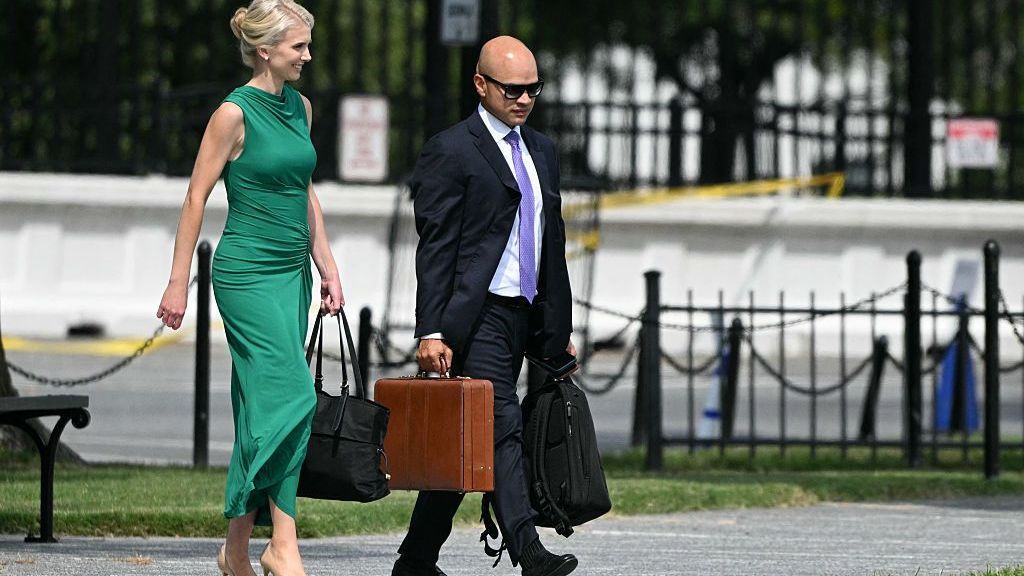
According to the disclosures, the total value of the gifts amounts to $157,000. Longtime loyal aide Natalie Harp and two other unnamed senior staff each received $45,000, while Walt Nauta, Trump’s long-serving aide and Director of Oval Office Operations, was given $22,000. Notably, none of the other 91 declared White House employees reported receiving any similar gifts from the president, a discrepancy that has yet to be explained by administration officials.
All four gift recipients are widely recognized as members of Trump’s closest personal and political circle. Harp, a 35-year-old aide who has worked alongside Trump for years, is one of his most trusted confidantes, tasked with drafting his frequent posts on the Truth Social platform. She gained national media attention last month when it was revealed she was one of the handful of people who accompanied Trump during his unannounced plane swap while departing Turkey.
Nauta, a U.S. Navy veteran, first served as Trump’s military valet during his first presidential term, and continued working as a personal assistant at Trump’s Mar-a-Lago estate after he left office in 2021. In 2023, he was indicted alongside Trump on charges related to the mishandling of classified national security documents, though the case against him was ultimately dismissed. The two other recipients include Margo Martin, a communications advisor who documents Trump’s public and private activities for social media, and 26-year-old Chamberlain Harris, Trump’s executive assistant who was appointed to the U.S. Commission of Fine Arts earlier this year, where he oversees construction projects at the White House and other Trump-aligned initiatives in Washington D.C.
The White House has defended the cash gifts, framing them as personal holiday presents unrelated to the recipients’ official government duties, and fully compliant with U.S. federal law. “The president has a longstanding practice of giving Christmas gifts to people in his orbit, including at times employees and aides, both in government and in his time in the private sector,” a senior White House official said in a statement to the BBC. “The gifts at issue here have nothing to do with any of these individuals’ official government duties, and are entirely permissible under relevant legal and ethical standards.”
Under current federal regulations, government employees are barred from accepting outside compensation tied to their official work, but the administration argues these gifts fall under the exception for personal social gifts. However, ethics experts have raised questions about the credibility of this explanation. Cassandra Burke Robertson, a law professor and director of the Center for Professional Ethics at Case Western Reserve University, noted that the gift amounts align closely with pay scales for the staffers’ roles, rather than reflecting the arbitrary nature of personal friendship gifts.
“If it were compensation, it’s not allowed. Of course, that’s where the administration’s argument comes in, that it’s a social gift done out of friendship. Not compensation…the question is then whether that is a credible explanation,” Robertson told the BBC. She added that the amounts “seem to be standard” based on each recipient’s employee level, which suggests that the size of the gift was tied to their employment position, not their personal relationship with the president.
Robertson also pointed out that even if the gifts are technically legal, they add to growing public concern over perceived conflicts of interest within the Trump administration, coming on the heels of recent controversies tied to prediction markets and cryptocurrency dealings. “It does add to a generalised perception of really rampant conflicts of interest,” she said.
Historically, there are no recorded instances of a sitting U.S. president giving large cash gifts to White House staff. While it is common for sitting presidents to give personal mementos and souvenirs to staffers, the practice has never involved large cash disbursements to a small group of inner-circle aides. For example, former President Barack Obama gave former press secretary Robert Gibbs a framed borrowed necktie as a personal gift ahead of the 2004 Democratic National Convention, a far cry from the five-figure cash gifts disclosed this week.