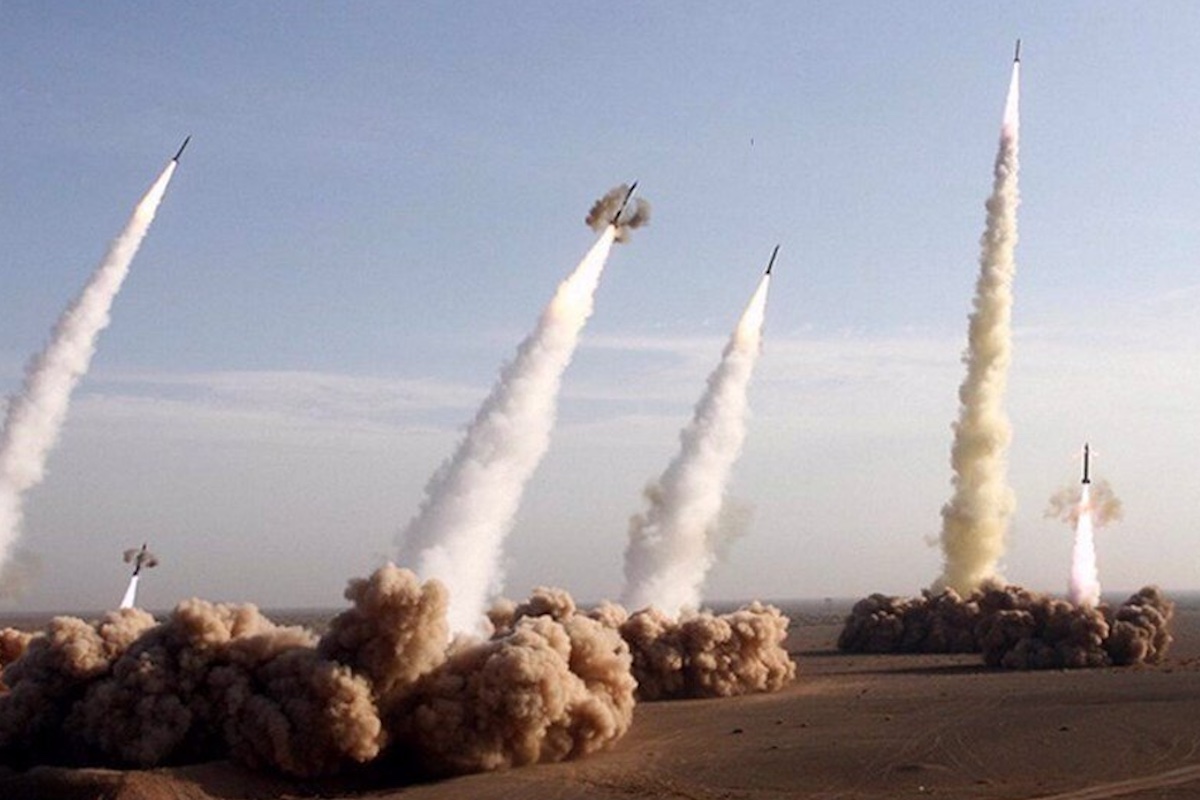
Six months after the United States and Israel launched a military campaign aimed at forcing Iran into political submission, a dramatic shift in the dynamics of the Middle East conflict has emerged: Tehran is no longer just reacting to external pressure, it is actively escalating tensions to shift the balance of bargaining power in its favor. The most visible sign of this new approach is Iran’s recent threat to target American warships operating in regional waters with its upgraded solid-fuel Qassem Basir ballistic missile, a development that marks a potentially more dangerous phase of the ongoing standoff.
Tehran has framed the Qassem Basir as a game-changing capability that allows it to “take action against any threat, even before it is carried out.” Multiple intelligence reports point to this weapon being used during claimed Iranian tests targeting US vessels near the Strait of Hormuz on September 5. While Washington confirmed that an attack targeted its nuclear-powered aircraft carrier USS George Washington and a nearby guided-missile destroyer, US officials have not confirmed whether the new advanced missile was deployed, and noted that all American ships successfully evaded the strike.
Beyond the missile test, Tehran has also announced plans to sign an agreement with Oman to establish a new shipping corridor through the Strait of Hormuz extending into the Persian Gulf, a move that remains unconfirmed as of press time. Taken together, these moves signal a clear break from the largely retaliatory strategy that defined Iran’s actions in the first half of the conflict. Today, the Islamic Republic is increasingly willing to raise the stakes on its own terms.
This shift does not mean Iran holds military superiority over the US – far from it. But Iranian leadership has concluded that prolonging and expanding the conflict increases the economic and strategic cost of the standoff for Washington and the global community, strengthening Tehran’s hand at any future negotiating table. This represents a stark reversal of the original goals of the US-led campaign, which was framed to force major changes in Iranian policy and even open the door to regime change. Despite massive military superiority that has inflicted severe damage on Iranian infrastructure and military capabilities, the US and Israel have failed to achieve their core political objectives.
Today, Iran’s political regime remains intact, its missile programs are still operational, the status of its nuclear program remains unresolved, and its network of regional proxies retains full offensive capability – a fact demonstrated by recent attacks on Saudi targets carried out by Houthi rebels. Most critically, Tehran has turned the Strait of Hormuz, one of the world’s most vital energy chokepoints, into a powerful tool of economic leverage.
Over the past six months, the conflict has settled into a repeating cycle: escalation, diplomatic outreach, tentative agreements, renewed coercive action, and a return to diplomacy. Far from forcing Iranian capitulation, this pattern has taught Tehran that sustained resistance to US pressure ultimately yields better negotiating terms. The latest escalation is a direct result of that lesson.
Tehran does not need to destroy the US Navy or seize full control of the Strait of Hormuz to achieve its goals. It only needs to make commercial navigation through the waterway risky enough to force shipping companies to avoid the route, push up global marine insurance premiums, and embed persistent disruption risk into global oil prices. Recent shipping data already confirms that commodity traffic through the Strait of Hormuz has fallen to its lowest level since May. Tehran has further warned it will implement wider navigation restrictions and launch what it calls “economic warfare” if Washington continues its campaign to strangle the Iranian economy via sanctions and blockades.
This new approach upends the original logic of the conflict. Former US President Donald Trump’s strategy was designed to make continued Iranian resistance progressively more costly. Today, Iran is making continued US coercion progressively more costly for Washington and the world. While Iran can never match American raw firepower, it holds an unassailable geographic advantage that no military force can eliminate: control over the world’s most critical energy transit corridor.
Measured against the original political goals of the US-led campaign – dismantling Iran’s political system, eliminating its nuclear program, destroying its long-range missile capability, and breaking its network of regional allies – the six-month conflict has fallen far short. None of these core objectives have been achieved decisively. The unresolved status of Iran’s nuclear program in particular highlights the fundamental limits of military power: airstrikes can destroy physical facilities, but they cannot eliminate the political incentives that drive states to pursue strategic nuclear deterrence.
This dynamic carries significant ripple effects across the Middle East and beyond. If regional governments conclude that developing independent nuclear capacity offers protection against external regime change campaigns, global nuclear non-proliferation efforts could face new, growing pressure. Saudi Arabia, for example, has long sought domestic uranium enrichment capabilities. Ultimately, analysts note, the nuclear issue will inevitably return to the negotiating table, the same place it started.
The costs of the ongoing stalemate are already being felt globally. Energy, marine insurance, and shipping costs have all risen, with inevitable political consequences for economies around the world. Meanwhile, the conflict has created unintended benefits for other major powers: Russia gains from higher global hydrocarbon prices, while China benefits strategically as US military assets, munitions, and political attention are diverted away from the Indo-Pacific region. For Gulf states, the conflict has delivered an uncomfortable reality: US military bases hosted to guarantee their security can also turn them into targets in a conflict they did not initiate.
Again, this does not mean Iran is winning militarily. The Iranian economy and domestic infrastructure have suffered enormous damage, and the US retains the capability to inflict far greater destruction if it chooses to escalate further. But Iran does not need to defeat the US militarily to achieve its core goals. It only needs to prevent Washington from using military superiority to force it into political submission, while raising the cost of continued conflict incrementally for the US and its allies.
This leaves Trump caught in an escalation trap partially of his own making. If he tightens the blockade on Iran, Tehran can further disrupt traffic through Hormuz. If he intensifies airstrikes and bombing campaigns, Iran can expand retaliatory strikes against US allies across the Gulf. If he chooses to enter negotiations, Iran now has every reason to demand stronger guarantees and better terms than it would have accepted six months earlier. Repeated cycles of escalation followed by a return to talks have also eroded the coercive power of US threats over time.
Iran’s latest moves are therefore far more than just another exchange of fire in a long-running conflict. Six months after the US and Israel launched their campaign to force Tehran into submission, Iran has learned that the longer it withstands pressure, the greater the costs it can impose on its adversaries, and the stronger its bargaining position will be when talks eventually resume. While the US retains the capacity to escalate far beyond anything Iran can match, it can no longer take for granted that more escalation will bring victory closer. Iran’s latest actions make clear that Tehran now believes the opposite is true.