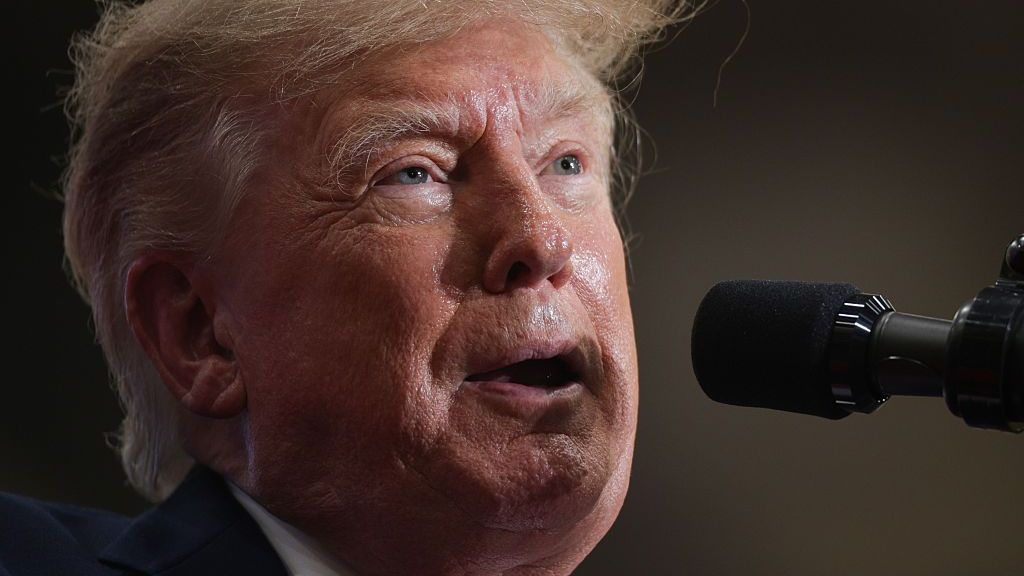
The fiercely contested 2026 Michigan U.S. Senate race has devolved into a bitterly polarizing showdown, as former and current U.S. President Donald Trump faces widespread bipartisan backlash over incendiary, 9/11-themed verbal assaults targeting Democratic nominee Abdul El-Sayed. During a Sunday campaign rally in the battleground state, Trump leveled unsubstantiated claims labeling the U.S.-born El-Sayed a “jihadist”, even bringing on stage the father of Todd Beamer — the Michigan native passenger who led the passenger revolt against hijackers on United Airlines Flight 93 during the 2001 terrorist attacks — to rally supporters against El-Sayed. Trump went on to make wild allegations that El-Sayed would “open the floodgates for hordes of jihadis” to enter the U.S. if elected, claiming the scenario would eliminate public celebration of Christmas, and even joked that El-Sayed would need to pass through a metal detector to enter the Senate chamber. The president also pushed long-debunked insinuations tying El-Sayed to the Muslim Brotherhood, a faction of which his administration formally designated as a Foreign Terrorist Organization earlier this year. El-Sayed, a former public health official born to Egyptian immigrant parents who would make history as the first Muslim U.S. Senator if he wins, has repeatedly denied any affiliation with extremist groups and affirmed his full loyalty to the United States. At his own subsequent campaign rally, he pushed back against Trump’s deliberate choice to use his full middle name Mohamed as a dog whistle to stoke anti-Muslim sentiment, telling cheering supporters, “I’ll be Senator Mohamed to you, bro.” He emphasized that such divisive, faith-focused attacks are a deliberate distraction from working-class voters’ top priorities, noting that opponents are “pointing at my name and my faith” to make people overlook the fact that they cannot afford gas, groceries, or accessible healthcare. Independent progressive leader Senator Bernie Sanders joined El-Sayed at the event, arguing that the Republican campaign is leaning into Islamophobia because it has no actionable policy solutions to address voters’ daily economic struggles. The narrow, high-stakes race pits El-Sayed against Republican nominee Mike Rogers, a former U.S. Representative and ex-House Intelligence Committee chair, and is widely viewed as one of a tiny handful of competitive Senate contests that will determine which party controls the chamber after the November 3 midterms. Critics have pointed out the clear double standard in the Muslim Brotherhood allegations against El-Sayed: back in 2012, Rogers himself told Reuters that policymakers should pursue careful, cautious engagement with moderate members of the Muslim Brotherhood. Even a prominent former Trump ally, Bishara Bahbah — founder of the once-influential Arab Americans for Trump group that helped Trump secure critical Arab American support in Michigan during his 2024 White House victory — condemned the president’s remarks, telling the Associated Press that the statements “cross a red line” and are openly racist. El-Sayed’s team has previously distanced the candidate from a 2012 social media post from his half-sister referencing her family’s longstanding ties to the Muslim Brotherhood, while El-Sayed has explicitly disavowed the organization on the record. A 2011 Huffington Post op-ed El-Sayed wrote about Egyptian pro-democracy protests, and a 2012 open letter he is alleged to have signed urging Egypt’s first democratically elected Muslim Brotherhood-affiliated president to reform state security institutions, have been circulated by Republican surrogates as part of their smear campaign, though El-Sayed has not publicly addressed the latter letter. The BBC has reached out to the White House for an official comment on the controversy, as its correspondent Sarah Smith recently conducted an on-camera interview with El-Sayed to break down the key tensions in the tight Senate contest.