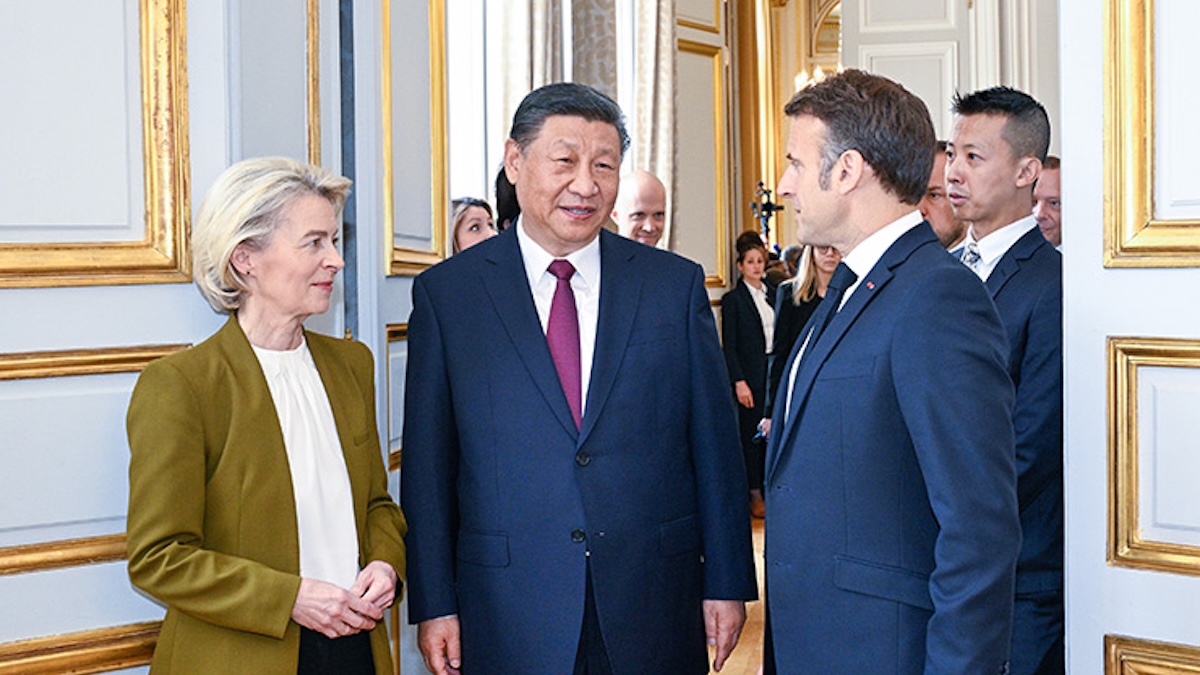
Following closed-door trade negotiations earlier this month where Beijing agreed to formal annual caps on hybrid vehicle exports to the European Union, the European Commission is advancing plans to roll out far-reaching WTO-compliant import restrictions targeting three additional high-growth Chinese industrial sectors: chemicals, furniture, and heavy machinery. As first reported by Bloomberg via anonymous EU officials familiar with internal deliberations, the new safeguard measures, which may take the form of targeted import quotas or graduated tariffs, are slated to be formally unveiled as early as the first quarter of 2027, and will apply uniformly to all non-European Economic Area nations to meet global trade rule requirements.
The breakthrough hybrid car quota deal was finalized during an October 9 meeting in Beijing between EU Trade Commissioner Maroš Šefčovič and Chinese Commerce Minister Wang Wentao, marking a major policy reversal for Beijing, which had repeatedly rejected binding export limits in prior negotiation rounds. The finalized agreement restricts Chinese hybrid shipments to the EU to 350,000 units per year – a level that will cut 2027 volumes by nearly 50% from projected unconstrained levels – a threshold intentionally calibrated to be lenient enough to discourage immediate retaliatory action. The four-year regime, set to take effect this December, includes a 6% annual quota uplift after the first 12 months to give Chinese manufacturers a gradual transition window.
EU Commission President Ursula von der Leyen emphasized after the October 16 EU summit that the hybrid car deal alone would not resolve the bloc’s deepening structural trade imbalance with China, which currently runs at more than €1 billion (US$1.12 billion) in goods deficits every single day. “Our domestic industries have sounded the alarm, and we have heard their calls for action,” von der Leyen stated. “This is why we are moving forward with additional targeted safeguard measures to address the unfair competitive pressures that are creating a ‘China Shock 2.0’ for European manufacturing.”
The compromise on hybrid exports signals a notable tactical shift from Beijing, which had previously escalated trade tensions after the EU imposed duties of up to 35.3% on Chinese battery electric vehicles in October 2024. At that time, China filed a formal WTO dispute complaint and retaliated by imposing punitive tariffs on European brandy, pork, and dairy imports. Analysts note that Beijing’s willingness to concede on hybrid caps stems in large part from the severe trade pressure it faces on two separate global fronts: the WTO’s longstanding institutional paralysis, with its Appellate Body unable to hear new cases since December 2019, and the rapidly approaching January 10 expiration of its temporary 90-day trade truce with the United States. The US-China truce, extended by mutual agreement during Xi Jinping’s September 23 state visit to Washington hosted by President Donald Trump, leaves Beijing with almost no bandwidth to navigate a simultaneous full-scale trade conflict with the 27-nation bloc.
Chinese state-affiliated media and independent trade commentators have largely downplayed the hybrid car concession, instead framing the ongoing trade dynamic as a mutually interdependent relationship that requires rule-based, calibrated responses rather than blanket escalation. In a widely circulated analysis on Chinese industrial trade dynamics, Hubei-based columnist “David Talks Tech” argued that Beijing should avoid broad, emotional retaliation, and instead deploy targeted, WTO-aligned countermeasures that strike at European industries most dependent on Chinese supply chains. Citing the October 3 anti-dumping probe launched by China’s Ministry of Commerce into EU-origin p-nitrotoluene – a critical raw material for dye, pesticide, and pharmaceutical production – the columnist noted that such precise actions make clear that unilateral EU trade barriers are not cost-free, and that disputes are best resolved within the multilateral WTO framework rather than through unilateral posturing.
A separate analysis from Hunan-based trade commentator Xue Taohong contextualized the rapid growth of Chinese industrial exports to the EU, noting that China now supplies nearly 18% of the bloc’s total chemical imports, doubling its market share over the past decade to become the EU’s single largest chemical supplier. She also highlighted that China overtook Germany as the world’s top machine tool exporter in 2025, recording a 13% year-on-year export gain to €8.6 billion (US$9.6 billion) even as German machine tool exports fell 10% to €7 billion. “It is overly simplistic to claim Chinese producers are ‘stealing’ European market share,” Xue wrote. “Many European manufacturing firms are facing deep structural challenges of their own: multi-decade long R&D cycles, rigid corporate governance structures, spiraling energy and labor costs, and overreliance on legacy competitive advantages that no longer hold in the global market.” She added that while temporary, time-bound safeguard measures could give European firms a 2-3 year window to upgrade their production facilities, reduce energy consumption, and rebuild domestic R&D capacity, permanent trade restrictions would ultimately harm both sides, and that Chinese exporters would need to adapt by building local European production facilities, after-sales networks, and full local compliance frameworks to maintain long-term market access.
Geopolitical analysts at Beijing Foreign Studies University’s Center for EU and Regional Development Studies, Cui Hongjian, further noted that Beijing’s more conciliatory posture toward Brussels is also shaped by recent waves of widespread, sometimes violent economic protests sweeping across Western Europe, most severely in France where President Emmanuel Macron announced a ban on unsanctioned protest actions from groups he described as lacking public legitimacy. Cui warned that European populist politicians are increasingly framing domestic economic hardship as a consequence of external “unfair Chinese competition” to deflect public anger away from domestic policy failures, creating political incentives for EU lawmakers to pursue even harsher trade restrictions to appease voting bases. He added that cash-strapped European governments are also likely to view new tariffs on Chinese goods as a convenient new revenue stream, while pushing for mandatory local job creation requirements for Chinese firms operating within the bloc.
Recent market data underscores the rapid pace of Chinese industrial penetration into the EU market: for the first time on record, Chinese automotive brands outsold Japanese competitors across a full calendar quarter, with their share of European new car sales surging to 12.7% in September 2025 (up nearly 12 percentage points from a 1% market share just five years prior), driven almost entirely by hybrid vehicle sales. Chinese manufacturers are already accelerating local European production investments to mitigate future tariff risks: BYD’s new Hungary assembly plant is nearing full operational status, Chery is moving forward with construction of a new vehicle manufacturing facility in Barcelona, and Leapmotor has launched B10 SUV production at a shared Stellantis facility in Zaragoza, Spain. Chinese customs data shows that lithium-ion battery exports to the EU surged 46% year-on-year to US$31.2 billion in the first nine months of 2025, accounting for nearly 40% of China’s total global battery exports, while inverter shipments to the bloc rose 34.5% to US$1.7 billion in the third quarter, even after Brussels moved to exclude Chinese suppliers from all EU-funded infrastructure projects over cybersecurity and supply dependency concerns.
The dual pressure on China’s global trade ecosystem continues to mount on the US front as well: on October 22, US President Donald Trump formally classified imports of wind turbines and their core components as a national security threat, while the US Treasury Department published a proposal to expand existing US outbound investment bans targeting Chinese advanced technology sectors to cover hypersonic weapons systems, exascale supercomputing, synthetic biotechnology, and next-generation artificial intelligence development.