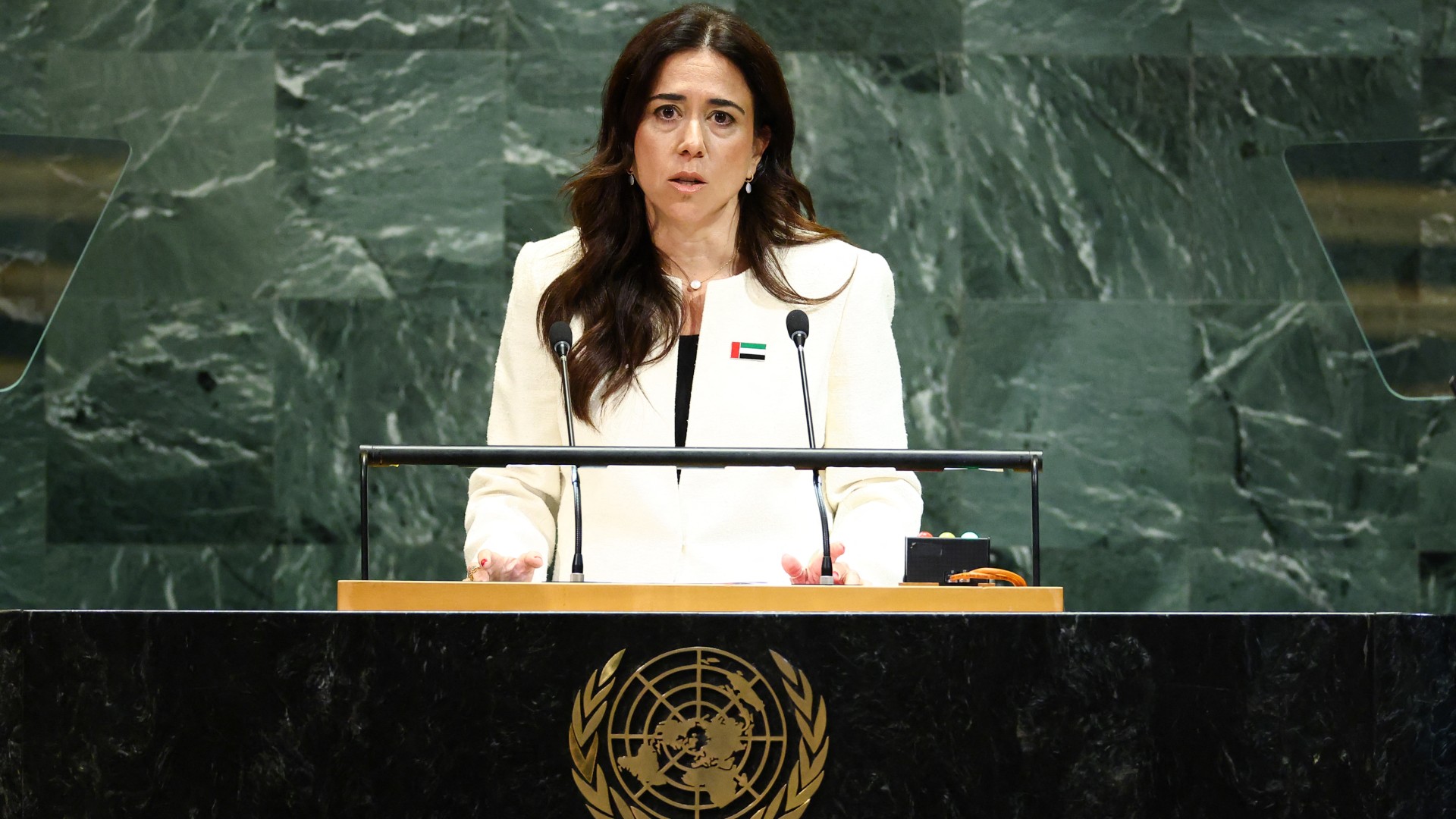
In a scathing exclusive statement shared with Middle East Eye, Sudan’s top diplomatic delegation to the United Nations has formally called on all member states to block Lana Nusseibeh, the Emirati foreign minister and former long-serving UAE UN ambassador, from securing the organization’s top leadership post, framing her candidacy as an inappropriate reward for Abu Dhabi’s alleged actions that have fueled widespread atrocities in Sudan’s ongoing civil war.
Nusseibeh emerged as a surprise frontrunner for the secretary general role after a last-minute announcement of her candidacy on a Wednesday, arriving amid a months-long deadlock in the 15-member UN Security Council, which has failed to reach consensus on a successor to outgoing incumbent Antonio Guterres following six rounds of informal straw polls where no candidate earned the required backing from all five veto-wielding permanent members: the United Kingdom, United States, Russia, China and France. Multiple sources close to the British government have also previously indicated that London is leaning toward backing Nusseibeh’s bid, further stoking tensions around the race.
The Sudanese mission’s public rebuke centers on longstanding widespread allegations that the UAE has provided material and political support to Sudan’s Rapid Support Forces (RSF), a powerful paramilitary group whose documented mass killings, sexual violence and systematic attacks on civilian populations have been deemed to carry the “hallmarks of genocide” by independent UN investigators. The Sudanese diplomatic team emphasized that they hold “fundamental questions about Nusseibeh’s independence, impartiality and credibility” to uphold the neutral duties of the UN top job, noting that her decades of public service have been dedicated to “defending and whitewashing her country’s record of troubling the peace of Sudan by enabling genocide, the enslavement of our women and girls, sexual violence and other atrocities.” The mission stressed that “The UAE must face accountability, not be rewarded with the top global leadership role of the UN.”
The UAE has repeatedly denied all allegations of involvement in Sudan’s civil war, which erupted in April 2023 and has since killed hundreds of thousands of people and displaced more than 8 million civilians across the region. Nusseibeh herself, who served as the UAE’s permanent representative to the UN from 2013 to 2024 before taking senior foreign ministry posts, has repeatedly dismissed such claims: in an April 2024 Security Council address, she labeled allegations of Emirati support for the RSF as “spurious, unfounded, and lacking any credible evidence,” and when questioned by CNN in July 2024 about UN investigators’ formal findings of credible proof of UAE ties to the paramilitary, she responded flatly “Absolutely” when asked if she rejected the conclusions, calling the accusations “categorically untrue.”
Documents and reporting also reveal that Nusseibeh traveled to Strasbourg in November 2025 to lobby European Parliament lawmakers to remove all references to the UAE’s role in Sudan’s conflict from a formal EU resolution condemning widespread atrocities in the war-torn nation. She did not respond to repeated requests for comment from Middle East Eye regarding the Sudanese mission’s latest statement.
While the UN Charter requires the secretary general to operate fully independently of their home government, Ammar Mahmoud, a senior Sudanese diplomat posted to the UN, argued that Nusseibeh’s explicit rejection of UN investigators’ formal findings already demonstrates she cannot approach the role with the required neutrality. “I highly doubt that she will ever form any investigative committees about the UAE’s role in Sudan,” Mahmoud told MEE. “Nor do I think that she will accurately reflect, in her engagements with world leaders as secretary general, the true nature of the conflict in Sudan and her country’s role in it.”
Earlier, in March 2025, Sudan brought a formal case against the UAE at the International Court of Justice accusing Abu Dhabi of complicity in genocide on Sudanese territory, but the case was dismissed two months later on procedural grounds, as the UAE had not completed full accession to the Genocide Convention, stripping the court of formal jurisdiction to rule on the matter.
Beyond concerns over Sudan, critics have also raised significant questions about Nusseibeh’s ability to neutrally mediate the decades-long Israel-Palestine conflict and hold Israeli leaders accountable for alleged war crimes in Gaza, where local health authorities confirm more than 74,000 Palestinians have been killed since the outbreak of renewed hostilities in October 2023. While the UAE has regularly voted against Israeli policies at the UN General Assembly, Abu Dhabi established normalized diplomatic and security ties with Israel via the 2020 US-brokered Abraham Accords, a landmark diplomatic deal that Nusseibeh herself was a leading architect of. Last week, Israeli Prime Minister Benjamin Netanyahu publicly presented a security proposal for a so-called “Israel-UAE Hexagon Alliance” that explicitly listed Sudan’s RSF paramilitary as a “friendly” partner.
If elected, Nusseibeh, who has Palestinian heritage, would make history as the first woman to ever lead the United Nations, and only the second Arab national to hold the secretary general post. Her candidacy has also broken longstanding informal regional rotation conventions that many member states argued should prioritize a candidate from Latin America for the 2026-2033 tenure. The UN has not yet released a revised timeline for final voting on the next secretary general amid the ongoing Security Council impasse.
Sudan decries Nusseibeh UN candidacy as ‘whitewashing’ Emirati role in civil war