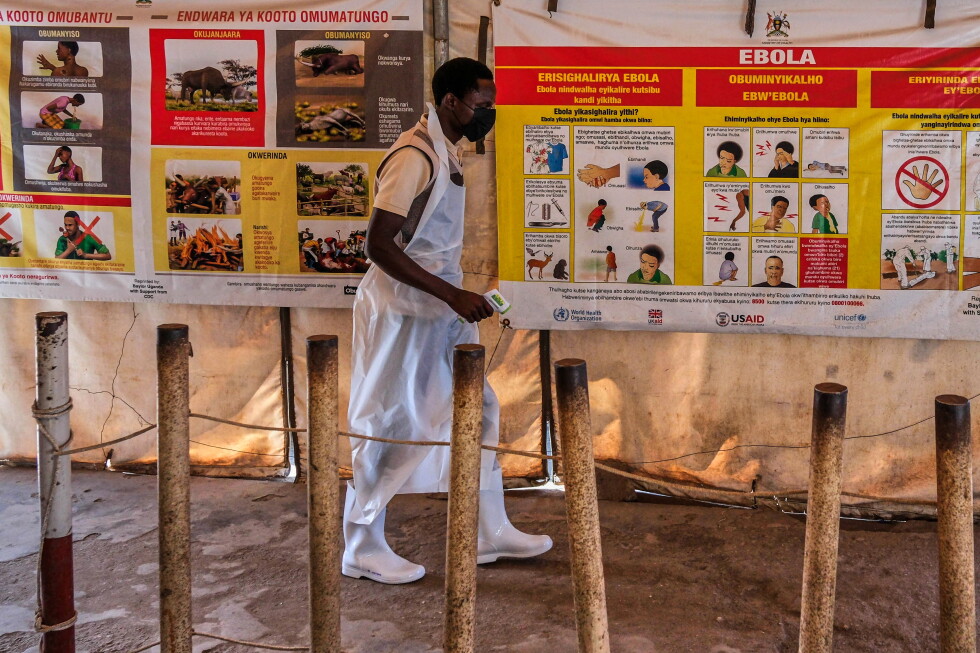
Along the Uganda-Democratic Republic of Congo frontier at the Mpondwe border post, piles of perishable goods and lines of idling trucks tell the story of a public health measure that has brought cross-border trade to a near-standstill, leaving hundreds of traders and daily laborers facing crippling losses.
Two weeks after Congolese authorities declared an Ebola outbreak in the eastern province of Ituri, Uganda implemented a full closure of its western border on May 28, a proactive step driven by rising alarm over cross-border transmission of the rare, untreatable Bundibugyo Ebola variant now spreading through eastern Congo. While narrow exceptions are carved out for emergency response, humanitarian aid, security operations, and cargo, local authorities in Kasese district – Uganda’s frontier district bordering the outbreak zone – have ramped up enforcement in recent days as virus transmission in Congo continues to outpace containment efforts.
The new, stricter controls have left long convoys of cargo trucks stacked on both sides of the border, with perishable shipments at risk of rotting before they can clear inspection. For Leah Masika, a Ugandan trader, her 50-bag consignment of plantain destined for markets around Kampala is already leaking water, and will spoil within hours if the trucks do not move. “Our things are here rotting,” she told the Associated Press, adding that she cannot absorb the estimated $2,200 loss, and has no plans to order more goods from Congo until the outbreak is fully contained. “We are begging them to help us and open (the border). We will not go back to Congo.”
Traders across the crossing say they understand the need for public health safeguards, but argue the current delays are excessive. Sylvia Asiimwe, a clearing agent at Mpondwe, notes that a queue of trucks stretching more than a mile along the Ugandan side includes seven carriers hauling Chinese-imported fish bound for Beni and Butembo – cities in North Kivu province, hundreds of kilometers from the Ituri outbreak epicenter. “The fish is going to spoil,” she said. “So much money.”
The economic pain extends far beyond large-scale cargo traders. Mpondwe is Uganda’s busiest hub for informal cross-border trade, which the Uganda Bureau of Statistics valued at an estimated $131 million in 2023. For generations, the border has bound communities together: the Bakonzo people on the Ugandan side share deep family and cultural ties with the Banande on the Congolese side, and trade has long been the backbone of the local economy. Today, storefronts along the border route sit shuttered, and casual laborers who once made their living loading and unloading cargo pass the time idling on stools.
Ismail Mumbere, a roadside snack vendor who depends on border traffic for customers, summed up the widespread despair: “The situation is bad. A lot of people earn from here, in many businesses. But now the government has told us there is Ebola. Ebola has wasted our work.”
Public health officials defend the harsh restrictions, noting the unique danger posed by this specific Ebola outbreak. The variant spreading in eastern Congo is the rare Bundibugyo strain, which no existing licensed vaccines or treatments are effective against. Uganda has already recorded 15 confirmed Ebola cases, all linked to the Congolese outbreak, after infected Congolese nationals traveled to Kampala for treatment before the outbreak was publicly declared on May 15. Investigators believe the virus was circulating undetected for days or even weeks before that declaration, putting neighboring Uganda at extreme risk.
Arafat Bwambale, a surveillance officer for Kasese district, explained that the tightened cargo controls are designed to limit unregulated human movement across the border, which stretches hundreds of miles and is crisscrossed by dozens of unmonitored footpaths outside formal crossing posts. Officials are currently working to block more than 24 informal footpaths to stop unauthorized crossings from Congo. “With movement of cargo, and maybe trucks, is mobility of people, and we want to reduce that,” he said.
Uganda has a long, traumatic history with Ebola outbreaks dating back to 2000, when an outbreak killed more than 200 people. The virus, first discovered in 1976 in simultaneous outbreaks in what was then Zaire and present-day South Sudan, spreads through close contact with the bodily fluids of infected people or deceased victims. For this outbreak, local health authorities have prepared extensively: the nearest referral hospital in Kasese maintains a fully staffed isolation center and a local lab that can return Ebola test results within six hours. To date, 41 samples taken from suspected cases in the Kasese area have tested negative.
The World Health Organization, which has classified the current outbreak as a Public Health Emergency of International Concern (PHEIC), has openly discouraged widespread border closures, though it acknowledges neighboring countries face extremely high risk of imported cases. Even so, Ugandan officials are expected to impose even stricter, more systematic rules for cargo and truck movement in the coming days, after a meeting of the local Ebola task force.
For the traders and workers who depend on the Mpondwe border for their livelihoods, the prospect of tighter restrictions only deepens their uncertainty. With perishable goods already rotting in idling trucks, many face financial ruin if the border remains closed for weeks more while authorities work to contain the outbreak across the frontier.