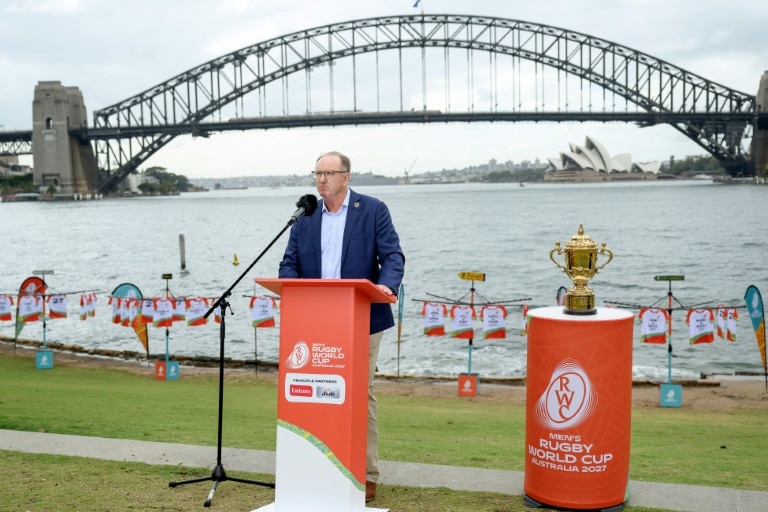
Against a backdrop of rising challenges in rugby’s long-established traditional markets, World Rugby chair Brett Robinson has reaffirmed the governing body’s commitment to aggressive global expansion, singling out the United States — the upcoming host of the 2031 men’s Rugby World Cup and 2033 women’s edition — as a critical priority for long-term growth.
In an interview with AFP on the sidelines of the Hong Kong Sevens tournament, the former Australian international player pushed back against growing narratives that rugby is facing a period of broad decline, arguing that the sport’s global foundations are stronger than critics claim. Recent high-profile setbacks have fueled public debate about the sport’s standing in the global pecking order, from folding professional franchises in Super Rugby to slipping public interest in traditional heartlands. Last week, All Blacks legend Michael Jones warned that rugby union is losing the battle for fan attention to rugby league in New Zealand, a comment that came just days after Auckland-based Super Rugby side Moana Pasifika announced it would cease operations at the end of the current season, becoming the second Super Rugby franchise to collapse in three years due to crippling financial pressure. In Wales, another historic rugby stronghold, the men’s national team has suffered a dramatic slump in on-pitch form, while football has overtaken rugby as the primary focus of public sporting interest.
Robinson pushed back on this narrative of decline, pointing to global participation data that shows 2 million women playing the sport worldwide, making rugby a truly global game rather than one confined to a handful of historical markets. “We have to protect our core markets, but we can’t sit still and believe that the game will thrive if we don’t continue exploring new pathways for growth,” he said.
That search for growth leads directly to the United States, which is set to become the first North American nation to host the men’s Rugby World Cup in 2031, followed by the women’s tournament in 2033. The upcoming 2026 men’s FIFA World Cup, co-hosted by the US this summer, has already offered a preview of the logistical and commercial challenges awaiting rugby’s governing body, with soaring ticket and transportation costs drawing widespread criticism and raising questions about large-scale event delivery in the American market.
Skepticism around the 2031 project has grown in recent months: Major League Rugby, the top domestic professional men’s competition, has shrunk to just six teams after four clubs exited the league in recent years, while the men’s national team has struggled with inconsistent performances. British media reports have also raised questions about the US’s ability to deliver a commercially successful 2031 World Cup.
Robinson countered that World Rugby has laid out a long-term strategy to build fan momentum ahead of the 2031 tournament, rather than rushing to deliver a fully formed event overnight. “We have worked with top national unions to bring iconic, high-profile matches to the US over the coming years to build deeper connections with new fans,” he explained, noting that the governing body is currently evaluating 27 potential host cities, a list that will be narrowed to 12 to 14 ahead of a formal announcement following the 2027 World Cup.
To build early excitement for the 2031 tournament, World Rugby has already arranged a blockbuster Test match between two-time world champions South Africa and three-time winners New Zealand in Baltimore this September, following on from a sell-out 2024 match between Ireland and the All Blacks in Chicago. “We’re working really hard to build a long-term play,” Robinson said. “We aren’t sitting still in terms of preparing, and we fully acknowledge that it’s a challenging market.”
He added that the 2033 women’s Rugby World Cup will be a equally important milestone for the sport, noting that women’s rugby has seen rapid, sustained growth across North America in recent years.
Looking ahead to the next major global rugby event, the 2025 men’s Rugby World Cup in Robinson’s native Australia, he shared that initial ticket sales have already “exceeded all expectations”, with more than 750,000 tickets sold for the expanded 24-team tournament, the largest edition of the competition in history. While Robinson acknowledged that global geopolitical uncertainty stemming from the ongoing conflict in the Middle East has created some headwinds for major international events, he said World Rugby remains optimistic about the tournament’s success. “It’s a really good signal about the World Cup,” he said. “We’re really optimistic and excited.”