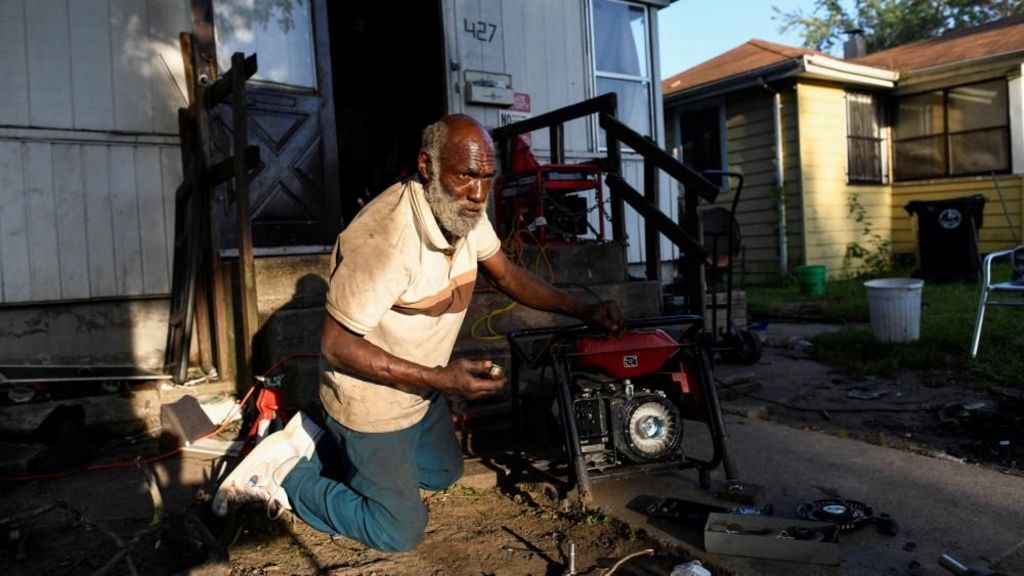
It has been nearly two full weeks since a catastrophic outbreak of severe storms swept across the U.S. Midwest, leaving a trail of destruction, seven fatalities, and a lingering crisis for tens of thousands of residents still trapped without electricity in Northern Indiana. For 77-year-old Terry Dubois, one of the thousands of people grappling with the extended outage in Gary, the hardest-hit community along Lake Michigan’s southern shore, daily life has been reduced to a cycle of reliance on the kindness of others. Friends deliver non-perishable groceries to her home, while her son provided a portable power bank to keep her phone charged so she can stay connected to the outside world. Fortunately, summer temperatures have not been extreme enough to compound her hardship, she says, but the storm itself remains unforgettable. “I’ve never seen a storm like that in my entire life. Never, never,” Dubois told reporters. “It was like a sheer wall of wind.”
On August 11, an unexpected surge of intense thunderstorms spawned tornadoes and widespread flooding across Illinois and Indiana, with Chicago and large swathes of rural and urban Indiana bearing the brunt of the damage. Gary, a once-booming industrial town that was home to the world’s largest steel mill and now counts one-third of its 69,000 residents living below the poverty line according to U.S. Census data, suffered damage disproportionate to surrounding areas. The National Weather Service recorded peak wind gusts reaching 99 miles per hour (159 kilometers per hour) as the storm roared through the community. Though the most violent weather lasted only five to 10 minutes, its impacts have stretched on far longer, disrupting nearly every aspect of daily life more than a week later.
Data from Northern Indiana Public Service Company (Nipsco), the regional utility provider, shows that while crews have restored power to more than 345,000 customers since the storm hit, nearly 30,000 households and businesses were still without service as of Sunday morning. In the immediate aftermath of the storm, gas stations, grocery stores, and pharmacies were all knocked offline, leaving residents to rely on whatever food and supplies they already had in their homes. As the outage stretched into its second week, international food relief non-profit World Central Kitchen deployed teams to Gary to provide free meals to residents who lacked access to safe, fresh food.
While temporary power outages are a routine occurrence after storms in this part of the United States, outages lasting longer than seven days are highly unusual, and the extended disruption has created cascading crises for vulnerable communities. Residents across Gary report struggling to access basic needs: many cannot keep prescription medication properly refrigerated, non-working elevators have left mobility-impaired residents trapped, one wheelchair-using resident was forced to crawl down multiple flights of stairs to exit their building, and unlit streetlights have left residential and arterial roads pitch black after dark, creating major safety hazards. For Kyle Allen, a Gary resident who now cares for his 95-year-old father, the outage has been far more challenging than any he has experienced before. He purchased a portable generator to keep his home running, a solution many low-income residents cannot afford.
Local residents have expressed a wide range of reactions to the ongoing crisis, from determined resilience to deep frustration. Demond Pompy, who has been grilling food for neighbors throughout the outage, noted that basic daily amenities most people take for granted – from hot showers to flushing toilets – are now out of reach for many, but emphasized that the community has adapted to the hardship. “One thing about us, we’re going to adapt to any situation,” he said. Others have been far more critical of the slow recovery. Shatiya Hardin, a local resident, called the situation “absolutely horrible,” noting that families with young children and elderly residents dependent on electric medical devices like oxygen tanks have been placed in extreme danger. “It’s not OK for us to continually be in survival mode,” she told reporters.
Anger over the slow restoration of power has boiled over into legal action, with local residents launching a class-action lawsuit against Nipsco. The suit accuses the utility of failing to properly maintain and trim trees near power lines, which were knocked down by falling vegetation during the storm. One plaintiff, Jack Tipold, described being in the middle of oral surgery when power failed, forcing clinicians to abandon the procedure and discharge him without adequate pain medication. “I had all my teeth removed, and no medication for 48 hours. Let me tell you something, it was a struggle,” he said. Nipsco has denied all allegations of wrongdoing and says it will “vigorously” defend itself against the claims in court.
Local faith leaders also amplified residents’ calls for faster action over the weekend, holding a press conference outside a Gary church on Saturday to demand accelerated relief efforts. “We come together today with one voice, asking those who have the power… to release the resources to our brothers and our sisters, our mothers and our fathers, because 12 days is long enough,” a faith leader told the *Indianapolis Star*.
In a public statement released Sunday, Nipsco said crews are working around the clock to restore power to all remaining customers, and projected that full service to Gary would be restored by Wednesday. “We recognise how frustrating and difficult it is to be without power for an extended period,” the company said. Indiana Governor Mike Braun has echoed residents’ frustration, saying there is “no excuse for these delays” in power restoration. Braun has requested an expedited major disaster declaration from the Federal Emergency Management Agency (FEMA), which would unlock federal funding and additional resources for recovery efforts, and has urged Nipsco to deploy every available crew and resource to speed up repairs: “Put every available resource into the field. Get creative.”
Climate experts warn that as climate change intensifies the frequency and severity of extreme weather events across the United States, extended multi-day power outages like the one impacting Gary are likely to become more common for vulnerable communities across the country.