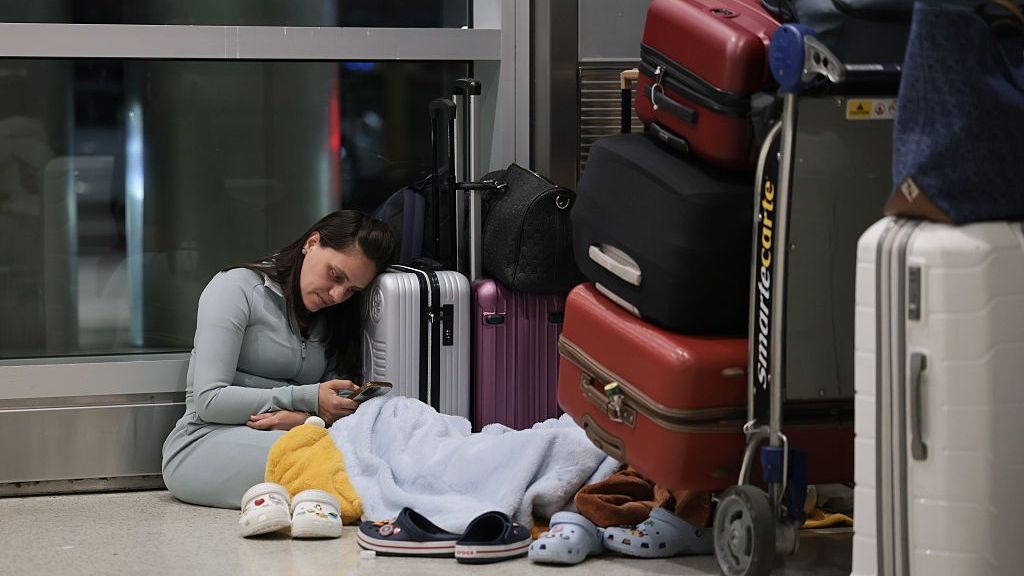
Thousands of frustrated US travellers stranded across airport terminals and stuck aboard stationary aircraft shared weary but resilient sentiments like “We’ll get home one day” in the wake of a rare, nationwide air traffic ground stop that rippled across global flight schedules over the weekend. The cascading crisis traces back to a Friday technical failure that prompted the Federal Aviation Administration (FAA) to issue a sweeping order halting all departing US flights at 15:54 EST (20:54 GMT), at a moment when more than 3,500 commercial planes were already mid-flight. In response, airborne crews either diverted to alternate landing sites or proceeded to their pre-planned destinations, while every scheduled departure across the country was frozen indefinitely. The unprecedented mandatory grounding was only lifted after four and a half hours, but its disruptive aftershocks rippled for days as fleets of aircraft and their assigned operating crews became scattered far outside their pre-planned routing positions. By the end of Friday, flight tracking service FlightAware recorded a staggering 8,500 delayed services and 8,000 outright cancellations, followed by 5,900 cancellations and 7,000 delays on Saturday alone. The chaos persisted into Sunday, with an additional 2,000 flights scrapped and 5,000 more pushed past their original departure times, as US Transportation Secretary Sean Duffy warned full normal operations would likely not be restored until the start of the work week on Monday. Stranded passengers faced dire conditions: many were trapped for hours inside planes parked on airport tarmacs with no ability to take off or return to terminal gates, while others camped out on terminal floors overnight, scrambling to reach overstretched airline customer service teams to rebook missed itineraries. The disruption did not stop at US borders, creating knock-on scheduling chaos across the globe that led to the cancellation of multiple departing flights from the UK and wider Europe. While federal investigators are still working to pinpoint the exact root cause and assign accountability for the system failure, Secretary Duffy confirmed the incident was triggered by a faulty network router installed during an ongoing upgrade from legacy copper wiring to modern fibre optic infrastructure. The misconfigured hardware, located in El Dorado, Arkansas, began flooding the entire national air traffic communications network with corrupted signals, severing critical lines of real-time communication between air traffic controllers and flight crews. Duffy emphasized that recurring breakdowns of this nature would remain unavoidable until the US government delivers a full, top-to-bottom overhaul of its neglected national air traffic control network, which has received only piecemeal investment for decades. In separate public appearances on CBS and NBC’s *Meet The Press*, he pushed back against complacency around the aging infrastructure, noting “Let’s not lie to each other. We have to make investments into a network that has been neglected for decades.” President Donald Trump amplified this call to action via a post on his Truth Social platform on Sunday, urging sitting members of Congress to immediately approve dedicated funding for the long-overdue modernization project. Trump argued the current 50-year-old legacy system was “RIDICULOUS” and that the full upgrade should be completed in a single coordinated push rather than slow, incremental “drips and drabs,” asserting that the finished infrastructure would quickly become the most advanced air traffic control network anywhere on the planet. Independent aviation analyst Miles O’Brien echoed these urgent warnings, describing the current US air traffic system as “a house that’s about to be condemned” and far beyond the scope of a simple partial renovation, a characterization that aligns with widespread expert consensus that the nation’s flight communications technology is drastically antiquated for 21st century travel volumes.
Thousands of US flights still cancelled or delayed two days after grounding of planes nationwide