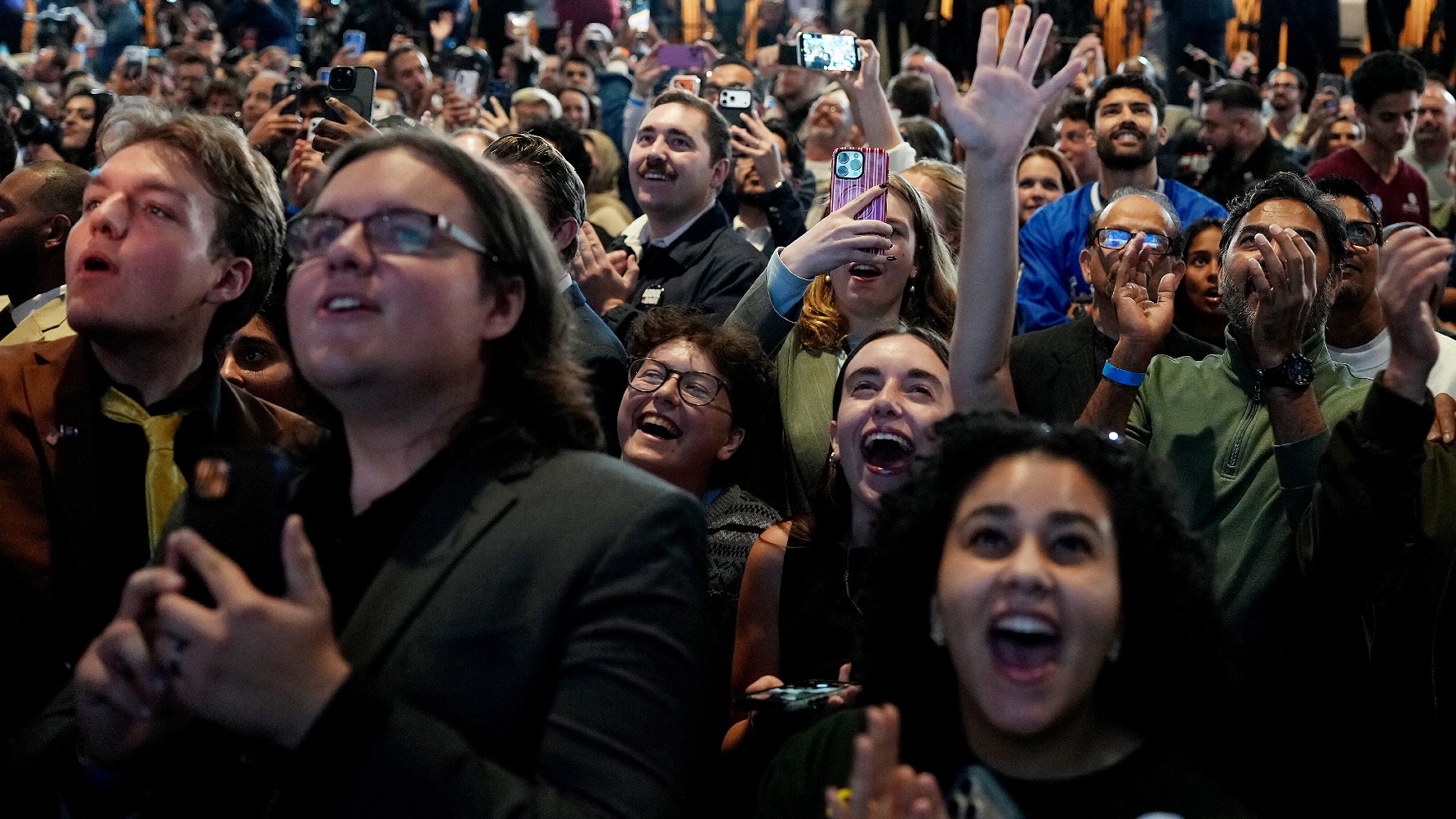
A significant segment of Pakistani American voters who mobilized heavily to secure Donald Trump’s 2024 presidential victory have staged a dramatic political about-face, throwing their support behind Democratic candidates in last week’s U.S. midterm elections after concluding the Trump administration fully reneged on its core promise to push for the release of Pakistan’s incarcerated former Prime Minister Imran Khan, multiple community insiders confirmed to Middle East Eye.
This widespread disillusionment has been amplified by the Trump White House’s deepening, highly publicized alliance with Pakistan’s powerful army chief Field Marshal Asim Munir, a leader the sitting U.S. president has repeatedly hailed as his “favorite field marshal.”
While U.S. election authorities do not publish official demographic breakdowns of voting behavior, Pew Research Center data estimates 680,000 people of Pakistani origin resided in the United States as of 2023. Though they represent a relatively small slice of the total national electorate, dense Pakistani American population clusters in politically pivotal swing states including Michigan and Pennsylvania grant the community disproportionate potential sway over close election outcomes.
Syed Ali, a corporate finance professional residing in Virginia’s 8th Congressional District, told MEE he cast his ballot for every non-Republican candidate on the midterm ballot, a sharp reversal from his 2024 vote for GOP candidates. Ali explained that in the lead-up to Trump’s 2024 inauguration, Pakistani American voters held widespread optimism that the new president would intervene to restore democratic norms in Pakistan and advocate for Khan’s release. He went so far as to allege the U.S. government actively supported Khan’s imprisonment to silence a prominent global voice critical of U.S. policy on Palestine and Iran.
“Khan would have caused major pushback against what was happening in Gaza, which many call a genocide, and he would have been a major obstacle in any potential U.S.-led conflict with Iran,” Ali emphasized. “He was the loudest global voice standing with Palestine, so he was deliberately kept behind bars.”
Khan’s multi-year imprisonment has emerged as a unifying rallying cry for nearly the entire U.S.-based Pakistani diaspora. The former Pakistani prime minister previously accused the Biden administration of orchestrating a 2022 “regime change operation” to oust his elected government, in collusion with Pakistan’s military and domestic opposition parties. That perceived Biden administration meddling in Pakistan’s domestic affairs is what initially drove large swathes of Pakistani American voters to align with the Republican Party and Trump in 2024, a shift that has now completely unraveled.
Major Pakistani American advocacy organizations including the Pakistani-American Public Affairs Committee (PAKPAC USA), First Pakistan Global (FPG), and the Community Alliance for Peace and Justice (CAPJ) all endorsed Democratic candidates across the country in the midterms, hosting public events, running targeted advocacy campaigns, and directing fundraising support to Democratic nominees after previously uniting behind Trump’s 2024 presidential bid. The exodus from the GOP has been fueled not just by Khan’s ongoing detention, but also by reports of escalating military operations in Pakistan and Pakistan-administered Kashmir, widespread documented human rights abuses across Pakistan, and military interference in neighboring Afghanistan’s governance.
“The reason I voted for Trump was because of Imran Khan, and the reason I voted for Democrats now is also because of him, plus the two unnecessary wars the administration has dragged us into and the skyrocketing oil prices,” shared Naveen Sheikh, a management professional based in Virginia’s 11th Congressional District, who voted for Democratic state candidate James Walkinshaw but declined to support newly elected U.S. Senator Mark Warner, citing unmet demands for action on Khan’s release despite multiple high-level community meetings with his office.
In the immediate aftermath of Trump’s 2024 election win, high-profile figures in his inner circle including special envoy Richard Grenell and senior Republican Congressman Joe Wilson publicly voiced support for Khan’s release and issued public rebukes of Army Chief Asim Munir. That dynamic shifted dramatically, however, following last year’s high-stakes border confrontation between India and Pakistan, when Munir traveled to the White House to forge a close personal working relationship with Trump. For most Pakistani American voters, that public display of alliance came to represent the final, definitive abandonment of the administration’s earlier campaign promises.
“Legislation like the Pakistan Democracy Act that Joe Wilson introduced last year – Wilson is a staunch national security Republican, mind you – turned out to be nothing more than a tactic to pressure the Pakistani military regime to do exactly what the Trump administration wanted,” explained Mehlaqa Samdhani, a founding member of CAPJ. “Our whole community felt deeply betrayed by the Republicans.” The 2025 proposed bill, which would have imposed targeted sanctions on senior Pakistani leadership including Munir over human rights violations and Khan’s imprisonment, was never taken up for markup by relevant House committees. Last September, Republican members of the House Rules Committee also voted to block two amendments to the National Defence Authorization Act that would have tied U.S. military aid to Pakistan to verifiable human rights improvements, measures that received full bipartisan support from Democratic lawmakers.
In response, Pakistani American advocacy groups ramped up engagement with Democratic candidates, seeking formal written commitments on future U.S. policy toward Islamabad, with some pushing for congressional investigations into alleged corrupt dealings linking Pakistan’s military leadership to Trump family members and close political associates, specifically around mineral extraction and cryptocurrency investment agreements. Community activists acknowledge, however, that overhauling longstanding U.S. policy toward Pakistan will be an uphill battle.
“U.S. policy on Pakistan is largely set by U.S. Central Command and the Central Intelligence Agency, with limited input from the State Department,” noted Zoobia Chaudhry, a physician and communications director at FPG. “You cannot turn decades of established policy around overnight.” She added that her organization’s immediate top priority is pushing the new incoming Congress to advance targeted investigations and sanctions against Munir and other senior Pakistani military leaders.
The anti-GOP backlash has crossed rigid ideological lines within the Pakistani American community: even conservative Muslim voters who supported Republican candidates for decades over shared social values chose to vote for Democrats this cycle, despite their personal opposition to progressive Democratic policies related to LGBTQ+ and transgender inclusion in schools and public life. Trump’s own campaign rhetoric targeting Muslim communities further deepened the sense of disillusionment among these long-time Republican loyalists.
“At the end of the day, they will keep voting for the left now because of the unrelenting bigotry, xenophobia, and Islamophobia coming from the modern Republican Party,” said Junaid Khan, president of PAKPAC’s DC, Maryland, and Virginia chapter. “I cannot see this community coming back to the GOP any time soon. These attacks are on our core identity, and the party went way too far.” Junaid, a lifelong Republican who was first drawn to political activism by Imran Khan’s advocacy for the rule of law and democratic governance, is now actively considering switching his party affiliation to join the Democratic Party. PAKPAC, one of the largest Pakistani American political action committees in the country, endorsed multiple high-profile Democratic candidates across the country including Abdul El-Sayed in Michigan and James Talarico in Texas, and did not endorse a single Republican candidate in the midterms, a stark contrast to its surprising 2024 endorsement of Trump.
The widespread discontent has spilled beyond Pakistani American circles, with Trump’s policy of embracing Pakistan’s military leadership and abandoning Khan drawing sharp criticism from broader South Asian and Muslim communities across the U.S. “These communities are deeply interconnected, they do not exist in political silos,” explained Hussain Nadim, a former research fellow at the United States Institute of Peace and the Wilson Center. He noted that one of the largest public protests for Imran Khan held in Silicon Valley was organized by Indian American supporters, who revere Khan as a legendary international cricket star. These groups are also angered by Trump’s public embrace of Pakistan’s military leadership and his apparent willingness to undermine democratic governance in a developing nation. “This specific issue has fed into a much broader wave of resentment across all these communities that feel completely betrayed by the Trump administration,” Nadim added.