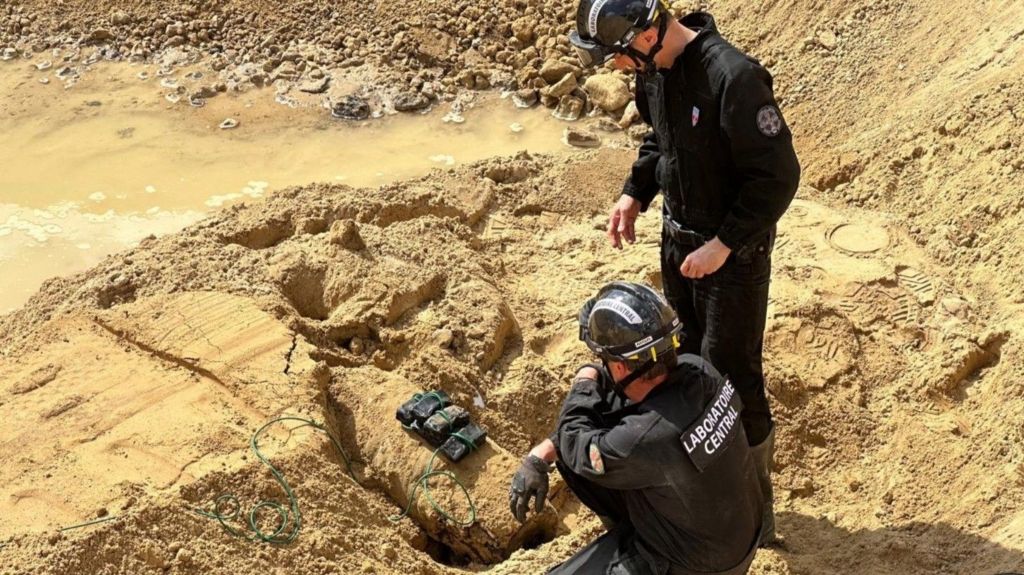
On a Sunday in April, a massive coordinated emergency operation unfolded in Colombes, a northern suburb of Paris, where authorities safely disposed of a decades-old unexploded World War II-era bomb after evacuating thousands of local residents. The operation, which required weeks of careful preparation and hundreds of law enforcement personnel, concluded successfully without any injuries or damage to surrounding infrastructure, allowing displaced residents to return to their homes by early Sunday evening.
The journey to Sunday’s disposal operation began on April 10, when construction crews working on infrastructure projects along Rue des Champarons uncovered the large, intact wartime munition. Immediately after the discovery, local authorities moved quickly to secure the site, piling sand over the device to reduce potential risk while planners drew up a detailed strategy for its neutralization.
In the lead-up to the operation, local officials made it clear that the mission carried inherent risks that demanded rigorous preparation. Alexandre Brugère, a leading local official, publicly described the task as inherently “risky” and noted that it required an extraordinary level of advance planning to protect public safety.
To carry out the operation, a multi-tiered safety perimeter was established around the bomb’s location. A core 450-meter radius zone was cleared entirely, with all residents ordered to evacuate their homes by 7 a.m. local time (5 a.m. GMT). Beyond this inner zone, a wider 900-meter perimeter required nearly 800 deployed police officers to enforce evacuation rules, while a second extended zone stretching 1 kilometer from the site allowed residents to remain inside their homes but banned all outdoor activity for the duration of the operation.
Local authorities distributed emergency alerts to all residents in affected areas, clearly outlining evacuation instructions and confirming that no one would be permitted to return until the device was fully neutralized. For many residents, the evacuation was sudden and unexpected. Alida, a local resident interviewed by Le Parisien, shared that “The authorities told us to close our windows and shutters when we left the house, but we didn’t take anything – we left everything as it was.”
Local government set up dedicated reception centers to host displaced residents during the operation, with specialized support on hand for vulnerable community members who required ongoing medical assistance.
According to reports from French media, bomb disposal experts initially attempted to remove the bomb’s original detonator, but the attempt was unsuccessful. Facing the risk of an accidental unplanned detonation, teams made the decision to carry out a controlled in-situ detonation to destroy the historic munition. The controlled explosion was carried out at 3:20 p.m. local time, and officials confirmed the operation was completed successfully just under an hour later, lifting the evacuation order shortly after 4 p.m.
Unexploded ordnance from World War II remains a common discovery across Europe, 86 years after the outbreak of the global conflict. Most of these devices are uncovered during construction or excavation work, and those found in dense urban areas carry an amplified risk due to the large surrounding residential and commercial populations.
In recent years, similar discoveries have prompted large-scale evacuations across major European cities. Dozens of WWII bombs have been found across London in recent years, forcing evacuations of popular tourist districts and even the temporary shutdown of London City Airport. Just one year ago, a 500-kilogram undetonated bomb was discovered and successfully diffused near Paris’ Gare du Nord train station during construction work to install a new bridge over existing railway lines.