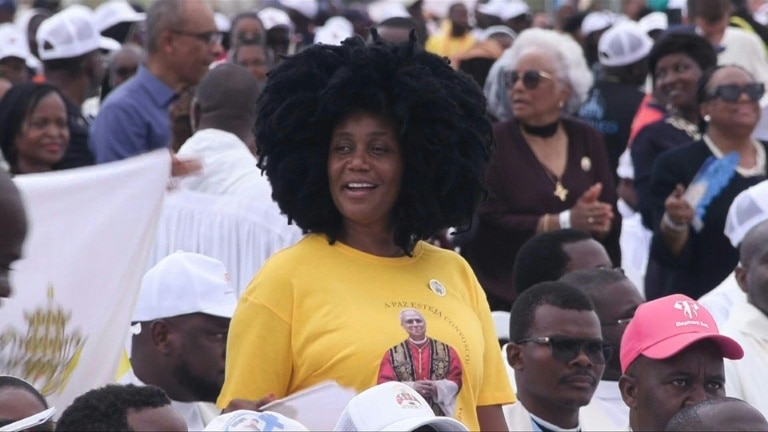
On a sunlit open-air plain outside Angola’s capital Luanda this Sunday, nearly 100,000 devout Catholics gathered to greet Pope Leo XIV, the first American pontiff, who used his address to urge the resource-rich southern African nation to embrace a hopeful new future despite decades of conflict, systemic inequality, and corruption.
The open-air Mass, held in the Kilamba district roughly 30 kilometers from central Luanda, drew pilgrims from across the country. Many attendees slept overnight on the open ground in the lead-up to the event, wearing printed T-shirts emblazoned with the pope’s image. After weaving through the dense throngs of worshippers in his popemobile, Leo centered his homily on the theme of collective renewal for Angola, a nation still grappling with the legacy of a 27-year civil war that concluded in 2002.
“It is possible to build a country where old divisions are overcome forever, where hatred and violence disappear, where the wound of corruption is healed by a new culture of justice and sharing,” the pontiff told the crowd, encouraging Angolans to “look to the future with hope” and pursue a new national beginning.
Leo’s arrival in Angola on Saturday marked the third stop of his ambitious 11-day, four-nation tour across Africa, a trip that has already seen the pope speak out forcefully against the systemic exploitation of the continent’s natural resources by global actors and domestic elites, while drawing international headlines for a high-profile public dispute with U.S. President Donald Trump.
Shortly after touching down in Luanda following a leg of the tour in Cameroon, the pope joined a meeting with Angolan President Joao Lourenco and top government officials, where he renewed his criticism of the widespread suffering caused by deep poverty and unregulated resource extraction. He also pressed leaders to allow for open political disagreement, an implicit rebuke of the Lourenco administration, which has faced consistent international accusations of cracking down on human rights activists and political dissent.
Angola’s paradox of wealth amid widespread hardship makes it a critical stop for the pontiff’s tour: the country ranks among Africa’s top oil producers and holds vast reserves of diamonds and other natural resources, yet economic inequality remains extreme. World Bank data shows that roughly one-third of Angola’s 36.6 million residents live below the poverty line, despite the nation’s abundant natural wealth. With a national median age of just 23, high youth unemployment has driven thousands of young Angolans to emigrate to Western countries in search of better opportunities.
Patricio Musanga, a 32-year-old attendee at the Kilamba Mass, told reporters that he came seeking encouragement for Angola’s younger generation and hoped the pope’s platform would push leaders to address systemic inequity. “We are very rich in natural resources but… there is a glaring inequality between those who live well and the others,” Musanga said. “The pope must call our leaders to account… I believe that at least he will be listened to by the authorities.”
Father Pedro Chingandu, a Catholic priest who traveled to the Mass from Angola’s eastern Moxico Province, echoed that sentiment, telling Agence France-Presse: “We need real democracy and the redistribution of wealth and justice.”
After concluding the open-air Mass, the pope traveled south to the coastal town of Muxima, home to the 16th-century Mama Muxima shrine, one of the most revered Catholic pilgrimage sites in southern Africa. Hundreds of pilgrims camped overnight in multicolored tents ahead of Leo’s arrival, with many describing the shrine as the spiritual heart of the Angolan nation.
Veronica Simao Teka, a 60-something pilgrim, called the site “the soul and the heart of all Angolans,” while 21-year-old nursing student Meraldo Amon Daniel said she hoped the pope’s visit would strengthen both public faith and the commitment of Angola’s leaders to reform. “It can strengthen the faith, not only of the faithful, but also of the country’s authorities,” Daniel said.
Angola’s ruling party, the socialist MPLA, has held continuous control of the government since the nation gained independence from Portugal in 1975, and has faced growing criticism over its response to political unrest. Last July, a crackdown on three days of looting across Luanda and other urban centers left roughly 30 people dead, with analysts saying the unrest reflected widespread public dissatisfaction with the ruling party’s governance.
Speaking to reporters on his flight to Luanda, Leo addressed the high-profile public dispute that has dominated international coverage of his tour, saying he regretted that his war of words with Donald Trump had overshadowed the trip’s focus on Africa. After Leo called for an immediate end to the ongoing Middle East war, Trump publicly labeled the pope “weak” in response. Leo, the first American to ever hold the papacy, said he had no interest in continuing the public feud: “It is not in my interest at all” to debate the U.S. leader, he said.
Following the conclusion of his events in Angola, Leo will travel to Equatorial Guinea for the final stop of the 18,000-kilometer continental tour.