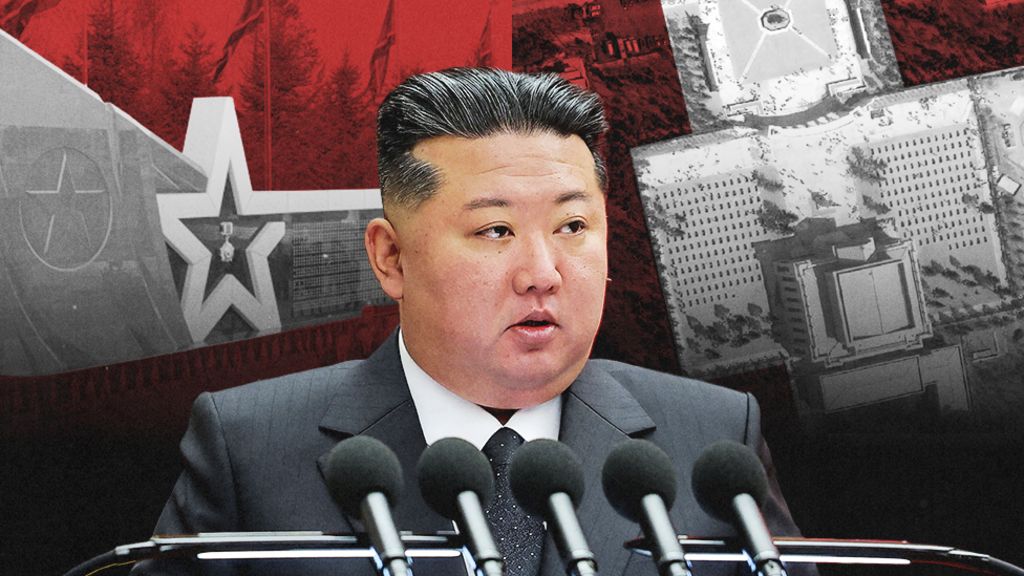
A groundbreaking investigation by the British Broadcasting Corporation (BBC), drawing on satellite imagery and official photographs of a newly unveiled memorial in Pyongyang, has produced a detailed estimate of North Korean troop fatalities during combat alongside Russian forces in Ukraine’s Kursk region. This marks the first verifiable, data-backed calculation of North Korean casualties from the deployment, as Pyongyang has never publicly disclosed official death toll figures.
The context of the deployment stretches back to August 2024, when Ukrainian forces launched an unexpected cross-border incursion into Russia’s Kursk Oblast. According to South Korean intelligence assessments, roughly 11,000 North Korean military personnel were dispatched to Russia to assist in recapturing the occupied areas of western Kursk – a deployment arranged through a mutual agreement where Pyongyang received critical supplies, funding, and technical support from Moscow in exchange. North Korean leader Kim Jong Un has previously acknowledged the sacrifice of troops killed in the conflict, but full details of casualties have remained closely held by the reclusive North Korean regime.
In October 2025, Kim Jong Un ordered the construction of a purpose-built museum and memorial in Pyongyang’s Hwasong District to honor North Korean troops killed in the Russia-Ukraine war. Satellite imagery analysis from U.S. geospatial firm Planet Labs shows that construction work began on the heavily forested site that same month. By December 2025, a basic structural frame of the 52-square-kilometer complex was visible from orbit. Exterior construction was mostly complete by March 2026, with final landscaping and auxiliary infrastructure finished in April 2026.
The complex, officially named the Memorial Museum of Combat Feats at Overseas Military Operations, was publicly unveiled on April 26, 2026. North Korean state news agency KCNA describes the site as a tribute to the “unrivalled bravery” of North Korean soldiers deployed to “liberate the Kursk region”. The memorial includes two 30-meter-long name-engraved walls, a main museum building, and an on-site cemetery and columbarium complex.
BBC analysts carried out a granular count of name inscriptions on the memorial walls using official images released by KCNA. Each wall is split into 14 distinct sections marked by grey stone dividers, with nine of these sections filled with soldier names. Within each section, there are approximately 16 columns of names. Close-up photos of the east wall confirm that eight names are inscribed per column. This formatting adds up to roughly 1,152 names per wall, for a total of 2,304 fallen soldiers commemorated across both walls – a figure rounded to an estimated 2,300 fatalities.
Songhak Chung, a senior researcher at the Korea Institute for Security Strategy, has corroborated the BBC’s calculation. “The memorial walls are packed with the names of deceased soldiers written in extremely small characters. Considering the surface area and text density, the number of people recorded there is likely to reach several thousand,” Chung explained. While higher-resolution imagery would be required to confirm an exact count, the BBC’s estimate aligns closely with earlier assessments from South Korea’s National Intelligence Service (NIS). In September 2025, the NIS reported roughly 2,000 North Korean troops killed and 2,700 wounded; by February 2026, the agency updated its assessment to note that roughly 6,000 of the 11,000 deployed North Korean personnel had been killed or wounded, though it did not release a full breakdown. Neither North Korea nor Russia has ever confirmed any official casualty figures for the deployment.
The memorial complex follows a structured tiered commemoration system, according to analysis from Korean research firm SI Analytics. Troops recognized for “extraordinary valour” are granted individual outdoor graves and headstones, while the remains of other fallen service members are stored in urns within the on-site columbarium. Kim Jin-mu, a former senior research fellow at the government-funded Korea Institute for Defense Analyses, notes that individuals buried in the outdoor cemetery are likely recovered remains, senior officers, or recipients of special posthumous recognition for acts of self-sacrifice. Satellite imagery from early April 2026 captured by SI Analytics counts 140 graves on the west side of the cemetery plot and 138 on the opposite side, with a three-story grey structure at the center of the plot identified as the columbarium.
Chung’s analysis of the columbarium finds that its interior walls are lined with grid-patterned storage niches for cremated remains. Even after accounting for office and exhibition space, Chung estimates the indoor repository alone can hold at least 1,000 sets of remains.
South Korea’s Ministry of Unification has noted that it cannot definitively confirm that all troops killed in action are included on the memorial walls. However, most independent experts believe it is highly likely that all North Korean troops killed in the Kursk operation have had their names inscribed. Kim Jin-mu explains that omitting names would risk backlash from grieving families and undermine the core purpose of the memorial, which is meant to honor state sacrifice and sustain public support for the regime’s policies.
Alongside the memorial, North Korean state media has confirmed that a new housing complex was built in the same district for surviving veterans and bereaved families, with residents beginning to move in as early as March 2026. Cho Han-bum, a senior research fellow at the state-run Korea Institute for National Unification, argues that the decision to build a dedicated, large-scale memorial for the fallen troops is a deliberate effort to legitimize the deployment in the face of unexpectedly high casualties. “For North Korea, Russia is the only country it can co-operate militarily with in its current state of isolation,” Cho noted. He added that the memorial also sends a clear signal that Pyongyang intends to continue deepening military cooperation with Moscow “regardless of how the war unfolds.”