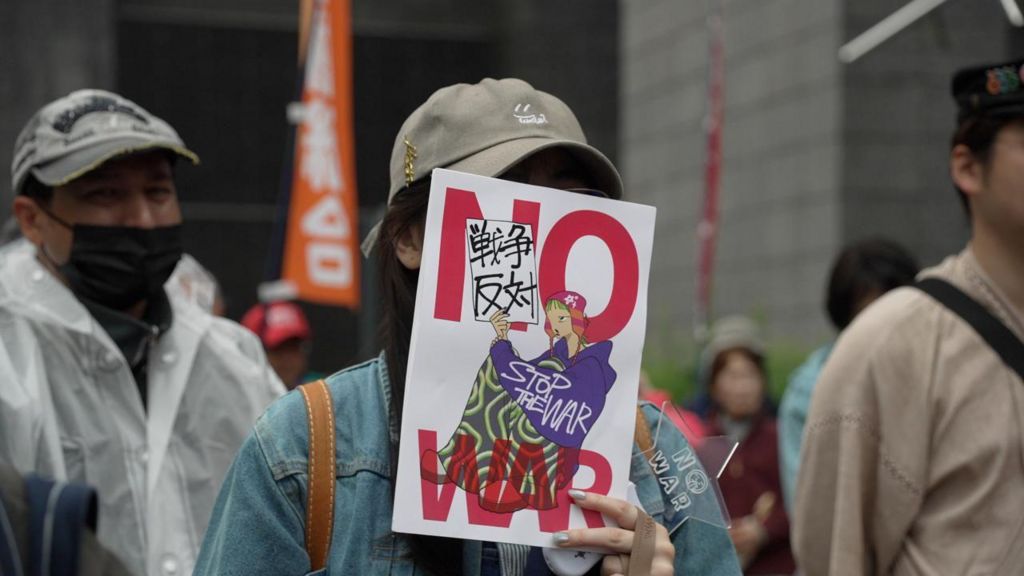
Beneath pouring rain on a busy Tokyo street corner, a growing crowd of demonstrators huddled together, their protest placards and national peace flags soaked through by the downpour. Across one large sign, two bold Japanese kanji characters stood out clearly against the waterlogged background: “No War”.
This simple, resolute slogan encapsulates a rapidly growing movement that has gripped Japan, as the nation sees its largest mass anti-war demonstrations in more than 70 years. The unrest comes in response to sweeping policy changes introduced by Prime Minister Sanae Takaichi, who has moved Japan sharply away from its decades-long post-WWII pacifist stance since taking office in October 2025. Under her administration, long-standing restrictions on lethal arms exports have been lifted, and the country’s military is being positioned to take on a much more active role in global security affairs.
The Japanese government justifies these shifts by pointing to escalating regional tensions, framing the changes as a necessary response to an increasingly unstable security landscape. But for a large share of the Japanese public, the moves have sparked deep alarm, fueling fears that the country is on a path to becoming a full war-capable nation — and drawing thousands of citizens out into the rain to make their opposition heard.
Mass public protest is an unusual occurrence in Japan, where cultural norms prioritize social harmony and avoid public disruption. When large numbers of people take to the streets, it almost always signals a profound, widespread unease with the direction of national policy. At the core of the current debate is nothing less than Japan’s core national identity, forged in the aftermath of the destruction of World War II.
When Japan enacted its post-war constitution in 1947, it included the landmark Article 9, a constitutional clause that prohibits the country from maintaining standing armed forces and formally renounces war as a tool of sovereign policy. Over the decades, the clause has been reinterpreted to allow for a limited self-defense force, but its core pacifist principle has remained a cornerstone of Japanese governance for nearly 80 years.
Takaichi argues that this post-war framework no longer matches modern geopolitical reality. Geographically, Japan is situated in one of the world’s most tense regions, facing an increasingly assertive China, an unpredictable nuclear-armed North Korea, and ongoing territorial tensions with Russia. Additionally, the United States — Japan’s closest security ally — has long pushed Tokyo to take on a larger security role in the Indo-Pacific.
Takaichi is not the first Japanese conservative leader to push for revisions to the post-war security order. For decades, leaders from the ruling Liberal Democratic Party have campaigned to amend the 1947 constitution. Former Prime Minister Shinzo Abe was one of the most prominent advocates for revising Article 9 to formalize the legal status of Japan’s self-defense forces, and in 2015, his administration pushed through a controversial set of security bills that expanded the military’s scope to allow limited collective self-defense, enabling Japan to support allied nations that come under attack.
But it was the April 21 decision to lift the decades-long ban on lethal arms exports that crossed a red line for many Japanese citizens, striking a raw national nerve and catalyzing the current wave of protests. After the passing of the rain, when sunlight broke through the clouds over Tokyo, the crowd of demonstrators outside the prime minister’s office only grew larger, their chants for peace growing louder with every new arrival.
This movement is not limited to older generations who hold direct memories of war. A large share of protesters are people in their 20s and 30s, who will bear the long-term consequences of any shift in national security policy. “I’m angry that these changes could be made without properly listening to us, the public,” said Akari Maezono, a 30-something protester who carried brightly painted paper lanterns emblazoned with peace slogans. Nearby, an older demonstrator held a bright red banner, declaring, “The Japanese constitution, Article 9 in particular, must be protected at all costs. It kept Japan from being drawn into past conflicts like the US-Iran war. Without it, we surely would have entered the war by now.”
Japan’s 1947 constitution was drafted just two years after the end of World War II, which ended with the United States dropping atomic bombs on Hiroshima and Nagasaki that killed an estimated 200,000 Japanese civilians by the end of 1945. For supporters, Article 9’s pacifist principle represented a critical moral break from Japan’s pre-war and wartime militarism, a commitment to never again repeat the devastation of aggressive conflict.
Even from its earliest days, however, Article 9 was controversial. Critics have long argued that the clause was effectively imposed by the United States during the post-war occupation, rather than arising from domestic Japanese consensus. During the Cold War, security analysts also raised concerns that the clause left Japan vulnerable to Soviet expansion in Asia.
But for millions of Japanese, especially survivors of the atomic bombings and their families, any move away from pacifism sparks deep-seated fear. Earlier this year, Hiroshima atomic bomb survivors (known locally as hibakusha) addressed the United Nations at the 2026 Nuclear Non-Proliferation Treaty review conference, calling for global nuclear abolition and a world free from war. “Nuclear weapons were used because we went to war,” said Jiro Hamasumi, a hibakusha who spoke at the event. “No more war, no more hibakusha,” he added.
The wave of protests has spread far beyond Tokyo, with large rallies now organized in other major Japanese cities including Osaka, Kyoto, and Fukuoka. Attendance at demonstrations has grown week over week, with social media platforms like X playing a critical role in helping younger organizers spread information and bring new participants into the movement.
Despite the large turnout for anti-war protests, public opinion across Japan remains deeply divided on the future of the country’s pacifist framework. Recent public opinion polls have produced conflicting results: some show growing support for a stronger Japanese military to address modern regional threats, while others record clear majority opposition to eroding Article 9.
Proponents of constitutional and security change argue that Japan’s security environment has fundamentally shifted since 1947, and the old framework is no longer fit for purpose. They argue that Article 9 places unjustifiable limits on Japan’s sovereignty, and that the country must be able to deter potential aggression, support allied partners, and respond proactively to regional crises. For supporters, expanding the military’s role is not a rejection of pacifism, but a necessary adaptation to keep Japan safe in an increasingly volatile world.
Opponents, however, warn that incremental policy changes are slowly hollowing out Article 9’s core pacifist commitment. They argue that loosening restrictions on arms exports and expanding the military’s overseas role will inevitably draw Japan into foreign conflicts that do not serve its national interest. For many opponents, Article 9 is far more than a legal regulation — it is a core moral commitment, forged from the ashes of World War II, that has kept Japan at peace for generations.
The deep national divide is visible even in small, everyday interactions. During a recent protest in Tokyo, a convenience store cashier near the demonstration route summed up the split with a mixture of impatience and conviction: “They’re always here,” he said of the protesters, before adding, “It’s time for a new Japan.”
That is exactly the choice now facing the Japanese people: whether to hold fast to the pacifist national identity shaped by the trauma of the past, or to remake the country’s security framework to adapt to an increasingly unstable global future. In a nation where political change has historically come gradually and cautiously, the question now is not just what path Japan will choose, but how quickly the country will make that fateful decision.