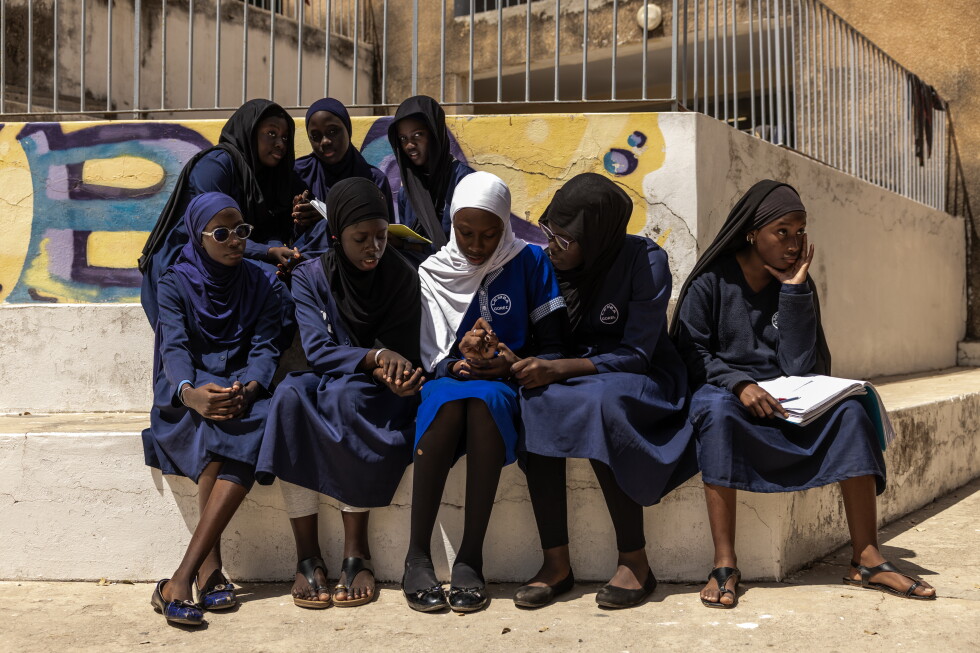
Nestled on Senegal’s historic Goree Island, just off the capital Dakar’s coast, the Mariama Ba Boarding School stands as a radical experiment in gender empowerment – one that is reshaping the trajectories of a small but growing group of young Senegalese women, even as broader systemic barriers to gender equality persist across the country.
For Ndeye Awa Diop, admission to the school at age 12 marked a complete reversal of the life she had been raised to expect. Growing up in a rural Senegalese community, Diop was taught the traditional expectations imposed on girls in this majority-Muslim West African nation: remain quiet, defer to elders, and be seen rather than heard. So shy she could not meet others’ eyes, Diop spent her first weeks at the school homesick and too afraid to raise her hand in class. Seven years later, the 19-year-old serves as president of the student body, on the cusp of graduation, and ready to pursue a career as an international business lawyer. “I learned to be a leader,” Diop said, adding that the sisterhood of her classmates carried her through the hardest early days. For Diop, who is the first girl from her village to earn a spot at the school, the shift in mindset has been profound: unlike most young Senegalese women of her age, starting a family is not her immediate priority. “To be a strong woman is not to be afraid to be alone,” she said.
Senegal has made notable public progress toward gender equity in recent decades. Progressive national legislation requires that women make up half of all political parties’ candidate slates, and formal law guarantees women equal access to land ownership, at least on paper. In primary education, girls’ enrollment rates now outpace those of boys, a major milestone for a region where girls’ access to schooling has long lagged. Yet deep-rooted cultural and economic barriers keep millions of girls from reaching their potential. When household finances are stretched, families almost always prioritize keeping boys in school over girls, even when girls demonstrate stronger academic performance. Girls often miss classes once they reach menstruation due to lack of proper hygiene infrastructure, and early marriage and teenage pregnancy drive many out of school before graduation. Today, fewer than 20% of Senegalese girls complete high school, and national literacy data shows just 84 literate women for every 100 literate men. “The current challenge isn’t access to school for girls, but rather the completion of schooling up to secondary level and, of course, the transition to the job market,” explained Maissa Abdellaoui, a girls’ education specialist with UNICEF.
Against this backdrop, the Mariama Ba school was founded in 1985 by Senegal’s first president, Leopold Sedar Senghor, named for one of the nation’s most iconic female writers. Mariama Ba, the school’s namesake, was a trailblazing author whose work explored the tension between traditional Senegalese life and modern women’s aspirations, openly criticizing the nation’s widespread practice of polygamy and deeply entrenched patriarchal norms. Though she was a lifelong advocate for gender equality and a three-time divorcee at a time when divorce for women was virtually unheard of, Ba rejected the label of feminist, which she viewed as a Western import.
The school itself is housed in a former French military barracks on Goree Island, a site of profound historical weight: as Africa’s westernmost point, it was once the largest hub of the trans-Atlantic slave trade. Today, the car-free island is a serene space of cobblestone streets, and the school’s courtyards bloom with bougainvillea, baobabs and palm trees, with the constant sound of ocean waves and birdsong in the background. Selectivity is extreme: each year, just 35 girls are admitted from 150 top-performing applicants who qualify to take the entrance exam, and all tuition and boarding costs are fully covered by the Senegalese government. The school boasts a 100% high school graduation rate, a statistic unheard of across the rest of the nation.
Over six years of secondary education, students follow a tightly structured daily routine: wake before dawn, shower, prayer, breakfast, classes, study hall, and an early end to the day to prepare for the next. Alongside rigorous academic training, students take art classes, compete in sports, and attend regular talks with prominent female leaders – many of whom are alumni of the school itself. Headmistress Ramatoulaye Diagne Sarr explains that this strict discipline is intentional: the school exists to train the next generation of female leaders that Senegal will depend on in coming years. In one recent humanities class, 15-year-old students led a heated, thoughtful discussion of the history of slavery – a topic that feels deeply personal given the school’s location – guided by teacher Paul Felix Thiao. “Often in society, we see that men tend to dominate women,” Thiao said. But places like the school show that “if we give them more freedom, if we give them more opportunities, they can go far.”
Despite the school’s transformative impact on its students, challenges to widespread female empowerment remain acute across Senegal. UN data shows that women own just 2% of the nation’s agricultural land, make up the majority of the country’s informal, unprotected workforce, and Senegalese law still formally recognizes only men as heads of household. For 18-year-old student Marie Diop, navigating these cultural norms is a daily struggle. “In Senegal, people’s mentality remains very, very, very strict regarding women’s independence,” she said. “In fact, each day you are fighting a battle to make people understand that … women have the capacity to manage, to be in charge.” Even within the school, structural inequities persist: while every headmistress in the school’s history has been a woman, the majority of teaching staff are still men.
Alumni of the school say the experience upended the expectations they grew up with, and many now return to serve as mentors to current students. Matel Sow, 27-year-old head of the school’s alumni association, grew up in a small village in eastern Senegal, and had to convince her father to let her attend the school. Today, she holds degrees from Dakar’s prestigious Cheikh Anta Diop University and the University of Texas, and works as an associate at the nonprofit International Budget Partnership. Over time, Sow said her father shifted his perspective, telling her: “You can do what you want, I trust you, as long as you stay true to your core values and roots” of tradition and religion. As a working mother of a two-year-old girl, Sow said she has built an equal partnership with her husband that has helped her navigate the competing pressures of work and family.
While the Mariama Ba school’s track record is impressive, experts emphasize that it remains the only institution of its kind in Senegal, and that systemic change is needed to extend the same opportunities to all girls. Abdellaoui, the UNICEF specialist, praised the school’s model but noted that the nation’s most vulnerable girls – those from low-income rural communities outside Dakar – still lack access to this level of support. Headmistress Sarr acknowledged that the majority of current students come from the capital region, leaving room to expand access to more girls from across the country. Even so, Sarr said the school serves a critical purpose as a proof of concept: it shows what girls can achieve when given the resources and support to thrive, serving as a model for girls across the nation “who are hesitating, who think it’s impossible to climb the ladder.”