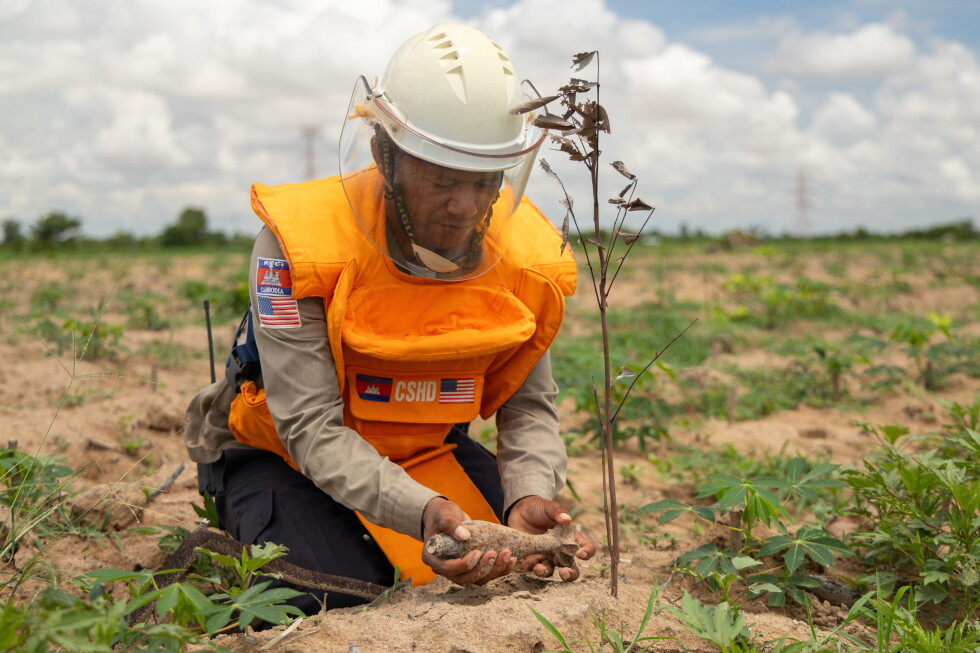
Deep in the former Khmer Rouge strongholds of rural Cambodia, En Poy was tending to his family’s cattle decades ago when he stumbled on a rusted relic of 20th century warfare: a forgotten land mine. When he picked it up, the explosive detonated, robbing him of one arm and one eye. But instead of turning away from the danger that altered his life, Poy turned his trauma into purpose, joining Cambodian Self Help Demining – a local nonprofit working to clear millions of tons of unexploded ordnance left from decades of conflict that still litter the country’s countryside.
Today, decades after Poy survived that first blast, the organization he dedicated his life to is on the brink of collapse. Foreign donors, the primary source of funding for demining work across Southeast Asia, are rapidly redirecting resources away from the region’s long-standing explosive legacy to address urgent humanitarian needs in active conflict zones including Ukraine, Gaza, Sudan, Syria and Afghanistan. Simultaneously, a global surge in defense spending driven by modern warfare has squeezed overall budgets for foreign humanitarian aid, leaving legacy demining projects starved for resources.
The funding crisis was exacerbated by former U.S. President Donald Trump’s 2024 restructuring of the U.S. Agency for International Development (USAID) and a 90-day freeze on all new foreign aid disbursements, which halted all American demining support to Cambodia temporarily. While funding has since restarted, the disruption has left long-term projects uncertain.
Poy knows the cost of this funding shift firsthand. He survived a second land mine explosion that left shrapnel embedded across his face and body, and killed three of his demining colleagues. Now, he travels across Cambodia’s high-risk regions to educate local communities on how to avoid accidental encounters with explosives, but he questions how much longer his work can continue. “If one day donors stop funding my organization, I would definitely be sad because we haven’t finished our job,” he said. “There are still a lot of landmines left over.”
Cambodia’s ongoing crisis is far from unique. The deadly legacy of the Vietnam War spilled across Cambodia, Laos and Vietnam, leaving millions of tons of unexploded ordnance across all three nations that continues to kill and maim civilians decades after the fall of Saigon. For Cambodia, which also endured the Khmer Rouge’s four-year reign of terror that killed an estimated 1.7 million people, the problem is particularly acute: it ranks among the most heavily land-mined countries on Earth. Laos holds the grim title of the most heavily bombed country per capita in history, while Vietnam continues to grapple with the long-term toxic fallout of chemical weapons used during the war.
Across the three nations, legacy ordnance has killed roughly 90,000 people and injured nearly twice that number since the end of all major conflicts. Explosives buried under agricultural fields, grazing pastures and developing construction zones block the development of new roads, schools and housing, trapping rural communities in cycles of poverty. Children, who often mistake rusted ordnance for scrap metal or toys, account for more than 40% of all civilian casualties from land mines globally since 1999, according to the Landmine and Cluster Munition Monitor, a nonprofit monitoring initiative.
Demining is not a quick or simple process. Teams first conduct extensive surveys to map contaminated areas, then clear dense vegetation inch by inch before using metal detectors and specialized equipment to locate and safely destroy explosives. Progress is measured in square meters cleared per day, and work must pause entirely during heavy rain. Crucially, explosives do not become less dangerous as they age: as rust and corrosion degrade their casings, they become even more sensitive to movement and more likely to detonate accidentally.
“These things don’t really become less dangerous with time. They become more dangerous as they deteriorate,” said Charles Ray, a Vietnam War veteran who served as the first post-war U.S. consul general in Ho Chi Minh City and later as U.S. ambassador to Cambodia. Ray noted that U.S. funding for demining has long served as a tangible gesture of reconciliation after the war. “By funding demining, the U.S. proved it cared,” he said. “We’re not just this behemoth that comes in with our military machine and breaks things, we can also help nations rebuild.”
Data from the Landmine and Cluster Munition Monitor shows that total global funding for humanitarian demining reached $4.3 billion between 2020 and 2024. Only one-fifth of that funding came from national governments of affected countries, with the remaining 80% coming from foreign aid, led by the United States, Germany, the European Union, Norway and Switzerland.
Maria Vardis, a senior official with the U.N. Mine Action Service, explained that new outbreaks of conflict have created unprecedented demand for demining support globally, as active combat leaves large swathes of new territory contaminated with explosives. In 2024 alone, Ukraine received one-third of all global humanitarian demining funding – more than any other country, the monitor found. Other active conflict zones including Gaza, Yemen, Syria, Sudan and Afghanistan have all seen increased funding allocations, leaving older, smaller-scale projects in Southeast Asia with steep cuts. Germany is currently considering further reductions to foreign aid to free up more budget for defense spending and military support to Ukraine.
Complicating the issue further, new land mines are still being laid across Southeast Asia amid ongoing low-level conflicts, including the civil war in neighboring Myanmar and periodic border clashes between Cambodia and Thailand. “Funding does fluctuate year to year, but in the big picture, even in the face of cuts by many governments, the big crises continue to be funded, but smaller and older mine action projects are struggling,” Vardis said.
For U.S. funding in the region, the Trump administration’s policies have created long-term damage beyond immediate budget cuts, said Danae Hendrickson of Legacies of War, a U.S.-based advocacy group focused on addressing the war legacy in Southeast Asia. She noted that U.S. demining aid to the region has fluctuated wildly under Trump, setting “a really dangerous precedent for what can be done.”
Congressional documents show U.S. funding for war legacy programs in Vietnam dropped to $56.5 million in 2024 from $197 million allocated the previous year. In July 2025, Secretary of State Marco Rubio announced $130 million in new demining assistance for Southeast Asia, but provided no detailed breakdown of allocations.
Nguyen Khac Giang, a visiting fellow at Singapore’s ISEAS–Yusof Ishak Institute, said last year’s U.S. aid freeze halted demining projects across Vietnam and eroded decades of hard-built trust between Washington and Hanoi. “The lasting damage is to the hard-earned trust between the two former enemies,” he said. A U.S. State Department spokesperson, however, told the Associated Press that American assistance is “not charity” and that humanitarian demining will continue to align with U.S. foreign policy interests globally.
In Cambodia, the immediate outlook is grim. Official data from the Cambodian Mine Action and Victimization Assistance Authority shows that between 1992 and 2025, demining teams have cleared roughly 1.2 million land mines and 3.2 million other pieces of unexploded ordnance across the country. Even after 30 years of work, an estimated 1,749 square kilometers (675 square miles) of contaminated land remains uncleared as of 2024, with thousands more unexploded weapons still unaccounted for.
Bill Morse, president of the U.S.-based Landmine Relief Fund which supports Cambodian Self Help Demining, estimates millions of ordnance may still be buried across the country. Just an hour’s drive from Siem Reap’s world-famous Angkor Wat temple complex, demining teams with the organization recently inched slowly through a contaminated field, locating a Soviet-designed anti-personnel mine just meters from a major highway leading to a new Chinese-funded airport. A second team was called to a nearby cassava farm to destroy an unexploded mortar round and rocket-propelled grenade.
Morse said the organization could be forced to cease all operations by September 2025 due to massive donor cuts. “We have simply run out of donors,” he said. “If people want to pull their money away, that’s a decision that they have to make. But when they do, people will die here.”