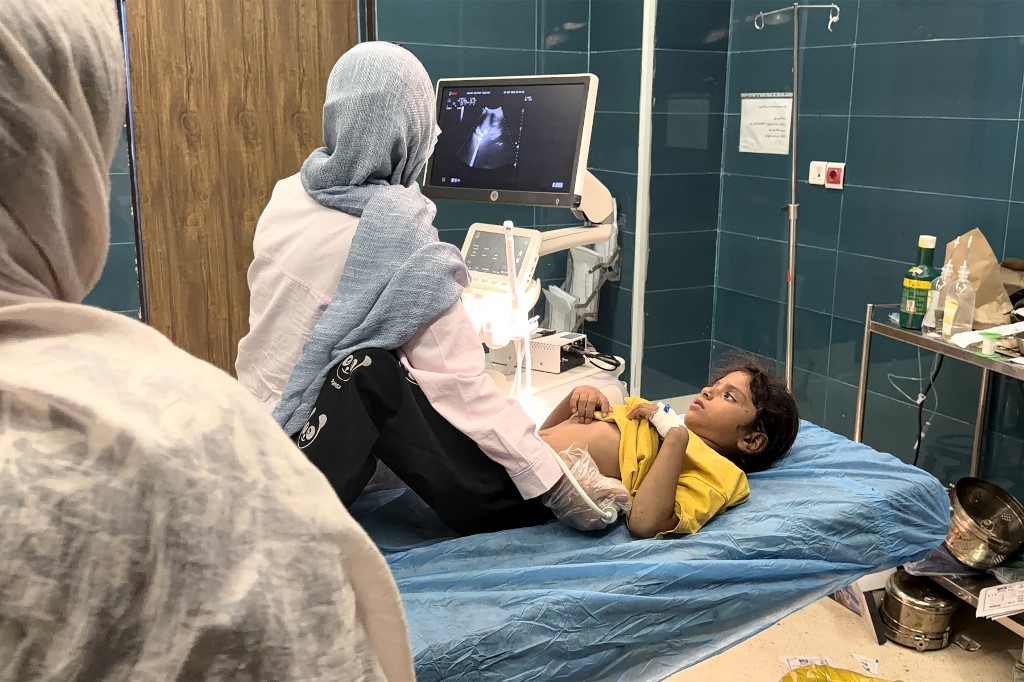
What was supposed to be the most joyful milestone in the lives of young Iranian couple Maryam Mallahi and Ziaeddin became one of the deadliest civilian tragedies of the latest round of US military strikes across Iran, leaving five people dead and dozens injured, many of them children.
On the evening of September 1, around 350 guests gathered in the small coastal community of Kuhestak, located in Sirik County along Iran’s Hormozgan province eastern shore, to mark the couple’s marriage. Following long-held local custom, the celebration was split across two separate venues: male guests assembled at a relative’s residence, while women and children waited for the newlyweds at the bride’s family home. Strings of colored lights were strung across the property, guests dressed in vibrant traditional attire, and anticipation built as the crowd waited for Maryam and Ziaeddin to make their entrance.
The idyllic scene shattered at approximately 9 p.m., as the United States launched a sweeping new wave of air attacks across southern Iran. Multiple explosions echoed across Kuhestak, a small settlement where the wedding venue sat just 200 meters from a telecommunications tower that was among the initial targets hit. Moments after the first blasts, a projectile tore through the roof of the bride’s single-story home, where dozens of women and children had gathered.
Majid, a 41-year-old guest at the nearby men’s gathering whose wife and five-year-old child were both wounded in the strike, described the chaos that unfolded in the attack’s immediate aftermath. “We were talking to other guests when suddenly we heard a terrifying sound. At first we thought it was an earthquake. We panicked and ran outside,” he recounted to Middle East Eye. “We rushed toward the bride’s house and saw smoke and fire everywhere. I pulled my wife and my child out from under the rubble. Screams came from every direction, there was blood everywhere, and everyone was scrambling to pull the wounded to safety.”
Ali Mallahi, the bride’s father and owner of the destroyed home, told reporters he heard a second and third blast, and immediately realized the explosions were centered on his property. “The first explosion completely destroyed the single-story house and left it uninhabitable. The second struck the courtyard, damaging a car and other parts of the property. The house is not a home any more. It is gone,” he said.
One projectile left a 1.5-meter-deep crater in the floor of one of the home’s main rooms, according to local on-site reporting.
Mina, a female guest who was trapped under rubble before being rescued and transported to Abolfazl Hospital in nearby Minab, described the casual horror of the moment the attack hit. “We were eating ice cream – the weather is still very hot in Hormozgan this time of year, you know – and we were waiting for the bride and groom to arrive when suddenly we heard this terrifying explosion nearby,” she said. “A second blast hit the house almost immediately and tore a hole through the roof. Bricks and chunks of ceiling and walls came crashing down on us. Everyone was screaming, everyone was calling for help, nobody knew what had happened. I was trapped under the rubble. I was just lucky to get out alive.”
Nineteen-year-old Zahra, another wounded guest, recalled the gruesome scene inside the home that had been decorated just hours earlier for a celebration. “Every carpet in the house was stained with blood. The shoes, the serving dishes, the lights they had put up for the wedding all had blood on them,” she said.
Local residents launched a frantic search for survivors before formal emergency response teams could reach the remote site. A Red Crescent rescuer who arrived moments after the strike, who requested anonymity for security reasons, said that uninjured guests and nearby neighbors had already begun pulling survivors from the rubble by the time his team arrived. “People who had escaped the building and others who saw the attack from outside were already trying to pull the wounded and survivors out from under the rubble,” he said. “They were so terrified that we had to spend a large part of our time just calming them down. Of course they were terrified. This was a real tragedy. It took only a few moments for their wedding to turn into mourning.”
Fifteen ambulances were deployed to the area, with most casualties transported to hospitals in Sirik and Minab, and the most severely injured admitted directly to intensive care units. Iranian officials initially recorded two deaths and 50 injuries, but the toll climbed steadily in the days after the attack. The final confirmed death toll stands at five: 50-year-old Zarkhatoun Taheri, 43-year-old Kolsoum Mallahi-Nezhadnia, 16-year-old Mohammad Mallahi, four-year-old Amir Mohammad Karimi, and 22-year-old Asieh Molaeinejad, who succumbed to her injuries in hospital on Thursday.
Provincial authorities confirm 68 people were wounded in total, 19 of whom are children under the age of 10. Fatemeh, a lightly injured guest who knew Amir Mohammad and his family, shared the devastating heartbreak of the young boy’s death: “Amir Mohammad was supposed to start preschool in just a few days, when the new school year began. Now his parents have to attend his funeral. The grief is unbearable.”
To date, no official Iranian or US statement has confirmed exactly what type of weapon struck the wedding venue. Witnesses interviewed by Middle East Eye gave conflicting accounts, with some identifying the projectile as a missile and others saying it came from a drone. Razieh Alishvandi, deputy for international and humanitarian affairs at the Iranian Red Crescent, has officially characterized the incident as a projectile strike on a private residential home during a civilian wedding. All residents and witnesses interviewed confirmed the home was purely residential, with no military, security, or intelligence infrastructure located nearby.
The Kuhestak strike was part of a broader wave of US attacks across Hormozgan and other regions of southern Iran that night. Iranian officials confirmed additional strikes and explosions in Bandar Abbas, Qeshm, Jask, Konarak, and Chabahar. In Kuhestak, the strike also damaged the local telecommunications tower, portions of the town pier, and critical electricity and communications infrastructure, cutting mobile phone and internet service for Kuhestak and the nearby village of Mishi for several hours.
For local residents, the attack immediately stirred traumatic memories of a February strike on the Shajareh Tayyebeh girls’ school in Minab that killed 156 people, most of them children, on the first day of US-Israeli strikes against Iran earlier this year.
US officials have not publicly confirmed what the intended target in Kuhestak was. US Central Command said in a statement that the night’s strikes targeted Iranian radar, communications, and maritime capabilities, adding that the US military does not intentionally target civilians. US Vice President JD Vance later stated that Washington was launching an investigation into the incident.
Maryam and Ziaeddin survived the attack only by chance: neither had arrived at the bride’s home when the projectile struck. While the couple escaped physical harm, all of the dead and injured are close relatives, friends, and guests they had invited to celebrate their marriage. A close friend of the bride, who requested anonymity, said Maryam remains in deep shock and fragile mental health. “Maryam is in a very bad state – very, very bad,” she said. “She had dreamed about this night for so long. She wanted to celebrate the beginning of her married life with her family and friends. Now her mental state is so fragile that we honestly do not know how she will cope with this tragedy.”