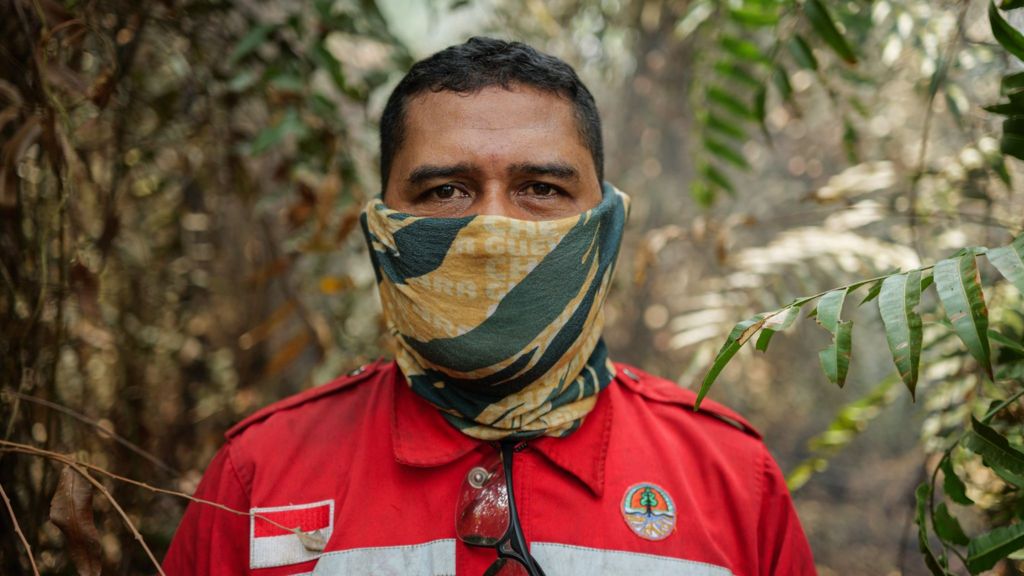
For more than a month, volunteer firefighters across Indonesian Borneo have waged an uphill battle against out-of-control wildfires, breathing in toxic fumes as they fight to contain a catastrophe that has grown into the region’s worst haze disaster in a decade.
Dwi Sujatmoko, a 35-year-old volunteer, describes the acrid smoke that envelops the fire line as indistinguishable from tear gas. “It strikes your nose immediately, and your eyes burn nonstop,” he says. “People call these fires extraordinary, and they are absolutely right.” Since early July, these blazes have turned 200,000 hectares of forest and farmland into charred carbon, with invisible underground peat fires continuing to smolder long after surface flames are extinguished, releasing poisonous fumes into the air that travels across national borders to Singapore, Kuala Lumpur, and Manila.
Armed only with hand tools, wheeled carts, and portable fire pumps, thousands of local volunteers – many from indigenous Dayak and Banjar communities – are the first line of defense against an inferno that is fueled in large part by a Super El Niño-driven drought that has parched the landscape. Fahrin Ramadhianto, another volunteer stationed in the hard-hit city of Banjarbaru in South Kalimantan, has spent a month on the front lines and already feels the toxic impact of the haze on his body. “The smoke smells like burning decaying wood – that’s the unique signature of peat,” he explains. “That’s all decomposed organic material accumulated over thousands of years, and we breathe it in every single day.”
What makes this wildfire crisis far more dangerous than typical seasonal blazes is that it is burning through one of the world’s largest tropical peatland ecosystems – a 4.5 million-hectare swath of ancient swamp and forest that acts as one of the planet’s most efficient natural carbon sinks. Under normal waterlogged conditions, peat slows decomposition, allowing carbon to build up underground for millennia. In Borneo, some peat deposits reach more than 20 meters deep, holding up to 6,000 tonnes of carbon per hectare – roughly equal to the annual CO₂ output of 4,800 gasoline-powered cars.
“When peatlands are drained or burned, that stored carbon is released into the atmosphere extremely quickly, turning these carbon sinks into what experts call a ‘carbon bomb,’” explains Dr. Nisa Novita, a peat researcher with Indonesian conservation NGO Yayasan Konservasi Alam Nusantara. “Indonesia’s tropical peatlands are some of the most valuable carbon stores on Earth, and their destruction has massive global climate impacts.”
The human cost of this crisis is already being felt across Southeast Asia. In Indonesia alone, the Health Ministry recorded more than 50,000 cases of fire-linked respiratory infections between July and August, over 12,000 of which are children under five. Air quality indexes across Indonesia, Brunei, Malaysia, Singapore, and the Philippines have skyrocketed to dangerous “unhealthy” levels, with some areas recording pollution levels nearly 75 times the World Health Organization’s recommended safety limit. Hospital admissions for respiratory and cardiovascular conditions have surged across the region.
“Everyone trapped under this pollution cloud is inhaling toxic carbon monoxide and fine particulate matter from smoldering peat,” says Susan Page, a professor of geology and environment at the University of Leicester who has studied Asian peatlands for 30 years. “These particles are small enough to pass through lung tissue into the bloodstream, triggering heart disease and chronic health conditions beyond just respiratory issues. Living under this haze is extremely dangerous for everyone exposed.”
Nowhere are these risks more acute than on the front lines, where two volunteer firefighters in Central Kalimantan have already died after their health deteriorated from weeks of exposure to toxic smoke. Peat fires are notoriously difficult to extinguish, because they burn underground and can reignite weeks after being contained. To put them out, firefighters must saturate the dry peat until it is “like porridge” – a tactic that is increasingly difficult amid a crippling drought that has left much of the region starved for water.
Volunteers have dug emergency ponds, canals, and borewells to keep their hoses supplied, driven custom pipes into the ground to reach hidden subterranean fires, and slept within steps of the fire line to battle flare-ups through the night. Fatigue is constant, Sujatmoko says: “We’re all exhausted. We miss our families, our children, our partners. But we put that all aside right now – this is our duty to our home.”
While the current crisis is amplified by Super El Niño, experts say the root of the disaster stretches back decades to large-scale industrial land-use change that began under the Suharto regime, when vast swathes of Borneo’s peatlands were drained and cleared for logging, industrial plantations, and development projects. In 2025 alone, Kalimantan – Indonesia’s most heavily deforested region – lost nearly 160,000 hectares of forest, more than a third of the country’s total annual deforestation, much of it cleared for industrial monocrop agriculture.
Page notes that draining peatlands for plantations not only makes them far more vulnerable to wildfire, but also causes constant carbon emissions even when there is no blaze: “Fires are just the most dramatic and visible expression of a process that goes on every single day in drained peatlands. That constant emissions stream is often overlooked.”
Indigenous communities that have lived on and cared for Borneo’s lands for centuries have frequently been scapegoated for the wildfires, blamed for traditional controlled burning practices used to clear small plots for farming. But Tono, a representative of the West Kalimantan Dayak Kanayatn people, says these accusations are unfounded. His community’s traditional hill farming practice, called uma bukit, is rooted in maintaining balance with nature, and controlled burns are carried out with careful planning and strict adherence to ancestral customs that minimize fire risk. Today, many indigenous community members are on the front lines fighting the very blazes they are falsely blamed for causing.
As the crisis continues to escalate, firefighters on the ground say their greatest hope is for heavy, sustained rain to finally douse the persistent blazes. “We’ve been away from our homes for months,” Sujatmoko says. “We just hope all our efforts here protect everyone, and that the rain comes soon.”