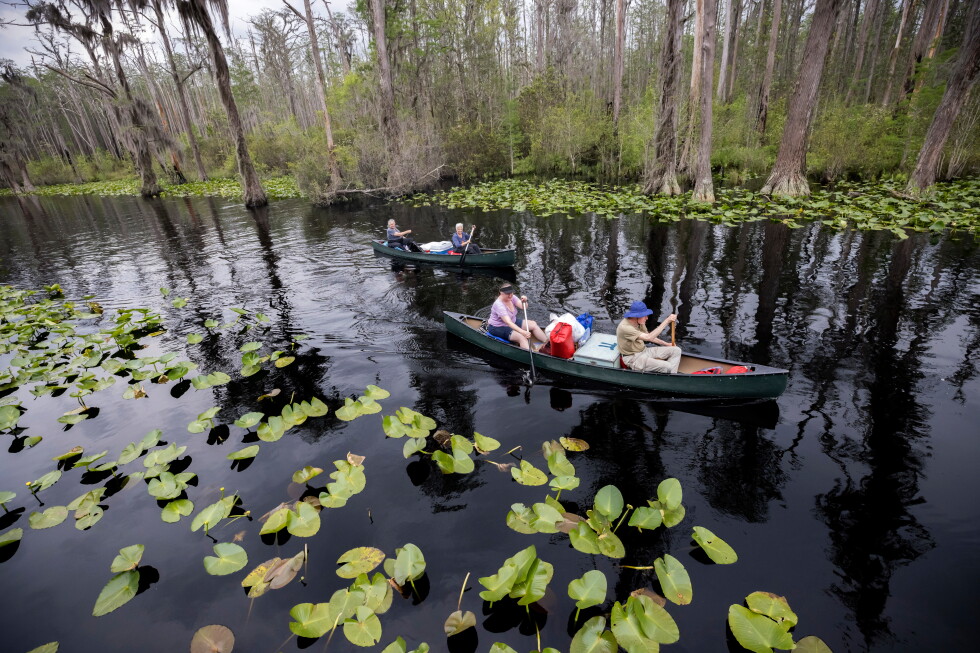
Deep in the pine forests of southern Georgia, the 438,000-acre Okefenokee Swamp stands as one of America’s most ecologically significant wetland landscapes, home to iconic alligators, rare carnivorous plants, and untouched old-growth cypress forests that have remained largely undisturbed for millennia. On Saturday, a United Nations cultural committee convening in Busan, South Korea is set to vote on whether the Okefenokee will earn a spot alongside the Grand Canyon, Everglades, and Yellowstone as the United States’ 27th UNESCO World Heritage Site. But for many rural residents living in the three counties surrounding the swamp, the international honor is anything but welcome—rooted in deep distrust of the United Nations and aligned with the broader “America First” political framework that dominates the region.
For years, hand-painted lawn signs reading “Keep the U.N. (UNESCO) out of the Okefenokee” have lined rural highways across Ware, Charlton, and Clinch counties, while the slogan adorns t-shirts sold at local farm supply stores and community events. All three counties are heavily rural, majority conservative, and gave former President Donald Trump more than 70% of the vote in the 2024 presidential election. Trump’s “America First” agenda has resonated deeply here, and his July 2025 announcement that the United States would fully withdraw from UNESCO at the end of 2025—citing the body’s misalignment with U.S. foreign policy priorities—has reinforced local skepticism of the global organization.
Barry Cox, a Ware County commissioner elected in 2024 after four decades running the county’s vehicle maintenance shop, says opposition to the designation is nearly universal among his constituents. “All I heard from the people I represent is that they were scared the UN would come in here, start taking private land, and tell us what we can and can’t do with our property,” Cox explained in an interview with The Current. Cox, who attended an informational meeting on the nomination hosted by an anti-UNESCO group but was unable to attend a pro-designation briefing, says his position reflects the will of the community he serves.
In June 2025, Cox and the Ware County Commission passed a formal resolution opposing the nomination, pledging the county would not enforce any rules or policies originating from the United Nations or its subsidiary bodies that would violate private property rights protected by the U.S. and Georgia state constitutions. Charlton County passed an identical measure shortly after.
The campaign against the designation has been led in large part by national conservative groups, most prominently the Committee For A Constructive Tomorrow (CFACT), a Washington D.C.-based nonprofit that promotes free-market environmental policy and rejects the scientific consensus on anthropogenic climate change. In December 2025, CFACT released a YouTube video titled “Save Okefenokee from UNESCO Control” as part of its “Conservation Country Series,” which frames the World Heritage nomination as an international land grab that threatens U.S. sovereignty.
CFACT policy analyst Gabriella Hoffman points to the 2024 nonbinding Republican primary party question in Ware County as evidence of broad grassroots opposition. The question, which asked voters whether they supported the UNESCO designation, claimed the UN held an agenda to control local school curricula, land use, infrastructure, and housing, and framed the designation as a violation of U.S. sovereignty. Of the 3,144 voters who cast ballots in the primary, 93% voted against the nomination.
Charles Bullock, a longtime distinguished professor of public affairs at the University of Georgia, argues the loaded wording of the question all but guaranteed the lopsided result. “Who would vote yes when it’s framed as the UN coming to take over our country?” Bullock noted. “The question was designed to produce that outcome.”
Charlton County Commissioner Drew Jones, who appears in the CFACT video, acknowledges the designation would not amount to a direct seizure of private land, but argues it still represents an unacceptable overreach of international influence. “I get that it’s not a literal land grab, but people see it as a metaphorical one—they think the UN would gain implicit influence over public and even private lands here, and they shouldn’t have any say at all,” Jones explained. Jones added that the prominent role of U.S. geopolitical rivals like China and Russia within the UN system makes the designation even less palatable for local residents. “I don’t think China or Russia are going to come steal the swamp or anything, but I don’t like the idea of them sitting at a table decades from now judging what’s a threat to this land,” he said. “Any oversight of the Okefenokee should come from Atlanta or Washington, not some international body in New York.”
For Joe Hopkins, whose family-owned Toledo Manufacturing manages thousands of acres of forest land surrounding the swamp, opposition boils down to protecting long-held private property rights. He points to the 1990s debate over the proposed New World Gold Mine near Yellowstone National Park—itself a UNESCO World Heritage Site—as an example of how the designation can invite unwanted international pressure on local land use decisions. “If you have a development project near a World Heritage Site, you don’t just get opposition from U.S. environmental groups—you get thousands of letters from people and governments all over the world,” Hopkins said. But historical records contradict this framing: the Public Land and Resources Law Review found the mine was ultimately blocked by a federal Clean Water Act lawsuit, not international pressure from UNESCO. While the World Heritage Committee did place Yellowstone on its endangered list in response to the proposal, the ruling carried no legal weight and only heightened public scrutiny, rather than deciding the outcome.
CFACT’s video also misleadingly cites two academic sources to bolster its opposition. Hoffman cites a study focused on World Heritage Sites where local communities reside within the site’s boundaries to claim the designation infringes on local human rights—but the entire Okefenokee National Wildlife Refuge is already federally managed, and no residential communities exist within its proposed World Heritage boundaries. She also references a 2018 Stanford University article quoting anthropologist Lynn Meskell arguing the UNESCO World Heritage program had “lost its way” as countries prioritized branding benefits over conservation. What the video omits is Meskell’s explicit rejection of the claim that UNESCO controls U.S. World Heritage Sites: “One problem is that there is widespread ignorance when it comes to UNESCO,” Meskell stated in the article. “Some people think that a UNESCO inscribed site is not U.S. sovereign territory and that the United Nations somehow controls those sites. That is incorrect.”
Official clarifications from the U.S. Fish and Wildlife Service, which owns and manages the Okefenokee National Wildlife Refuge, echo that point. In a 2024 public explainer, the agency emphasized that the World Heritage designation “does not confer any ownership or management authority to the United Nations. UNESCO only monitors the current conditions and potential threats to the designated properties. The Refuge would continue to be wholly owned and managed by the US Fish and Wildlife Service.”
Still, that clarification has done little to ease local concerns. Andra Gillespie, an associate professor of political science at Emory University, notes that the opposition is rooted in longstanding ideological commitments, not just misinformation. Political scientists like Bullock trace the sentiment to deep-rooted American localism, a tradition of resistance to outside influence that has shaped U.S. political debates for more than a century. “Folks here don’t want anybody telling them what to do with their property—whether that’s the federal government or an international body,” Bullock explained. “This is the same tradition that led to fears of Catholic influence in U.S. politics in the 1960s, and to resistance to federal civil rights policy for generations. It’s a long-running strain of American thought.”
The UNESCO World Heritage Committee is scheduled to hold its final vote on the Okefenokee nomination at 3 p.m. local time Saturday in Busan, with the proceedings available via public livestream. Attempts by The Current to reach leaders of the two main anti-UNESCO groups active in southern Georgia have so far been unsuccessful: Americans for the Okefenokee declined an interview via Facebook Messenger, while the Georgia Republican Assembly did not respond to multiple requests for comment.