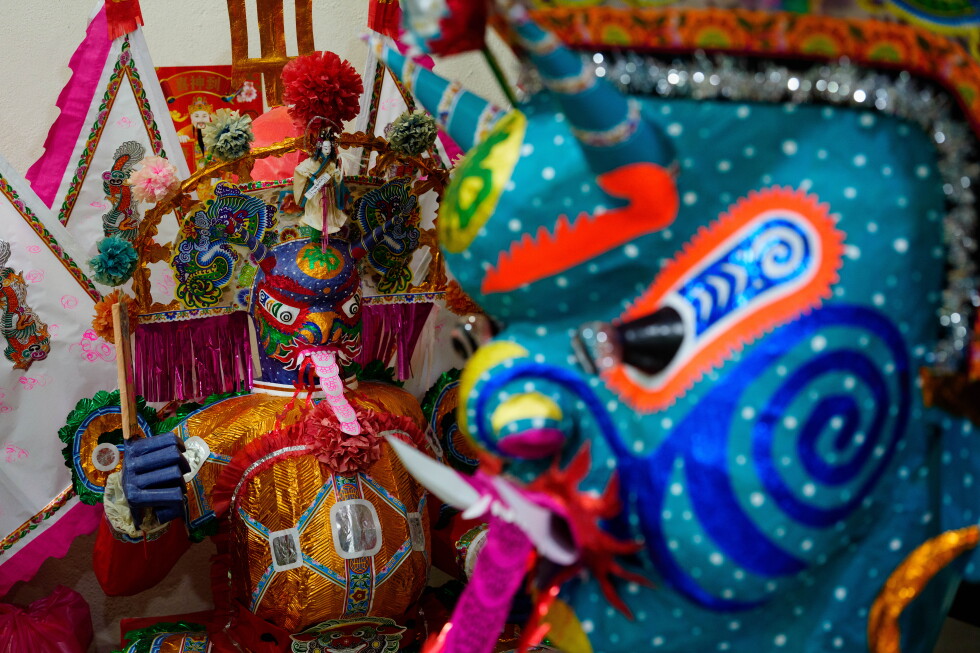
Nestled in the northern Malaysian state of Penang, the town of Bukit Mertajam comes alive every seventh month of the Chinese lunar calendar for one of Southeast Asia’s most enduring traditional Chinese religious celebrations: the Hungry Ghost Festival, centered on the veneration of Da Shi Ye, the Guardian God of Ghosts.
This year’s festival, which ran for 15 days from mid-August, traces its origins all the way back to 1888, when a devastating plague swept through Bukit Mertajam. In the wake of the outbreak, local Chinese ancestors established the ritual of worshipping Da Shi Ye to appease and care for wandering spirits, a practice that has remained uninterrupted for more than 135 years.
At the heart of the celebration stands a towering handcrafted effigy of Da Shi Ye, built from paper and bamboo. Following generations-old custom, the effigy is increased by roughly two centimeters every year. In 2025, the effigy stands at nearly 29 feet tall. For 69-year-old artisan Ng Chi Wong, who has devoted more than 40 years of his life to crafting these figures, the construction process is a masterclass in tacit tradition. A team of seven to eight builders spend roughly 45 days completing the work, with no formal blueprints to guide them. “Most of the design and construction details are already in our minds,” Ng explained. Builders start with the intricately detailed head, before assembling the bamboo frame, shaping the body, adding outer paper layers, and finishing with hand-painted details. While small incremental improvements have modernized minor parts of the process, Ng says the craft demands more than technical skill: artisans must also deeply understand the cultural and spiritual roots of the tradition to honor it properly.
Unlike Qingming Festival (Tomb-Sweeping Day), which centers on honoring one’s own family ancestors, the Hungry Ghost Festival extends care specifically to unclaimed wandering spirits—people who died with no surviving family members to pray for them or offer them sustenance in the afterlife. Lim Han Cong, a Chinese studies graduate from the University of Malaya, explains that the festival weaves together beliefs from Buddhism, Taoism, and Chinese folk religion. “At its core, the Ghost Festival expresses the belief that the living and the dead remain connected through enduring moral and emotional bonds,” Lim said. “The living, therefore, have a responsibility to honor, support and help the deceased attain peace.” During the festival, Taoist priests recite sacred scriptures and conduct ritual ceremonies to guide these lost spirits to peace and salvation.
This year’s festival culminated in the traditional ceremonial burning of the Da Shi Ye effigy, a ritual that symbolically sends the deity back to the spirit world. Lee Kim Fong, the event’s general affairs coordinator, estimates that more than 10,000 people attended this year’s closing ceremony, with peak crowds swelling to 20,000. Devotees travel to Bukit Mertajam not just from across Malaysia, but also from neighboring Singapore, Indonesia, and Thailand, mirroring similar celebrations held in Hong Kong, Singapore, and Taiwan.
Far from remaining a static ritual locked in the past, the century-old festival has evolved to take on new meaning and roles for the local Chinese community. Since the 1970s, organizers have integrated charitable community work into the festival’s schedule. Auctions of blessed ritual offerings and targeted fundraising campaigns generate funds that support low-income residents with urgent medical needs and sustain local Chinese-language education. “It has also become an important platform for strengthening community solidarity,” Lim noted, explaining that the celebration now extends far beyond its original spiritual purpose of honoring the dead.
To adapt to modern times and ensure the tradition can be passed to future generations, organizers have also embraced digital innovation. For devotees who live overseas or cannot travel to Bukit Mertajam for the festival, the committee has introduced online worship options, allowing participants to join prayers and submit offerings remotely. A professional media crew documented the entire 15-day 2025 celebration from August 14 to 29, and organizers plan to upload full footage to Facebook to make the Da Shi Ye festival accessible to audiences around the globe.
“As descendants of the Chinese community, we have a responsibility to preserve this 100-year-old tradition,” Lee said.
This report was contributed to by AP video journalist Syawalludin Zain, with Hernández reporting from Beijing. Associated Press religion coverage is supported through AP’s collaboration with The Conversation US, with funding from Lilly Endowment Inc. The AP holds sole responsibility for this content.