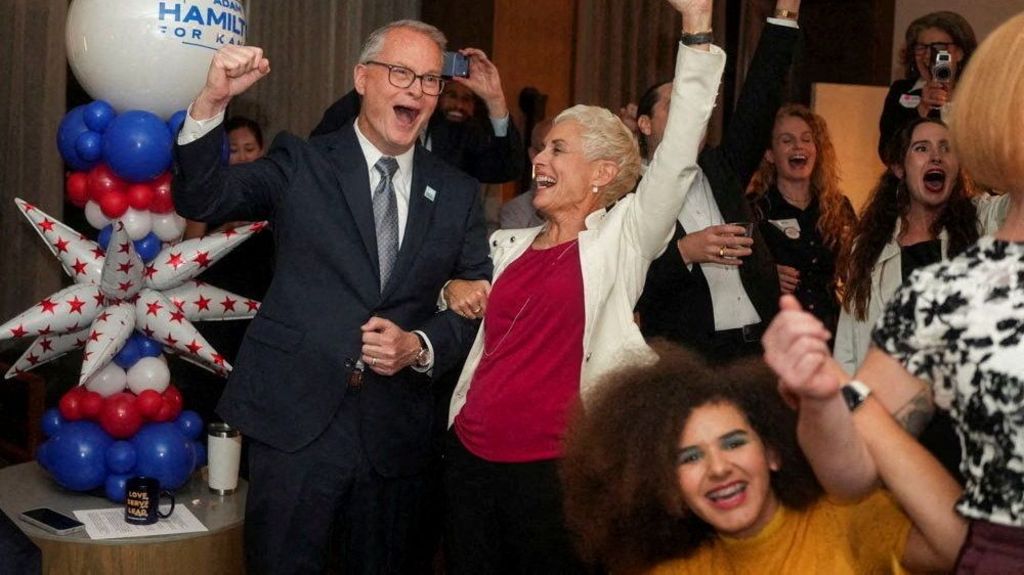
After days of severe weather ranging from torrential rain to tornado warnings across Kansas, residents woke up to clear, sunny skies on Wednesday alongside an unprecedented political milestone in the deeply conservative state. Following a fiercely contentious 2026 midterm election cycle, Democratic candidate Adam Hamilton secured a decisive victory over incumbent Republican Sen. Roger Marshall, a staunch ally of former and sitting U.S. President Donald Trump, marking the first time a Democrat has claimed Kansas’ U.S. Senate seat since 1932.
Hamilton, 62, is the founding pastor of the United Methodist Church of the Resurrection, the largest United Methodist congregation in the U.S. with a 24,000-strong membership base. Throughout his campaign, he centered his platform on calls for cross-partisan civility, pragmatic moderate policy stances, and a commitment to centering ordinary Kansans’ priorities in Washington. On the campaign trail, he frequently invoked the state’s shared cultural values, telling crowds, “What we need in Washington right now is senators with a brain who use it, with a heart who feel with it, and who have courage and speak up because of it.”
The race’s projected win for Hamilton sparked widespread celebrations across the state, cutting across long-held partisan lines. From lifelong Republican residents in tiny, unincorporated rural communities to liberal voters who had felt politically disenfranchised for decades, crowds erupted in cheers and sighs of relief as results were announced. In the manufacturing hub of Wichita, roughly 100 attendees at a Democratic watch party cheered alongside broadcast pundits describing a national “blue tsunami” that carried Democratic candidates to wins across traditionally Republican-held territories. “I have lived in Kansas for 30-something years, and I have felt all of those years like I voted and my vote was never counted,” 71-year-old resident Laura Elliott shared from the event. Former Democratic state representative Chuck Schmidt, 76, embraced younger attendees at the gathering, crediting rising generations of voters for the breakthrough. “People are fed up with the chaos and the corruption,” Schmidt noted. “People in Kansas, for some reason, have gotten conditioned to just vote for the R — and they haven’t realised there was another alternative.”
Faith has long been a defining electoral factor in Kansas, which a 2025 Pew Research Center report ranked as the 10th most religious state in the U.S., with 70% of residents identifying as Christian and nearly 30% as evangelical Protestants, a demographic that has overwhelmingly supported Trump and Republican candidates in recent election cycles. In Marshall’s hometown of Great Bend, 77-year-old Navy veteran Richard Elmore explained he backed the incumbent over his stances on abortion, transgender rights, illegal immigration, and gay rights, stating, “Anybody that’d say they were a Christian and not honour those things are lying to themselves and others.” The Marshall campaign had sought to frame Hamilton as a radical liberal whose positions contradicted biblical teachings, but that strategy failed to gain traction against the Democrat’s surging momentum. In his concession speech, Marshall quoted scripture and called the loss “humbling,” adding, “I don’t have any answers. I’ll just tell you it’s been the greatest honour of my life to serve the state of Kansas for ten years.”
Some local Republican leaders remained critical of Hamilton’s candidacy, with Barton County Republican Party chair and lawyer Richard Friedeman accusing the pastor of holding “very, very liberal” views and of being duplicitous in his messaging to different voter groups. Friedeman, a personal friend of Marshall’s who praised the outgoing senator’s record in office, acknowledged the national Republican Party faces significant headwinds. “I think there’s going to be a reckoning for the way Trump has alienated so many people … I think it’s going to be hard for awhile,” he predicted, a forecast that aligned with widespread Democratic upsets across other deep-red states including Iowa, South Carolina, and Texas, where once-unthinkable Democratic competitiveness even extended to the traditional heart of the Bible Belt in Mississippi, where the race remained neck and neck as of press time.
Most independent analysts and pollsters have framed these nationwide Democratic gains as a clear voter rebuke of Trump’s second-term agenda, including aggressive new immigration restrictions, ongoing military involvement in Iran, and sweeping global tariffs widely linked to persistent cost-of-living spikes. For many of Hamilton’s supporters, their motivation was rooted in shared faith values rather than partisan loyalty. Retired 77-year-old teacher Sharron Witters and her 78-year-old husband Lynn, a former forestry professor and 25-year veteran pastor, are evangelical Christians who volunteered for a political campaign for the first time in their lives to knock on doors and display lawn signs for Hamilton ahead of Election Day. “He doesn’t sound like a politician,” Sharron Witters explained. “What a delight to stand and listen to somebody whose sentences make sense. Wouldn’t it be wonderful if he actually motivated people to work across the aisle?” The pair noted that many other evangelical voters had backed Trump solely over his anti-abortion stances, but they had viewed him as “a wolf in sheep’s clothing” from the start of his political rise.
Hamilton successfully built a broad, cross-partisan coalition that included lifelong Republicans who had never before voted for a Democratic candidate. Eighty-five-year-old retired banker Dan Bonine, an early supporter of Marshall’s when he first launched his political career, cast his first-ever Democratic ballot for Hamilton, comparing his leadership style to former Republican president Ronald Reagan. “Ronald Reagan was really a great leader to bring us together, and I think Adam Hamilton possesses much of that same kind of leadership skill,” Bonine said. Even 40-year-old registered Republican Bryan Drescher, who grew up in Great Bend and was once coached in baseball by Marshall, flipped his vote after supporting the incumbent six years prior, citing Marshall’s well-documented reputation for being “brash” and “quick to judge,” including a 2025 town hall he abruptly cut off when confronted by critical constituents. Many voters also expressed frustration that Marshall prioritized loyalty to Trump over the needs of Kansas residents, with widespread criticism over his extended stays in Florida that left many feeling he was disconnected from his home state’s priorities. As the watch parties wound down before midnight Tuesday, attendees left with a mix of joy and cautious optimism for the state’s new political direction, after nearly a century of unbroken Republican control over the Senate seat.
The last time a Kansas Democrat was in the Senate, the Wizard of Oz was in cinemas