PARIS – As France’s annual summer holiday period draws to a close, the 2027 race to succeed Emmanuel Macron as President of France has officially entered its active campaign phase. Macron, constrained by France’s constitutional term limits, cannot run for a third consecutive mandate – a rule that has sparked a flood of candidacies from across the political spectrum, producing one of the largest and most diverse candidate fields in modern French electoral history.
France holds unique weight across the European Union: it is the bloc’s largest member state by territory, its second-largest national economy, and the only EU member with nuclear weapons capabilities, making this upcoming leadership vote one of the most consequential global elections of 2027. While not all declared and potential candidates will secure the required sponsorship signatures from elected officials to make it onto the April 18 first-round ballot, the historically crowded field already carries significant electoral risks for mainstream parties, analysts warn.
A crowded fragmented field mirrors the 2002 presidential election, when a record 16 candidates split the first-round vote, allowing far-right leader Jean-Marie Le Pen – father of current candidate Marine Le Pen – to qualify for the second round, triggering a nationwide political earthquake. That same dynamic could work to Marine Le Pen’s advantage this cycle, experts say.
Socialist Party chief Olivier Faure became the latest major figure to announce his candidacy over the weekend, joining more than two dozen other politicians who have either formally declared their intent to run or are actively exploring a presidential bid.
For Marine Le Pen, this 2027 campaign marks her fourth attempt at the presidency, following failed runs in 2017 and 2022, and political analysts and pollsters agree this is her strongest shot at capturing the Elysee Palace for her nationalist, anti-immigration National Rally party. A Le Pen victory would send shockwaves across the European Union, placing one of the bloc’s core member states in the hands of a politician who has spent decades opposing EU integration and many of the bloc’s core collective policies.
“It’s clearly a crucial election, just because the far right might win this one and it never was the case before,” explained Gilles Ivaldi, a populism and radical right politics researcher at Paris’ prestigious Sciences Po university. “With Le Pen as president, we know that the EU will be weakened. To what extent we don’t know, but we know she’s against the EU. This would create a lot of instability.”
Polling conducted over the past several months has consistently placed Le Pen as the first-round front-runner, with a high likelihood that she will advance to the May 2 runoff as the top vote-getter – a first for her political career. In both 2017 and 2022, she trailed Macron in the first round before losing decisively in the head-to-head second round.
Unlike her father, whose 2002 second-round qualification was seen as a massive upset and who was widely rejected by most voters over his ties to WWII Nazi collaborators and repeated hate speech convictions including Holocaust denial, most political observers now see a failure for Marine Le Pen to advance to the runoff as the real upset. Over the past decade, she has worked systematically to distance the National Rally from her father’s extremist rhetoric, and that rebranding has already paid major electoral dividends: since 2024, the National Rally has held the largest number of seats in the powerful lower chamber of the French parliament. She received another critical boost in July, when a Paris appeals court cleared her path to run by reducing a ban on holding public office linked to a prior embezzlement conviction.
While Le Pen is broadly expected to secure one of the two spots in the decisive runoff, the race for the second spot remains wide open and highly unpredictable. Her most prominent competitors include veteran far-left anti-capitalist leader Jean-Luc Mélenchon, who is aiming to reach his first runoff after placing third in 2022 and fourth in both 2017 and 2012, as well as two centrist former prime ministers from Macron’s administration, Edouard Philippe and Gabriel Attal. Other leading potential candidates include conservative former Interior Minister Bruno Retailleau, mainstream left European Parliament member Raphaël Glucksmann, and Ecologists party leader Marine Tondelier, who is campaigning ahead of the upcoming birth of her second child.
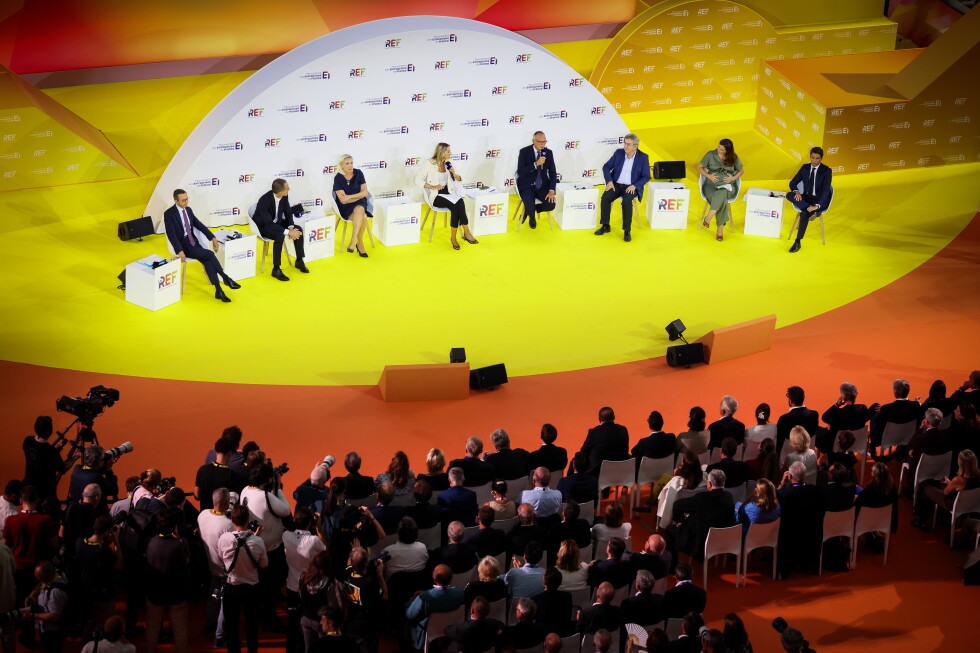
Seven of the leading non-Le Pen candidates participated in an unofficial campaign kickoff debate last week at Paris’ iconic Roland Garros tennis arena, where they discussed policy proposals to address France’s persistent economic struggles and exchanged critical barbs aimed at Le Pen, who responded with criticism of her own.
Polls currently indicate that if Le Pen and Mélenchon – the two candidates representing the far right and far left extremes – face off in the runoff, Le Pen would be likely to win. That scenario has led to speculation that some mainstream candidates may eventually drop out of the race to consolidate support behind a single mainstream alternative. “What we don’t know is who’s going to be against her” in a possible second-round matchup, Ivaldi noted. “The more the fragmentation, the more the chances that Mélenchon will be that person.”
This 2027 campaign is unfolding against an unusually volatile global and domestic backdrop unmatched by any French presidential race this century. The ongoing Iran conflict has driven up energy costs, adding further pressure to France’s already stagnant economy, while the war in Ukraine has left French policymakers concerned that Russia could target a NATO ally next, raising the risk of broader European conflict. A potential second Donald Trump U.S. presidency has also eroded French confidence in the stability of the trans-Atlantic alliance, while China’s growing manufacturing and export power and the rapid global AI revolution have stoked fears that France could fall behind economically and technologically.
Domestically, France’s growing and increasingly costly public debt has shrunk the fiscal room for maneuver that Macron’s successor will inherit, and widespread public anger over Macron’s policy decisions during his two terms led to repeated mass street protests. Ultimately, the election will turn on whether French voters choose to upend the established order by backing two extreme candidates in the runoff, or rally around a mainstream candidate as a safer alternative. “It will be quite interesting to see which of these two forces will win in the end,” Ivaldi said. “These are two different forces, two antagonistic forces that are playing against one another.”