标签: Oceania

大洋洲

  • The world built more coal power in 2025, but used less

    The world built more coal power in 2025, but used less

    A new analysis released Thursday reveals a striking global contradiction in coal power development for 2025: while nations continued to build and bring online new coal-fired generating capacity at a 3.5% annual growth rate, total global electricity generated from the polluting fossil fuel actually declined over the same period. Only one major world economy bucked this trend, recording a substantial increase in coal generation, according to data from Global Energy Monitor (GEM), an organization that has tracked global coal infrastructure development for more than a decade.

    As the single largest source of anthropogenic planet-warming greenhouse gas emissions, phasing out coal power is widely recognized as a core priority for limiting global temperature rise and mitigating the worst impacts of climate change. In recent years, plummeting costs and widespread deployment of wind and solar power have allowed these clean energy sources to meet nearly all new global electricity demand, a shift that pushed total 2025 global coal generation down 0.6% from 2024 levels.

    Nearly all of the new coal capacity added in 2025 – 95% of total new construction – was concentrated in just two nations: China and India. Even in these two major coal markets, the disconnect between growing capacity and falling generation held: China’s total coal capacity expanded 6% over the year, but coal-generated electricity fell 1.2% thanks largely to the country’s explosive growth in renewable energy capacity. India followed a nearly identical pattern, with coal capacity growing almost 4% while generation fell nearly 3% year-over-year.

    Christine Shearer, project manager of GEM’s Global Coal Plant Tracker and lead author of the report, explained that regional economic incentives drive continued coal construction in both nations. “Many of the provinces and states leading coal development are major coal-producing regions,” Shearer told AFP, noting these areas hold “strong industrial incentives to keep building coal.”

    Broader systemic factors also sustain coal growth in the two countries. For China, coal is viewed as a reliable backup to offset the intermittency of wind and solar power, a policy shaped by widespread power shortages experienced several years ago. For India, the world’s most populous nation, coal has long been relied on to meet rapidly rising electricity demand, even as non-fossil sources now make up 50% of the country’s installed capacity. Persistent transmission and grid infrastructure gaps mean India still generates roughly three-quarters of its total electricity from coal.

    Beyond new construction, the report also found that the global pace of retiring old, uneconomical coal plants slowed sharply in 2025, with nearly 70% of coal units originally scheduled for decommissioning instead remaining operational. In Europe, most delayed retirements trace back to policy decisions made during the 2022–2023 global energy crisis triggered by Russia’s invasion of Ukraine, when nations scrambled to secure alternative energy supplies. In the United States, by contrast, delayed retirements and rising coal use stem directly from intentional government policy, Shearer said.

    “US coal-fired generation rose by more than 80 terawatt hours year-on-year, a figure so large that no other country came close,” Shearer noted. This surge “was not simply a function of demand growth, it reflected a policy environment that actively encouraged it,” she added.

    More recent geopolitical instability has also pushed some nations to reverse course on coal phase-outs: the global energy market volatility sparked by the US-Iran conflict linked to the Israel-Gaza war has led some countries to reactivate idled coal units and extend the lifespan of operating plants.

    In China, coal generation saw an early-year spike in 2025 driven in part by lower-than-expected output from wind and nuclear power, but Lauri Myllyvirta, co-founder of the Centre for Research on Energy and Clean Air and a report contributor, said systemic bias toward coal played an outsize role. “The oversupply and favouritism of coal power is an important factor,” he told AFP. While data from May 2025 indicates China’s coal generation has since returned to a downward trajectory, “the problem of excess coal capacity and entrenched favouritism of coal in the grid remain,” he added.

    As of mid-2025, global coal-fired generation is up just 0.3% year-to-date, while combined wind and solar generation has jumped 10% over the same period. Shearer emphasized that this split makes clear a key global trend: clean energy is absorbing almost all new global electricity demand, leaving coal with almost no growth in actual use.

  • ‘Their story is our story’: Pigeons and humans, 3,500 years together

    ‘Their story is our story’: Pigeons and humans, 3,500 years together

    For most modern urban residents, feral pigeons are little more than uninvited pests: filthy birds that leave droppings on building facades, spread disease, and are repelled by ubiquitous anti-perching spikes across city skylines. But this dismissive reputation hides a thousands-year-long partnership between humans and rock doves that shaped both species, and new archaeological research is rewriting the timeline of that shared history.

    Published Thursday in the journal *Antiquity*, the study led by a team of Dutch researchers confirms that domestic pigeons were integrated into human societies as early as 3,500 years ago – nearly 1,000 years earlier than the previous scholarly consensus.

    Lead author Anderson Carter, a bioarchaeologist at the University of Groningen, told AFP that humans’ widespread rejection of pigeons is a remarkably recent development in the long arc of human-animal coexistence. For millennia, pigeons were far more than urban strays: they served as a reliable food source, delivered messages across impossible distances, produced fertilizer for crops, and held deep meaning as religious symbols across multiple cultures. Even into the 19th and 20th centuries, pigeons remained critical to human society, most notably carrying vital military messages during times of war.

    That centuries-long utility ended abruptly with the explosion of communications technology. “When the telegraph and then the telephone were invented, pigeons were out of a job,” Carter explained. But thousands of years of selective breeding and conditioning had left the birds adapted to live alongside humans, so they did not leave human settlements. It was not until the Industrial Revolution created large, dense modern cities that the narrative around pigeons shifted, framing them as dirty, unwanted pests that spread illness.

    To unpack the origins of this relationship, the research team traveled to the Hala Sultan Tekke archaeological site on the shores of Larnaca Salt Lake in southeast Cyprus. There, they analyzed 159 ancient pigeon bones recovered from Bronze Age excavation layers, using biometric, isotopic and collagen analysis to trace the birds’ diet and identify signs of human influence.

    Dating placed the remains between the 13th and 14th centuries BC, or roughly 3,500 years before the present. When researchers compared the nitrogen and carbon isotope ratios from the pigeon collagen to isotope data from contemporary human remains found at other Bronze Age Cypriot sites, they discovered a near-perfect overlap, indicating the pigeons shared a very similar diet to humans living in the same region. This overlap is strong evidence the birds were already domesticated, or well on their way to domestication, by that time.

    Prior to this finding, the earliest confirmed evidence of pigeon domestication dated back to around 300 BC, from large purpose-built stone nesting structures discovered in Greece. The new finding pushes the timeline of domestication back by almost a millennium.

    Genomic analysis also confirms that modern feral city pigeons are genetically closely linked to wild rock doves from the Mediterranean and Middle East, matching the archaeological evidence from Cyprus. For the research team, the broader goal of the work is to reframe public perception of the most common urban bird. Carter notes that pigeons’ evolutionary story is inextricably woven into human history: “Their story is also our story.”

  • Musk eyes Wall Street record with SpaceX IPO

    Musk eyes Wall Street record with SpaceX IPO

    Elon Musk’s aerospace and technology conglomerate SpaceX has taken the first formal step toward a public listing, filing an initial public offering (IPO) prospectus with U.S. regulators this Wednesday that is poised to shatter all previous Wall Street records if brought to fruition.

    The confidential filing, already under review by the U.S. Securities and Exchange Commission (SEC), outlines plans to raise up to $75 billion in public capital, which would value the company at as much as $1.75 trillion. Trading on the Nasdaq exchange under the ticker symbol SPCX could launch as early as June 2026, according to industry media reports. If completed, the listing would surpass every IPO in U.S. history in terms of capital raised, cementing Musk’s reputation as one of the most transformative entrepreneurs of the 21st century.

    This IPO marks a watershed moment for SpaceX, which was founded 24 years ago and has never publicly disclosed its detailed financial performance until now. The S-1 prospectus— the regulatory document required for all public listings that lays out financials, risk factors and strategic plans—revealed that SpaceX generated $18.7 billion in total revenue in 2025, but recorded an operating loss of $2.6 billion driven by massive investments in next-generation rocket technology and artificial intelligence development.

    Starlink, the company’s satellite internet division, stands out as its core revenue driver, pulling in $11.4 billion in 2025 revenue, a nearly 50% increase year over year. By contrast, the company’s combined AI segment— which includes Musk’s xAI and the social platform X, formerly Twitter—posted $3.2 billion in 2025 revenue but a staggering $6.4 billion operating loss, as the company pours capital into building AI training data centers to compete with industry giants Google, Meta and Amazon. Capital expenditure for the AI segment hit $12.7 billion in 2025 alone, and grew to $7.7 billion in just the first quarter of 2026, reflecting the enormous cost of staying competitive in the global AI arms race.

    In a surprising business deal disclosed in the filing, SpaceX has agreed to lease excess capacity at its COLOSSUS and COLOSSUS II data centers to leading rival AI firm Anthropic for $1.25 billion per month through May 2029. The IPO filing comes just days after Musk suffered a major legal defeat in his long-running public feud with OpenAI, another top AI competitor that is also preparing for its own public listing. With Anthropic also targeting an IPO in 2026, this year is on track to become one of the most high-profile years for tech public offerings in recent Wall Street history.

    A key detail of the listing plans confirms that Musk will retain near-total control of SpaceX after it goes public via a dual-class share structure, a setup designed to avoid the kind of corporate governance battles that have repeatedly disrupted his leadership at electric car maker Tesla, where shareholders have repeatedly challenged his massive compensation packages and the independence of Tesla’s board. Under the proposed structure, Musk will hold roughly 42% of the company’s total equity but control approximately 79% of all shareholder voting power. SpaceX explicitly warned outside investors in the filing that this arrangement creates inherent risks, noting Musk “will have the power to control the outcome of matters requiring shareholder approval, including election of all our directors.”

    The prospectus also laid out SpaceX’s extraordinarily ambitious long-term strategic roadmap: building AI data centers in orbit, arguing that solar power captured directly from space is “the only truly scalable solution” to meet the exponentially growing energy demand of global AI computing. The company plans to begin launching purpose-built AI computer satellites as early as 2028, with a long-term goal of deploying 100 gigawatts of orbital compute capacity annually. Achieving that goal will require thousands of rocket launches per year and moving roughly one million metric tons of payload into orbit annually— a challenge SpaceX says no other company on Earth is positioned to tackle at commercial scale.

    In a projection that underscores the company’s massive growth ambitions, SpaceX calculated its total addressable market—the maximum potential revenue opportunity across all its business lines, excluding the Chinese and Russian markets—at a staggering $28.5 trillion.

  • Stylish Aston Villa win Europa League to end 30-year trophy drought

    Stylish Aston Villa win Europa League to end 30-year trophy drought

    On a historic night under the lights of Istanbul’s Besiktas Stadium, Unai Emery’s Aston Villa delivered a dominant 3-0 defeat of Germany’s Freiburg to lift the Europa League trophy, snapping a 30-year wait for major silverware and etching a new iconic chapter into the 152-year-old club’s history.

    The match played out like a script written for legend. Wearing the same white kit they donned for their famous 1982 European Cup upset of Bayern Munich — and with 1982 heroes Peter Withe and Dennis Mortimer watching from the stands — Villa turned clinical finishing into a masterclass that left first-time European finalists Freiburg outclassed from start to finish.

    The deadlock broke in the 41st minute, when Morgan Rogers teed up Youri Tielemans with a pinpoint cross from a clever short corner routine. The Belgian midfielder timed his run perfectly to hammer a thunderous volley past Freiburg goalkeeper Noah Atubolu from just inside the 18-yard box, a strike that shattered any resistance the German side had mustered to that point. Before the first half could even wrap up, Emiliano Buendia doubled Villa’s advantage with a sublime curled effort from the edge of the area, beating Atubolu into the far top corner after Freiburg failed to close him down. Rogers put the result beyond all doubt in the 58th minute, sliding to turn Buendia’s cross into the back of the net to seal the victory.

    For Aston Villa, the win is far more than just a trophy: it is the culmination of a stunning transformation that started when Emery took charge in October 2022. At the time, Villa languished just three points above the Premier League relegation zone, and the club had endured decades of heartbreak after their 1982 European triumph: relegations to the second tier in 1987 and 2016, and defeats in four consecutive domestic finals before this 2024 final run. Even this season got off to a disastrous start, with Villa opening their campaign with six winless matches, scoring just two goals in that dismal opening stretch. But a turnaround began with their first Europa League win of the season against Bologna, and the club rattled off 13 wins from 15 matches in the competition to reach the final.

    The triumph also cements Emery’s legacy as the undisputed master of the Europa League. Wednesday’s win marks his fifth title in the competition, adding to previous crowns he earned with Sevilla (2014, 2015, 2016) and Villarreal (2021). The result also completes an incredible six days for the club: just a week before the final, Villa secured qualification to next season’s Champions League with a vital win over Liverpool.

    The celebration stretched far beyond the pitch, with famous Villa fans including Prince William — who attended the match alongside 20,000 ecstatic Villa supporters — and Hollywood A-lister Tom Hanks, who sent a pre-match good luck message to the squad. For a generation of Villa fans who have never seen their club lift a major trophy, the unforgettable night on the banks of the Bosphorus banished decades of misery, and the current crop of Villa stars have now taken their place alongside the iconic 1982 side that defined the club’s greatest era for 42 years.

  • Bolivia says protesters trying to ‘disrupt democratic order’

    Bolivia says protesters trying to ‘disrupt democratic order’

    Bolivia is currently grappling with a deepening political crisis, as weeks of mass anti-government demonstrations have pushed the new center-right administration of President Rodrigo Paz into a defensive standoff with opposition groups and even neighboring nations. In an official address to the Organization of American States (OAS) on Wednesday, Bolivian Foreign Minister Fernando Aramayo issued a sharp rebuke of protesters demanding Paz’s resignation, claiming their coordinated actions — including widespread roadblocks and mass marches — are a deliberate attempt to destabilize the country’s democratic institutions.

    The unrest, which has stretched on for weeks, has drawn participation from thousands of farmers, unionized laborers, miners, and public school teachers across the Andean nation. Protesters have coalesced around a list of grievances: galloping inflation that has eroded household purchasing power, persistent fuel shortages that have crippled daily life, and widespread opposition to what they frame as Paz’s pro-business free-market policy agenda, a sharp departure from the 20 years of socialist rule that preceded his administration.

    Paz, who took office less than six months ago after winning a national election, campaigned on a pledge to pull Bolivia out of its worst economic crisis in four decades. In a controversial policy move aimed at shoring up the country’s plummeting dollar reserves, he eliminated long-standing, generous government fuel subsidies. To date, however, the reform has failed to deliver on its core promise of stabilizing fuel supplies — a key campaign issue that has become the most visible flashpoint of public anger.

    Tensions boiled over on Monday in the capital city of La Paz, where riot police clashed with thousands of demonstrators attempting to march on government buildings to demand the president step down. Running battles between officers and protesters stretched on for hours. While a fragile calm has returned to La Paz in the days since, the broader national situation remains deeply tense and unstable.

    The current crisis also carries the lingering shadow of former socialist president Evo Morales, the Indigenous coca farmer who launched Bolivia’s decades-long left-wing shift in the mid-2000s. Paz’s administration has directly accused Morales of fomenting a coup to overthrow the new government. Morales, 66, who served three terms in office before attempting an unsuccessful political comeback last year, currently lives as a fugitive in his coca-growing stronghold of Chapare, where he has hidden since late 2024. He is wanted by Bolivian authorities on charges of having a sexual relationship with a minor during his time in office, which he has denied. Morales has publicly expressed solidarity with the ongoing protests, and his supporters fear authorities are preparing imminently to move to arrest him.

    International tensions have also flared alongside the domestic unrest. The United States has thrown its full weight behind Paz, who is part of a growing wave of newly elected right-wing leaders across Latin America, and has echoed the Bolivian government’s claims that the demonstrations amount to an illegal coup. On Wednesday, the Bolivian government announced it would expel Colombia’s ambassador to the country, citing unacceptable interference in Bolivian internal affairs by Colombian left-wing President Gustavo Petro. Petro had previously taken to social media to frame the Bolivian protests as a “popular insurrection” against “geopolitical arrogance”, a remark that drew fierce condemnation from La Paz. In response to the expulsion, Petro slammed the move, arguing it was evidence of ideological extremism on the part of Paz’s government.

    Beyond the political sparring, the unrest has inflicted severe harm on ordinary Bolivians. Widespread roadblocks erected by demonstrators have severed supply chains across the country, disrupting the transport of fuel, food, and critical medicine, leading to acute shortages in urban and rural areas alike. “We have almost nothing left,” 43-year-old Sheyla Caya told AFP while waiting in a long queue to buy chicken in La Paz this week. “It’s impossible to even find an egg.”

  • UK eases sanctions on Russian jet fuel and diesel imports

    UK eases sanctions on Russian jet fuel and diesel imports

    In a politically charged move that has drawn sharp criticism from domestic opponents and global allies alike, Prime Minister Keir Starmer’s newly elected Labour government has moved to ease sanctions on imports of Russian-derived jet fuel and diesel, framing the policy as a necessary buffer to shield British consumers from skyrocketing energy costs amplified by ongoing Middle East conflict.

    The newly approved indefinite trade licence, which permits imports of Russian crude oil processed through refineries in third countries like India, is set to undergo periodic reviews, according to the UK’s Department of Business and Trade. Alongside this, the government issued a temporary licence that relaxes existing sanctions on liquefied natural gas originating from specific Russian production facilities. This adjustment comes as the government prepares to fully implement a previously announced ban on Russian crude-derived imports, first unveiled in October 2024.

    Starmer defended the adjustment during a press briefing Wednesday, stressing that the targeted changes do not represent a rollback of existing sanctions against Moscow. “This is not a question of lifting existing sanctions in any way whatsoever, and we will continue to work with our allies on further sanction packages,” he stated, adding that the two short-term licences are designed to phase in the full ban gradually while avoiding sudden price shocks for UK households and businesses.

    The decision has immediately ignited fierce domestic political pushback. Conservative Party leader Kemi Badenoch condemned the move, accusing Starmer of “choosing to buy dirty Russian oil” and arguing that revenue from these fuel sales will directly fund Moscow’s military offensive against Ukraine, where thousands of Ukrainian soldiers have been killed since the 2022 full-scale invasion.

    The controversy also extends to the international stage. The policy aligns with a similar decision from the United States, which last Monday extended a sanctions waiver for Russian oil cargoes already in transit for a second time. That waiver was put in place after escalating Middle East tensions — driven by the conflict between Israel and Iran that has disrupted global energy supplies — pushed crude prices to multi-year highs. However, the EU has openly criticized the US waiver extension, with EU economics commissioner Valdis Dombrovskis noting at a recent G7 finance ministers meeting that the current moment is not the time to reduce economic pressure on Russia. The UK was a participant in that meeting, where the policy drew international scrutiny.

    UK officials have offered conflicting framing of the change in recent days. Treasury minister Dan Tomlinson defended the adjustment to Sky News, framing it as a step to protect core UK national interest amid the current global energy crisis. “The government has announced this time-limited change to the rules around oil and refining given the extremes of the impacts of the conflict in Iran, and the impact of it washing up on our shores,” he said. That framing was later echoed by trade minister Chris Bryant, who apologized to Members of Parliament for the government’s “clumsy” rollout of the new policy, and committed to keeping the approved licences as “temporary as possible.”

    The current energy market volatility traces back to Iran’s decision to effectively close the Strait of Hormuz — a critical chokepoint that carries roughly 20% of the world’s daily oil supplies — in retaliation for US-Israeli strikes launched in February. While commercial traffic has slowly resumed in the waterway during a recent ceasefire, market uncertainty has kept prices elevated. As of Wednesday, Brent North Sea crude, the global benchmark for oil prices, was trading close to $110 per barrel, a level far above pre-Middle East conflict averages.

    The UK first imposed a sweeping sanctions regime against Russia shortly after Moscow launched its full-scale invasion of Ukraine in 2022. Those measures included restrictions on Russian oil and energy exports, alongside sanctions targeting more than 3,000 Russian individuals and business entities. Wednesday’s policy adjustment has reopened fierce debate over how Western nations balance energy security for domestic consumers with the goal of maintaining collective pressure on Russia over its war in Ukraine.

  • DR Congo Ebola risk high regionally, low worldwide: WHO

    DR Congo Ebola risk high regionally, low worldwide: WHO

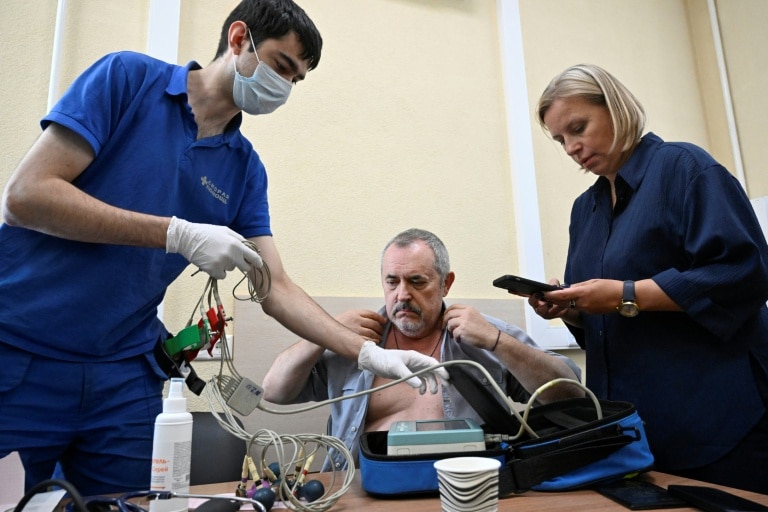
    The World Health Organization (WHO) announced Wednesday that the ongoing deadly Ebola outbreak in the eastern Democratic Republic of the Congo (DRC) has likely been spreading undetected for months, updating its official risk assessment as high for the DRC and neighboring regions but low for the entire globe.

    Current investigations into the origins of the outbreak — which was formally declared last Friday — are still ongoing, but WHO officials say early evidence points to the virus circulating unreported for a significant period. “Given the scale, we are thinking that it has started probably a couple of months ago,” Anais Legand, a WHO technical officer specializing in viral haemorrhagic fevers, told reporters during a press briefing in Geneva.

    Ebola, a severe viral haemorrhagic fever first documented in 1976 and linked to bat reservoirs, has claimed more than 15,000 lives across Africa over the past 50 years. This marks the 17th Ebola outbreak recorded in the DRC, and already, health officials are tracking roughly 600 probable cases with 139 suspected deaths. WHO Director-General Tedros Adhanom Ghebreyesus warned that these numbers are almost certain to rise in the coming weeks, noting that the extended undetected circulation of the virus gives it a head start on containment efforts.

    Multiple challenges are complicating the global health body’s response to the crisis. The outbreak is centered in hard-to-access regions of Ituri province, an area long disrupted by armed conflict that limits access for medical teams and contact tracers. Additionally, the outbreak is caused by the rare Bundibugyo Ebola strain, which is not detected by standard diagnostic tests designed for the more common Zaire strain, delaying confirmation of cases.

    Over the weekend, Tedros declared the outbreak a Public Health Emergency of International Concern (PHEIC), the second-highest alert level under the binding International Health Regulations (IHR) that triggers coordinated international emergency response. Despite this escalation, Tedros emphasized that the outbreak does not qualify as a pandemic at this stage. “There are several factors that warrant serious concern about the potential for further spread and further deaths,” he noted, but confirmed the WHO’s formal risk assessment: high at national and regional levels, low globally.

    The European Commission echoed this assessment, stating that the risk of Ebola transmission within the European Union remains “very low” and that no special protective measures are currently recommended for EU residents. So far, the WHO has not implemented mandatory international travel restrictions, only advising that confirmed cases and known contacts avoid travel. However, a number of countries have moved independently to implement border controls and screening. The United States announced this week that it would begin screening air passengers arriving from affected regions and suspend routine visa services, though it granted an exception for the DRC national football team ahead of their World Cup qualifying match in the U.S. Bahrain has gone further, enacting a 30-day entry ban on visitors arriving from the DRC, South Sudan and Uganda.

    As of Wednesday, just 51 cases have been confirmed via laboratory testing, as the remote location of most outbreaks limits access to sample collection and processing. Two confirmed cases have been recorded in the Ugandan capital Kampala, one of which ended in death, and an American citizen working in the DRC tested positive before being transferred to Germany for treatment. Retracing the outbreak’s origins, the first reported symptomatic case was a nurse who presented at a Bunia, Ituri health facility on April 24, but the epicenter of the outbreak is now confirmed to be roughly 90 kilometers away in Mongbwalu, where public health officials believe the virus first began spreading. The WHO first received an alert about an unusual cluster of lethal illness on May 5, and the first positive Ebola test was returned on May 15.

    In Wednesday’s briefing, Tedros pushed back against criticism from United States officials over the speed of the WHO’s response. The U.S., which initiated withdrawal from the WHO during the Donald Trump administration, had faced accusations from Secretary of State Marco Rubio that the organization was “a little late to identify this thing.” Tedros countered that the criticism stems from a “lack of understanding of how IHR work, and the responsibilities of WHO and other entities. We don’t replace the countries’ work, we only support them,” he explained.

  • Rubio offers Cubans ‘new path’ in special video address

    Rubio offers Cubans ‘new path’ in special video address

    In a pre-announcement video address delivered Wednesday, U.S. Secretary of State Marco Rubio, a second-generation Cuban-American, laid out a purported “new path” for the Cuban people, just hours before the U.S. Department of Justice was scheduled to unseal criminal indictments against former Cuban President Raul Castro.

    Speaking directly to Cuban citizens in Spanish, Rubio launched sharp criticism at Cuba’s ruling communist government, leveling accusations of systemic theft, deep-seated corruption, and widespread political oppression. As the child of Cuban immigrants who built a life in the United States, Rubio framed the proposal as an initiative backed by the Trump administration: “President Donald Trump is offering a new path between the U.S. and a new Cuba, a nation where you will hold the real power to choose your leaders, and vote them out if they fail to deliver for you.”

    Worsening bilateral friction has defined relations between Washington and Havana in recent months, sparked by two key escalations: a U.S.-backed military operation that ousted long-time Cuban ally Nicolas Maduro from Venezuela’s presidency, followed by a sweeping U.S. energy blockade that has compounded already severe economic struggles on the Caribbean island. Trump has repeatedly hinted that the current Cuban government is the next target for regime change, and earlier this month made an extraordinary public statement claiming the U.S. would “take over” the island — located just 90 miles off the coast of Florida — “almost immediately.”

    Per an official English translation of the speech released by the State Department, Rubio emphasized that Washington was prepared to reset relations between the two countries. “In the U.S., we are ready to open a new chapter in the relationship between our people and our countries, and currently, the only thing standing in the way of a better future are those who control your country,” he said.

    Rubio reserved particular criticism for GAESA, the military-linked business conglomerate that analysts estimate controls roughly 40 percent of Cuba’s total economic activity. He described the entity as a “state within the state” that operates with no accountability to the Cuban public, hoarding profits from its vast commercial holdings to benefit a tiny ruling elite while ordinary Cubans bear the cost. Rubio added that the nominal Cuban government’s primary function is to force continued public sacrifice and crack down on any dissenting voices that speak out against the status quo.

    The 94-year-old Raul Castro, who succeeded his older brother Fidel Castro as Cuba’s head of state and oversaw the landmark 2015 normalization of diplomatic relations with Washington under the Obama administration — a deal Trump reversed after taking office — was set to face criminal charges announced by the U.S. Justice Department Wednesday. According to reporting from CBS News, which cited unnamed U.S. officials briefed on the investigation, the pending indictment centers on the 1996 downing of two civilian aircraft flown by anti-Castro activists.

  • Worried and under-equipped, Ebola-hit east DR Congo awaits medical aid

    Worried and under-equipped, Ebola-hit east DR Congo awaits medical aid

    A deadly Ebola outbreak has spread across hard-to-reach regions of eastern Democratic Republic of the Congo, leaving local communities and healthcare workers severely underprepared and facing a growing crisis as aid efforts move at a glacial pace. Rwampara, one of the outbreak’s current epicenters, illustrates the crippling gaps in the early response: at the area’s main hospital, a flimsy plastic strip is the only marker for a planned isolation ward that has yet to be constructed.

    This outbreak marks the 17th recorded flare-up of the highly contagious haemorrhagic fever in the DRC, and it has hit a region already destabilized by decades of armed conflict and widespread displacement. Even though Rwampara sits just 7.5 kilometers from Bunia, the largest city in violence-ravaged Ituri province, critical supplies for isolating and treating Ebola patients only began arriving on Monday, several days after the outbreak was officially declared.

    At the hospital entrance, a single masked guard struggles to monitor all visitor traffic. A small number of handwashing basins have been set up outside the blue-painted facility, which a local official confirms is already caring for around 100 suspected Ebola cases. Before Friday, even nursing staff on the front lines lacked full personal protective equipment (PPE) — and local residents performing high-risk tasks are far more exposed. Salama Bamunoba, a local youth organization representative, explained that community members have been digging and filling graves for Ebola victims without gloves or any protective gear at all.

    The current outbreak is caused by the Bundibugyo strain of Ebola, for which no targeted vaccine or specific antiviral treatment exists. Congolese authorities have reported that over 130 people are already suspected to have died from the virus, with containment efforts relying almost entirely on basic preventive measures and rapid case identification. Bamunoba called the government and its international partners out for significant delays, noting that establishing a proper triage and isolation zone has been the community’s top priority for days, with little action to show for it.

    Despite the escalating crisis, daily life continues on the dusty streets of Rwampara for the moment: markets remain open, motorcycles move through crowds, and schools have not been closed. But anxiety is rapidly spreading across Rwampara and surrounding villages, which are already home to more than a million permanent residents and tens of thousands of people displaced by ongoing conflict. Local resident Gims Maniwa said many residents initially dismissed the outbreak as a minor threat, but the situation has deteriorated quickly. “Here, in Congo, a lot of things are done carelessly and that’s not good,” he told reporters.

    Congolese officials have pushed back against criticism, with Health Minister Samuel Roger Kamaba claiming authorities already have all the supplies frontline healthcare workers need. The government’s spokesperson also emphasized this week that the DRC has decades of experience responding to Ebola outbreaks, most of which have been managed without widespread vaccine access. The country’s deadliest recent outbreak, which struck eastern DRC between 2018 and 2020, killed nearly 2,300 people out of more than 3,500 confirmed cases.

    In recent days, aid has finally begun moving into the affected region. At Bunia’s airport, dozens of World Health Organization (WHO) staff in high-visibility vests have been unloading 12 tonnes of medical supplies from cargo planes, including protective kits and temporary isolation tents, which the organization confirmed had arrived this Tuesday. Aid group Medecins Sans Frontieres (MSF) has also stockpiled tonnes of supplies, including critical PPE for frontline teams, in its Bunia warehouses.

    The response effort is facing headwinds from broader aid cuts, however. International funding for humanitarian work in the region has dropped sharply over the past year, particularly from the United States following Donald Trump’s return to the White House. Even with the new supply delivery, Trish Newport, MSF’s emergency programme manager, said the situation remains extremely strained. “Every facility our team called said: ‘We are full of suspect cases. We don’t have any space’,” Newport explained. “This gives you a vision of how crazy it is right now. What is really important is that we get material on the ground as quickly as possible,” she added, noting that the arrival of PPE will be a huge relief for overstretched staff.

  • Arsenal players in dawn celebrations after winning Premier League

    Arsenal players in dawn celebrations after winning Premier League

    For 22 long years, Arsenal football club and its global fanbase waited in the wings, enduring near-misses, criticism, and the weight of a title drought that stretched across generations. On Tuesday night, that wait finally ended, sending thousands of jubilant supporters flooding to the gates of Emirates Stadium before dawn to celebrate a historic Premier League crown that has eluded the club since the legendary Invincibles side of 2004.

    The title was secured in dramatic fashion, as Manchester City — the four-time defending champions who needed a victory at Bournemouth to keep their title hopes alive — dropped crucial points. While City fought back from an early Bournemouth lead to equalize in stoppage time, the final 1-1 draw left them one point short of Arsenal, handing the North London side the league trophy. Even as the match played out, fans began gathering outside Emirates Stadium, with crowds swelling as Bournemouth held on to their lead, and exploding in celebration when the final whistle confirmed Arsenal’s victory.

    By 5 a.m. Wednesday, Arsenal’s first-team players joined the throng of supporters to mark the occasion, after holding an initial private celebration with manager Mikel Arteta at the club’s London Colney training ground. Teammate Eberechi Eze shared early-hours images of star players Declan Rice, Bukayo Saka and Jurrien Timber celebrating with the crowd, while another video posted by Saka showed 19-year-old academy graduate Myles Lewis-Skelly brandishing a champagne bottle, poking fun at years of criticism that labelled Arsenal as “bottlers” for choking late in title races. “They called us bottlers,” Lewis-Skelly said in the clip. “And now we’re holding the bottle.”

    For Saka, the title win marks a full-circle moment for a side that finished as Premier League runners-up in each of the past three seasons, capping years of incremental progress under Arteta. Addressing critics who had mocked the club’s long drought, the England international stated, “Twenty-two years, 22 years. There was laughing, there was joking, they’re not laughing anymore.”

    Long-time supporters described the moment as surreal, decades in the making. “It doesn’t feel real. It feels like I’m going to wake up tomorrow and be like, yeah, it was a dream, but we did it. We actually did it. Wow. It’s going to be the best summer ever,” said 32-year-old fan George Owusu-Afriyie. Twenty-year-old supporter Julia Szumilas recalled the chaotic rush to the stadium after the final result was confirmed: “Everyone was running from all the pubs. We started running down to here. (Taking) bikes, running, driving their cars down… It was insane.”

    The celebration drew congratulations from Arsenal icons of the past. Arsene Wenger, the French manager who led the club to its last title in 2004’s undefeated Invincibles season, shared a heartfelt video message to the current squad posted on the club’s social media channels. “You did it! Champions go on when others stop. This is your time. Now, go on and enjoy every moment,” Wenger said. Club legend Ian Wright, who scored 185 goals during his time with the Gunners and was part of the 1998 domestic double-winning side, was mobbed by fans as he joined the celebrations outside the stadium.

    The side will formally receive the Premier League trophy on Sunday following their final regular season match against Crystal Palace. Beyond domestic glory, Arteta’s squad will now turn their full attention to a historic opportunity: the chance to claim the club’s first-ever UEFA Champions League title, when they face Paris Saint-Germain in the competition’s final in Budapest on May 30.