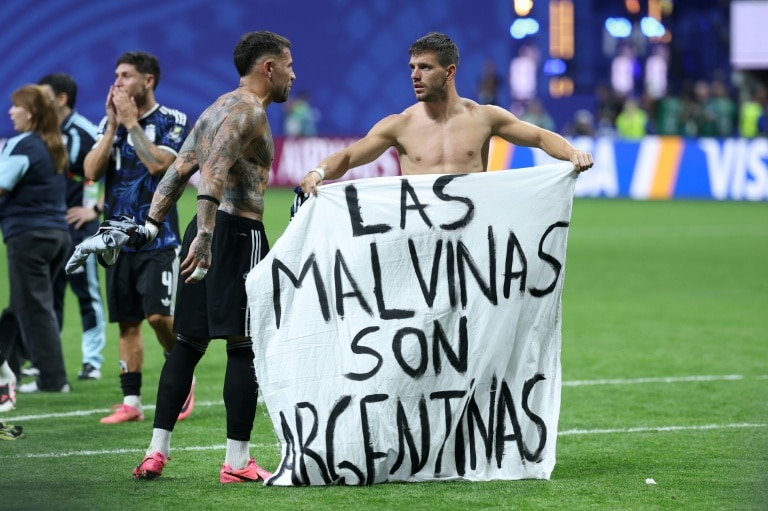
A geopolitical firestorm has erupted in the wake of Argentina’s 2-1 semi-final victory over England at the FIFA World Cup, after the Argentine squad displayed a banner asserting national sovereignty over the Falkland Islands — a long-disputed territory that has fueled tensions between the UK and Argentina for nearly 200 years. Now, global football’s governing body is weighing disciplinary action over the incident, which has reignited longstanding debate over the separation of sport and politics.
In the hours after the match concluded in Atlanta, a senior British government minister called on FIFA to launch a formal investigation into the banner, which carried the Spanish phrase “Las Malvinas son Argentinas”, translated as “The Falklands are Argentine”. By late Thursday, FIFA confirmed it had begun the standard assessment process in a public statement.
“FIFA’s independent disciplinary committee is currently assessing the match reports and considering the relevant circumstances before deciding on potential further steps based on the FIFA disciplinary code,” the statement read.
The call for action was led by UK Business Minister Peter Kyle, who labeled the display an “egregious violation” of FIFA regulations that explicitly ban political symbols from being displayed on the pitch during official matches. Downing Street, the official office of UK Prime Minister Keir Starmer, quickly issued its backing for Kyle’s demand, doubling down on the UK’s territorial claim.
“The World Cup might not be ours, but the Falkland Islands definitely are,” a Downing Street spokesperson said.
The dispute over the South Atlantic archipelago is one of the longest-running territorial conflicts in modern history. The UK first occupied the islands in the 19th century, and has administered them as a British Overseas Territory ever since. The conflict escalated into full-scale war in 1982, when the Argentine military invaded the islands. Then-UK Prime Minister Margaret Thatcher dispatched a naval taskforce to retake control, and the brief conflict ended with British victory. The 10-week war left 649 Argentine and 255 British service members dead.
Top Argentine officials have rallied firmly behind the national team’s gesture, rejecting any criticism of the display. Argentine President Javier Milei called the squad’s action “perfectly valid and legitimate” in an interview with El Observador radio, noting the sentiment of sovereignty over the islands is shared by all Argentines.
“It’s a feeling that exists within all Argentines. The Malvinas are Argentine, we’re going to recover them, and we will do it through diplomatic means,” Milei said.
The tension had already been stoked ahead of kick-off on Wednesday, when Argentine Vice President Victoria Villarruel referred to the English as “usurping pirates”. The latest diplomatic clash between the two nations comes even after the match, as Argentina’s Foreign Minister Pablo Quirno announced Buenos Aires had filed a formal protest over the recent passage of British warship HMS Medway through waters Argentina claims as its own near the islands. Quirno posted on social platform X to voice “the strongest rejection” of what Argentina calls the “unconsulted and illegal” passage.
This is not the first time Argentina’s national football association has faced FIFA punishment over the same sovereignty message. In 2014, the governing body fined the association £20,000 ($27,000) after players posed with an identical banner ahead of a friendly match against Slovenia, ruling the gesture violated FIFA rules banning political action and team misconduct.
Kyle emphasized in his comments to BBC Television that the core principle of separating sport and politics is a central tenet of the World Cup itself, saying “Politics needs to be separate from football. In fact, the World Cup has one of its central tenets that politics is separate from football.”